
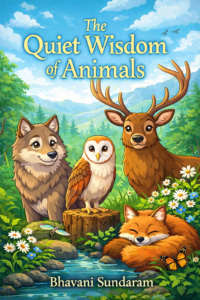
INTRODUCTION
The Quiet Wisdom of Animals
In the hush of forests, along dusty roads, beneath moonlit skies, and beside quiet waters, animals are always teaching us—without words, without noise, without asking to be heard.
They teach us patience by waiting.
Kindness by sharing.
Courage by standing still when afraid.
Love by staying close.
Animals do not hurry through life. They do not pretend to be something they are not. They listen more than they speak, trust more than they doubt, and forgive without keeping count. In their simple ways lives a wisdom that humans often forget while growing up.
This book is a gentle collection of stories where animals become mirrors—reflecting our fears, our hopes, our mistakes, and our goodness. Each tale carries a quiet lesson, not shouted, but softly placed in the heart, like a feather landing on still water.
These stories are meant to be read slowly.
To be shared before bedtime.
To be remembered long after the last page is turned.
May The Quiet Wisdom of Animals remind children and grown-ups alike that sometimes the greatest truths are spoken not aloud—but through paws, wings, and watchful eyes.
The Street Dog Who Guarded Dreams
Every night, when the city folded its noise and the lanes learned to whisper, a street dog named Kalu took his post beneath a flickering lamp.
He owned nothing, no collar, no doorway, but he guarded everything.
Children slept in cramped rooms above shops, their dreams spilling out through half-open windows like warm light. Kalu could smell those dreams: chalk-dust classrooms, mango summers, kites tugging at the sky. He lay still, ears alert, tail curled around his paws, as if dreams might slip and fall without someone watching.
When nightmares crept in, shadows shaped like hunger or fear, Kalu lifted his head. A low growl rolled from him, not loud enough to wake the world, just enough to remind darkness that this street was claimed. Stray thoughts scattered. Bad dreams lost their way.
On rainy nights, he paced the puddles, counting footsteps. On winter nights, he pressed his body against doors to keep the cold from sneaking inside. If a child whimpered in sleep, Kalu sat up straight, eyes steady, as though courage could be lent through walls.
By morning, the city never thanked him. Brooms erased paw prints. People hurried past. Someone tossed him a crust; someone else shooed him away. Kalu accepted both with the same quiet dignity.
Because heroes don’t always wear names. Some wear scars. Some sleep under streetlights.
And some, like Kalu, stand guard so dreams can grow brave enough to come true.
MORAL: Dreams can grow brave enough to come true
The Turtle Who Was Late for Everything
Once upon a time, in a green and giggling forest, lived a turtle named Timmy.
Timmy was kind, gentle, and thoughtful—but he was late for everything.
He was late to breakfast, late to games, late to school, and even late to his own naps.
“Timmy!” the rabbits would call.
“We’ve already finished hopping practice!”
The birds would chirp, “The concert is over!”
And Timmy would smile softly and say,
“I know… I was on my way.”
Timmy didn’t rush.
He noticed things.
He noticed how dew sparkled like diamonds on spider webs.
He noticed ants carrying crumbs ten times their size.
He noticed sad leaves falling alone and gently nudged them aside.
One day, the forest planned a Big Picnic by the river.
Everyone was excited.
“Be on time!” said the deer.
“Don’t be late!” laughed the squirrels.
Timmy left early, very early.
But on the way, he found a hedgehog stuck in a bush.
He helped him out.
Then he saw ducklings afraid to cross a stream.
He stayed and showed them how.
Then he noticed dark clouds rolling in and warned the beavers, who rushed to strengthen their dam just in time.
By the time Timmy reached the picnic spot, it was empty.
“Oh,” he sighed. “I’m late again.”
Just then, the entire forest appeared—cheering!
“Surprise!” they shouted.
The picnic had been moved because of Timmy.
The hedgehog hugged him.
The ducklings quacked happily.
The beavers bowed.
“You may be late,” said the old owl wisely,
“but because of you, everyone is safe, helped, and happy.”
Timmy smiled, tucked his head into his shell, and felt warm inside.
From that day on, no one teased Timmy again.
Because they learned something important:
MORAL: Being slow doesn’t mean being wrong. Sometimes, it means you’re exactly where you’re needed most.
The Sparrow Who Forgot How to Sing
Once upon a quiet morning, in a neem tree by a small village, lived a little sparrow named Chiku.
Chiku had once been known for his song.
He sang at sunrise.
He sang when the wind danced.
He sang even when the rain tapped softly on the leaves.
But one day… Chiku forgot how to sing.
He opened his beak.
Nothing came out.
He tried again.
Still nothing.
The other birds filled the sky with music, the mynas whistled, the parrots laughed, the koel called from far away.
Chiku listened, but his own voice felt lost.
“What’s wrong with me?” he wondered.
Days passed.
Chiku sat quietly on his branch. He watched the world instead of singing to it.
He watched a grandmother feed rice to pigeons every morning.
He watched children laugh as they chased dragonflies.
He watched the sun rise slowly, as if it had nowhere else to go.
One afternoon, a storm came.
The wind shook the trees, and a tiny fledgling fell from its nest.
The little bird chirped in fear.
Without thinking, Chiku flew down, wrapped his wings around the trembling chick, and stayed with it until the storm passed.
And then, without trying, without thinking
A sound escaped Chiku’s beak.
It was not loud. It was not perfect.
But it was kind.
A soft, warm song filled with comfort.
The fledgling calmed. The rain slowed. The tree seemed to listen.
Chiku blinked in surprise.
His song had not disappeared.
It had been waiting.
Waiting for a moment that mattered.
From that day on, Chiku sang again—not to be heard, not to be praised, but to heal, to thank, to belong.
And the sparrow learned:
MORAL: Sometimes we forget our song because we are meant to listen first. Our voice returns when the heart remembers why it sings.
The Cat Who Borrowed Names
In a narrow, sun-warmed lane lived a cat who had no name.
She was grey like morning mist and moved like a secret.
People noticed her, but no one named her.
One day, a little boy pointed and said,
“You look like a Tiger!”
So the cat borrowed the name Tiger for the afternoon and walked boldly down the street.
Later, an old woman smiled and said,
“Ah, you’re such a Sweetie.”
The cat borrowed Sweetie and curled gently at her feet.
At night, a girl whispered,
“I’ll call you Moon.”
The cat borrowed Moon and sat quietly on a wall, glowing in silver light.
Everywhere she went, the cat borrowed names.
To the shopkeeper, she was Shadow.
To the children, she was Whiskers.
To the baker, she was Madam.
She wore each name like a different collar, some made her brave, some made her soft, some made her feel loved.
But when the lane fell asleep and the stars blinked awake,
the cat sat alone and wondered,
“Who am I when no one is calling me?”
One night, the rain came softly.
The cat sheltered under a parked cycle.
A tiny kitten, cold and shivering, crept close.
“What’s your name?” the kitten mewed.
The cat thought for a long moment.
Then she wrapped her tail around the kitten and said,
“I am Here.”
The kitten purred.
From that night on, the cat still borrowed names
Tiger, Sweetie, Moon, Shadow, but she no longer worried about keeping one.
MORAL: A name can be borrowed, but kindness is who you are. And being “Here”is sometimes the most beautiful name of all.
Toby The Turtle Who Wanted To Run
Toby the turtle lived near a sunny pond where animals raced for fun. Rabbits sprinted, deer leapt, and birds zoomed overhead. Toby watched quietly.
“I wish I could run,” Toby sighed.
One day, the animals planned a big forest race. Toby decided to join. He practiced day and night, stretching his legs and whispering, “Faster, faster.”
On race day, Toby came in last.
But something surprising happened.
Along the path, Toby had helped a fallen ant, comforted a tired snail, and guided a lost duckling back home. By the time he reached the finish line, the animals were waiting—not impatiently, but proudly.
“You didn’t win the race,” said the rabbit, “but you won our hearts.”
MORAL: moving slowly doesn’t mean going nowhere—it often means seeing more.
The Fox Who Returned Lost Things
In a forest near a winding path lived a fox named Lumo.
Lumo had a special habit, he returned lost things.
A bird’s feather.
A squirrel’s acorn.
A hedgehog’s tiny scarf.
Whenever Lumo found something, he followed the feeling it carried and returned it home.
One day, Lumo found something strange—a lost worry.
It felt heavy and cold.
So Lumo sat with it until it felt lighter.
MORAL: Because not all lost things need to be returned. Some just need to be understood.
The Elephant Who Remembered Every Path
In a wide green forest lived an old elephant named Kavi.
Kavi did not run. Kavi did not trumpet loudly.
Kavi remembered.
He remembered paths no one else did—paths hidden under leaves, paths that curved gently around danger, paths that led to water even in the driest summer.
When animals were lost, they came to Kavi.
“Which way?” they asked.
Kavi closed his eyes and listened—not to sounds, but to memories. He remembered walking beside his mother long ago, feeling the earth beneath his feet.
One year, the river dried up. Panic spread through the forest. Animals rushed in every direction.
Kavi walked slowly. Others doubted him, but they followed.
After hours of quiet walking, they reached a small pool hidden behind trees—cool, clear, and waiting.
From that day on, the animals learned something important.
MORAL: Not all leaders walk fast, some walk wisely
The Sparrow Who Borrowed Courage
A small sparrow named Ira was afraid to fly high.
She could hop. She could flutter. But the open sky felt too big.
Each morning, she watched others soar.
One day, the wind whispered, “You don’t need all the courage at once.”
So Ira borrowed courage, a little from the sun,a little from the leaves, a little from the sky itself.
She flew just a little higher than before.
Every day, she borrowed again.
Soon, Ira realized something wonderful.
Courage doesn’t disappear when borrowed. It grows.
And one morning, Ira flew without fear, not because the sky had changed,
but because she had.
MORAL: Sometimes, courage begins as something borrowed—from a friend, a moment, or a kind word—until we discover it was always within us.
The Whispering Forest Friends
Deep inside a green, glowing forest lived many animals who shared the same home. The trees were tall and kind, the river hummed soft songs, and the wind carried secrets from one leaf to another. The animals called their home The Whispering Forest, because if you listened carefully, the forest always seemed to speak.
There was Milo the Deer, gentle and curious, who loved to explore new paths.
Tara the Tortoise walked slowly but never gave up.
Chiku the Monkey swung from tree to tree, full of jokes and laughter.
Luma the Owl watched over everyone at night, wise and calm.
And Bela the Bunny, small and quick, who worried about everything but had the biggest heart.
One morning, the river that flowed through the forest stopped singing. Its water had become thin and muddy. The plants drooped, and the animals grew worried.
“If the river dries up, the forest will suffer,” said Luma softly.
“But what can we do?” Bela asked, twitching her nose.
Milo lifted his head. “We do it together.”
The friends decided to find the cause. Chiku climbed high to look ahead, Tara followed patiently, Bela hopped close to Milo, and Luma flew above them.
Soon, they discovered fallen rocks blocking the river’s path.
“It’s too big for one of us,” Chiku sighed.
Tara smiled slowly. “Then we all try.”
Chiku pushed with his strong arms. Milo used his antlers to shift smaller stones.Bela carried pebbles away one by one. Luma guided them, calling out where to move. And Tara, steady and determined, kept going even when tired.
At last—splash!
The river flowed freely again, sparkling with joy.
The forest seemed to breathe again. Flowers lifted their heads, birds sang louder, and the animals cheered.
“That’s the forest whispering ‘thank you,’” said Luma.
Bela smiled. “I was scared… but I’m glad I didn’t run away.”
Milo nodded. “Bravery isn’t being the strongest. It’s caring enough to help.”
That night, under the glowing moon, the animals rested together, knowing that as long as they stood side by side, the Whispering Forest would always be safe.
Moral: When friends work together with kindness and courage, even the biggest problems can be solved.
The Dog and the Cat Who Learned to Share
Once upon a time, in a cozy little house near a garden, lived a dog named Bruno and a cat named Miso.
Bruno was big and bouncy. He loved running, barking, and wagging his tail at everyone.
Miso was small and quiet. She loved sunny windows, soft naps, and peaceful corners.
They lived in the same house… but they did not get along.
“That’s my bowl!” barked Bruno.
“That’s my spot!” hissed Miso.
Every day, they argued.
One afternoon, their family went out, leaving Bruno and Miso alone. Suddenly, a strong wind blew and the door to the garden slammed shut.
Bruno barked loudly. Miso climbed up high and meowed nervously.
“I’m scared,” whispered Miso.
“I don’t like this either,” said Bruno, softly for once.
Bruno tried pushing the door,but it wouldn’t move.
Miso noticed a small latch above the handle.
“If I climb up, can you lift me?” she asked.
Bruno nodded.
With Bruno’s strong back and Miso’s quick paws, the latch opened—click!
The door swung open, and fresh air rushed in.
They looked at each other and smiled.
That evening, Bruno shared his bowl.
Miso shared her sunny spot.
From that day on, they still had different habits—but they learned something important:
And in that little house, a dog and a cat became the best of friends.
Moral: Friendship grows when we help each other and learn to share.
The Horse and the Donkey
Once upon a time, in a quiet village surrounded by fields and hills, there lived a strong brown horse and a small grey donkey. They belonged to the same farmer and shared a wooden stable at the edge of the farm.
The horse was tall and proud. He loved to admire his shiny coat and powerful legs.
The donkey was gentle and patient. He had kind eyes and a soft way of walking.
Every morning, the farmer loaded sacks of grain and sent them down the long road to the market.
The donkey always carried heavy sacks, while the horse carried lighter ones.
One sunny morning, the donkey sighed and said,
“Dear Horse, my load is very heavy today. Could you carry one sack for me?”
The horse tossed his mane and replied,
“Why should I? You are made for hard work. I must save my strength.”
So the donkey said nothing and continued walking.
Step by step, under the hot sun, the donkey grew tired. His legs trembled, his breath became slow, and finally, he stopped and could go no further.
The farmer rushed over, worried. The donkey had collapsed from exhaustion.
With no choice, the farmer took all the sacks from the donkey and placed them on the horse instead.
Now the horse had to carry every single sack,and the donkey too, resting across the load.
The horse felt the weight press down on his back.
His legs shook. His pride faded.
As they walked, the horse thought sadly,
“If only I had helped my friend earlier, I would not be carrying so much now.”
That evening, back at the stable, the horse gently said to the donkey,
“I am sorry. Tomorrow, I will share the load.”
The donkey smiled softly.
And from that day on, they walked together—
sharing work, helping each other, and moving forward with lighter hearts.
Moral of the Story : When we refuse to help others, we often end up carrying a heavier burden ourselves.
The Butterfly Who Didn’t Rush
In a bright garden lived a butterfly who had just learned to fly. Other butterflies fluttered quickly from flower to flower.
“Hurry!” they called. “There’s so much to see!”
But this butterfly flew slowly.
She rested often. She watched ants carry crumbs and bees dance in the air.
“I’m too slow,” she worried.
One day, a tired old turtle wandered into the garden. He moved even slower than she did.
The butterfly landed nearby and stayed.
Together, they watched the sun move across the sky. For the turtle, it was the happiest day he’d had in a long time.
The butterfly realized something important, slow wings still bring joy.
Moral: Going slow lets others catch up to happiness.
The Firefly Who Loved The Quiet
In a meadow full of fireflies lived one tiny firefly who glowed more softly than the rest.
Others blinked brightly and raced through the night.
“I’m not bright enough,” the little firefly worried.
One evening, a child sat alone in the meadow, feeling afraid of the dark. The little firefly hovered nearby and glowed,just a little.
The child noticed.
Then another glow appeared.
Then another.
Soon, the meadow twinkled gently,not dazzling, not loud.
The child smiled and lay back, watching the lights.
The little firefly realized that night didn’t always need brightness.
Sometimes, it only needed reassurance.
Moral: Gentle light can be just as powerful as bright light.
The Monkey Who Loved Stealing
Deep inside a lush green forest, not very far from a busy village, lived a young monkey named Chiku. Chiku had bright eyes, a long curly tail, and fingers quicker than the blink of an eye. He was famous across the village for one thing,and that thing was stealing.
Bananas, mangoes, guavas, groundnuts, sweets, lunch boxes—nothing was safe when Chiku was around.
Every morning, while the village was still sleepy, Chiku would swing from tree to tree and whisper to himself,
“Today, I will steal the best food again!”
He loved the thrill—the rush of grabbing something and running away. He felt proud when people shouted,
“Hey! Stop that monkey!”
To Chiku, it all felt like a game.
Soon, the villagers grew tired.
The fruit seller tied ropes around his baskets. The children covered their tiffins tightly. Mothers chased Chiku with brooms.
“No one trusts you anymore, Chiku!” shouted the potter one day.
But Chiku only laughed.
“Why should I care? I get food without working!”
And so, he kept stealing—more than he needed, more than he could eat.
One hot afternoon, Chiku spotted a huge basket filled with golden mangoes resting near a well. His eyes sparkled.
“So many mangoes!” he squealed.
“I will take ALL of them!”
He grabbed as many as he could and climbed to the tallest tree. He ate and ate, stuffing his mouth, ignoring his full stomach.
Chiku clutched his tummy. It hurt badly. His head spun, and his tail drooped.
“Help… someone help me…” he cried softly.
But no one came.
The fruit seller turned away. The children hid behind doors. Even the birds flew off.
Chiku realized something painful, He was alone.
As the sun began to set, a little girl named Meera came to fetch water from the well. She saw Chiku shivering on the branch.
“Why are you crying?” she asked kindly.
Chiku looked down, ashamed.
“I steal from everyone. Now I’m sick… and no one cares.”
Meera thought quietly and said,
“When you steal, you take without love. When you ask or help, you receive with love.”
She offered him water and a small piece of fruit.
Chiku was shocked.
“You’re not angry with me?”
Meera smiled.
“Everyone deserves a chance to change.”
The next day, Chiku did something he had never done before.
Instead of stealing, he helped.
He picked fallen fruits and placed them back in baskets. He returned a child’s lunch box he once stole. He waited patiently when he felt hungry.
At first, the villagers didn’t believe him.
“He’ll steal again,” they whispered.
But Chiku didn’t stop trying.
Days passed. Weeks passed.
Slowly, smiles returned. The fruit seller shared bananas willingly.
Children played with Chiku without fear. Meera waved at him every morning.
One evening, Chiku sat on his favorite tree, watching the village glow with lamps. His stomach was full,but more importantly, his heart was full too.
“I thought stealing made me smart,” he said softly,
“But kindness made me happy.”
From that day on, Chiku was no longer known as the stealing monkey,
but as the monkey who changed.
MORAL: Stealing brings fear and loneliness, but honesty and kindness bring trust and joy.
THE ELEPHANT WHO FORGOT HIS STRENGTH
Deep inside a wide, whispering forest lived an elephant named Golu.
Golu was enormous—taller than the tallest bushes and heavier than a hundred rocks piled together. His legs were thick like tree trunks, and his trunk could lift fallen logs with ease. Yet, strangely, Golu did not believe he was strong at all.
Once, when Golu was very young, he had tried to pull a tree branch to help a trapped bird. The branch had snapped loudly, and the noise frightened him. From that day on, Golu decided that using strength only caused trouble. So he stopped trying.
Years passed, and Golu became known as the most careful elephant in the forest.
When ants struggled to cross a stream on floating leaves, Golu stood far away, afraid he might splash water if he stepped closer.
When monkeys asked him to move a heavy stone blocking their path, Golu shook his head and said,
“I’m sorry. I might break something.”
The smaller animals were puzzled.
“An elephant afraid of strength?” they whispered.
One hot afternoon, a terrible storm swept through the forest. Rain fell like ropes from the sky, and the wind howled angrily. When the storm finally passed, the forest was left bruised and broken.
The river had overflowed.
A giant tree had fallen across the only path to the meadow.
Worst of all, a family of deer was trapped on a small patch of land, surrounded by rising water.
The animals gathered, frightened and unsure.
“We need help,” cried the rabbits.
“We need strength,” said the monkeys softly.
All eyes turned to Golu.
Golu felt his ears grow warm.“I… I don’t think I can,” he whispered.
“What if I make it worse?”
Just then, a tiny voice spoke. It was Meethi, the smallest mouse in the forest.
“Golu,” she said gently, “being strong doesn’t mean being careless. It means helping when others cannot.”
Golu looked at the deer,tired, trembling, and scared. He felt something stir inside him, something he had forgotten for a long, long time.
He took one slow step forward. Then another.
Carefully, he waded into the river. The water pushed against his legs, but he stood firm. He lowered his trunk, letting the deer hold on, and guided them safely to dry ground.
Next, Golu walked to the fallen tree. He wrapped his trunk around it, took a deep breath, and lifted—slowly, steadily—until the path was clear again.
The forest grew quiet. Then it erupted with cheers.
“You did it!” squeaked the squirrels. “You saved us!” cried the deer.
Golu blinked in surprise. He looked at his trunk, his legs, his reflection in the calm water.
“I didn’t break anything,” he said softly. “I helped.”
From that day on, Golu did not fear his strength anymore. He learned to use it with kindness, patience, and care. And the forest learned something too:
That true strength is not about how big you are, but about how gently you use what you have.
Moral: Strength is a gift meant to help others—when guided by kindness, it never causes harm.
THE SPARROW WHO SHARED THE SKY
High above a quiet village lived a little sparrow named Chikki.
She was small, brown, and easily overlooked—but she loved the sky more than anything else in the world.
Every morning, before the sun fully woke up, Chikki flew higher than all the other birds. She loved the wide blue space, the soft clouds, and the way the wind carried her like a secret.
“This part of the sky is mine,” Chikki chirped proudly.
“I found it first.”
Soon, other birds noticed how high Chikki flew.
A pigeon asked politely, “May I fly there too?”
Chikki shook her head. “It’s too crowded already.”
A myna flapped up one day and said, “The sky is so big. Surely there’s room for all of us.”
But Chikki replied, “This corner is special. I don’t want to share it.”
So Chikki flew alone, higher and higher each day, guarding her little patch of sky.
One afternoon, dark clouds gathered suddenly. The wind grew rough, and the sky no longer felt gentle. Chikki flapped hard, but a strong gust pushed her far away. She tumbled, spun, and lost her sense of direction.
“Help!” she chirped, frightened.
But no bird was near.
She had always flown alone.
Just as her wings began to ache, a group of birds appeared below—pigeons, mynas, crows, even tiny finches. Together, they formed a moving circle in the air, flying close enough to block the harsh wind.
“Follow us!” they called.
Chikki hesitated for just a moment, then joined them. Flying together, the wind felt softer. The sky felt kinder. Slowly, safely, they guided Chikki back toward the village.
When the storm passed, the sky opened again—wide, blue, and beautiful.
Chikki looked around and realized something important.
The sky hadn’t become smaller when others flew in it.
It had become fuller.
From that day on, Chikki flew with others. She showed younger birds how to catch the warm winds and shared her favorite flying paths.
And every morning, when the sky turned golden, many wings filled the air—together.
Moral: Joy grows when shared, and even the biggest skies feel better with company.
THE TURTLE WHO TOOK HIS TIME
In a quiet green forest, near a pond that reflected the sky like a mirror, lived a turtle named Timmo. Timmo was not fast. He was not flashy. He did not leap, dash, or zoom the way others did. Timmo walked. Slowly. Carefully. Thoughtfully.
Every morning, the forest woke up in a hurry.
The rabbits raced the wind. The deer bounded across clearings. The birds fluttered from branch to branch, always late for something important.
Timmo, meanwhile, stepped out of his little home just as the sun warmed his shell. He stretched his neck, blinked at the day, and smiled.
“Good morning,” he said to the trees.
“Good morning,” he said to the pond.
“Good morning,” he said to himself.
And then he took his first step.
One day, the animals gathered near the big banyan tree. A path through the forest had broken after a storm, and the elders announced that a new path must be made before winter arrived.
“We must finish quickly!” shouted the squirrel.
“Yes, yes! Faster is better!” cried the rabbit.
“No delays!” added the fox.
Timmo listened quietly.
“We will start tomorrow,” declared the deer. “Everyone must work fast.”
The animals glanced at Timmo and whispered.
“How will he help?” giggled the monkey.
“He’ll still be on the first stone when winter comes,” laughed the rabbit.
Timmo said nothing. He simply nodded. “I will come,” he said gently. “I will take my time.”
The next morning, the forest buzzed with activity. Animals rushed to clear branches, move stones, and pack soil.
Timmo arrived last.
He examined the ground. He tested the stones with care. He noticed where water pooled and where roots lay hidden.
While others hurried, Timmo thought.
Soon, problems appeared.
Stones placed in a hurry slipped.
Paths cleared too quickly flooded after rain.
Animals argued, tired and frustrated.
Timmo quietly began placing flat stones near the pond, one by one, pressing each firmly into the earth.
“Why are you so slow?” snapped the fox.
Timmo smiled. “Because I want it to last.”
That night, heavy rain poured over the forest.
By morning, much of the hurried path had washed away. Mud covered footprints. Stones lay scattered.
The animals groaned.
“But look!” cried the squirrel.
Timmo’s section—slowly built, carefully placed—remained strong and dry. The stones held firm. The water flowed around them instead of over them.
The forest fell silent.
“How did you do that?” asked the rabbit softly.
Timmo shrugged. “I listened to the ground.”
From that day on, the animals changed how they worked.
The deer measured twice before moving stones. The rabbit slowed down and stopped tripping. The monkey learned patience.
And Timmo?
He kept walking as he always had.
Slow. Steady. Sure.
When the path was finished, it was the strongest the forest had ever known.
At the opening, the elder owl said,
“Speed may begin the journey, but patience completes it.”
The animals cheered,and this time, they cheered loudest for Timmo.
Years later, young turtles would ask Timmo,
“Why don’t you hurry like everyone else?”
Timmo would smile and say,
“Because the world is not a race. It is a path. And paths are best built step by step.”
And then,without rushing at all, he would take his next step forward.
Moral: Taking your time can lead to stronger, wiser results than rushing ahead.
THE BEAR WHO LEARNT TO LISTEN
Deep inside a whispering forest lived a young bear named Bruno. Bruno was big, strong, and very loud. When he walked, the ground thumped. When he laughed, the birds flew away. And when he spoke—everyone else stopped talking, because Bruno’s voice filled the air like thunder.
Bruno loved to talk.
He talked while eating.
He talked while walking.
He talked even when no one had asked him anything at all.
Listening, he believed, was for quieter animals.
One morning, the forest animals gathered near the river to decide how to cross it safely. The rains had made the water wild and fast.
“We could build stepping stones,” said the beaver. “Or tie vines together,” suggested the deer.
Before anyone could finish, Bruno boomed, “I KNOW! We’ll just jump! I can jump first and show you!”
“But Bruno—” the turtle began. “No time!” Bruno said, already splashing into the water.
The jump failed. Bruno landed with a loud SPLASH! and barely climbed out, wet and embarrassed. The animals sighed.
“You never listen,” murmured the owl. Bruno pretended not to hear.
A few days later, a strange problem appeared. The berry bushes stopped growing fruit. The bees buzzed worriedly. The birds chirped in concern.
“We should find out why,” said the fox.
“I’ll scare the bushes into growing!” Bruno roared and shook the branches.
Nothing happened—except berries falling into the mud.
“STOP!” cried the birds.
But Bruno didn’t notice. He was too busy talking.
That night, the forest felt uneasy and quiet.
The next morning, Bruno woke up with a sore throat. When he tried to roar—nothing came out.
He gasped. He tried again. Still nothing.
For the first time in his life, Bruno was silent.
He walked through the forest, unable to speak. And something strange happened.
He heard things.
The bees whispered about dry soil. The river murmured about blocked streams. The trees creaked softly, asking for space and care.
Bruno sat very still. And he listened.
Bruno noticed rocks blocking a small stream near the berry bushes. Carefully,quietly,he moved them aside. Water began to flow again.
The bees buzzed happily. The bushes lifted their leaves. Tiny berries slowly returned.
The owl smiled. “You listened,” she said softly.
Bruno nodded.
For the first time, he understood something important: Listening showed him more than talking ever had.
When Bruno’s voice finally returned, it was different.
He spoke less. He asked more. He paused before acting.
When animals gathered, Bruno sat down and said, “Tell me what you think.”
And the forest felt calmer, kinder, wiser.
Young cubs often asked him, “Why are you so quiet now?”
Bruno smiled and replied, “Because the world speaks all the time. You just have to be quiet enough to hear it.”
And then he listened, to the forest, to his friends,and to his heart.
Moral: Listening helps us understand, solve problems, and grow wiser than speaking alone.
THE FOX WHO LOST HIS CUNNING
In a golden forest where leaves whispered secrets, lived a fox named Firo. Firo was famous,very famous,for his cunning. He could trick a crow into dropping cheese, convince a rabbit to give up its carrot, and escape trouble with a sly smile and a quicker lie.
“Think first, trust later,” Firo always said.
And more often than not, he trusted no one at all.
The animals admired him from afar,but they never truly trusted him.
One autumn morning, the forest prepared for the Great Harvest Feast. Everyone brought something to share.
The squirrel gathered nuts.The deer brought apples. The bear carried honey.
Firo arrived empty-pawed.
“Why carry food,” he thought, “when I can outsmart my way into plenty?”
He flattered the squirrel and took a handful of nuts.
He pretended to help the deer and quietly pocketed apples.
He promised to guard the honey and tasted more than he should.
By sunset, Firo was full—but the others noticed.
Whispers spread through the forest like falling leaves.
A few days later, danger came.
Firo spotted a hunter’s trap hidden beneath leaves near the river. He ran to warn the others.
“Danger!” he cried. “A trap by the water!”
The rabbit frowned. “The fox exaggerates,” said the deer. “He wants the river all to himself,” muttered the squirrel.
No one followed him.
Firo stood frozen as the animals walked closer to danger.
At the last moment, the bear noticed the trap and stopped everyone just in time. The forest was safe,but the truth stung Firo like cold rain.
Even when he told the truth, no one believed him.
That night, Firo sat alone beneath a tree. For the first time, his cleverness felt heavy instead of helpful.
“Of what use is a sharp mind,” he whispered, “if no one trusts the heart behind it?”
The next morning, something changed.
Firo helped without tricking. He shared without expecting more.
He spoke honestly,even when it gained him nothing.
When the squirrel dropped her nuts, Firo returned them. When the rabbit was lost, Firo guided him home. When food was scarce, Firo went hungry so others could eat.
Slowly, quietly, the forest noticed.
Weeks passed. Trust grew back like fresh grass after rain.
One day, the owl said, “Firo, you are no longer the most cunning fox.”
Firo smiled. “I know,” he replied. “I finally learned something better.”
“What is that?” asked the owl. “That cleverness without kindness is just another trick.”
Moral: Cleverness may win moments, but honesty and kindness build trust that lasts.
THE PEACOCK WHO LEARNT TO WALK
In a bright forest filled with colors and songs lived a peacock named Neel. Neel was breathtaking. His feathers shimmered with blues and greens, dotted with eyes that seemed to hold the sky itself. Whenever he spread his tail, the forest stopped to stare.
Neel loved to dance.
He twirled in clearings. He spun near the river. He danced even on narrow paths where his feathers brushed against thorns.
Walking, Neel believed, was far too ordinary for someone as splendid as him.
While the other animals walked from place to place, Neel stayed behind, dancing.
The deer crossed the forest to find fresh grass. The rabbits hopped to new burrows. The cranes walked long distances to the wetlands.
Neel remained where admiration followed him.
“Why rush?” he thought. “Let the world come to me.”
But one season, the forest changed.
A long dry spell came. Water grew scarce. Food moved farther away. The animals began walking together toward greener lands beyond the hills.
“Come with us,” said the deer kindly.
Neel laughed softly. “I will dance my way there.”
But dancing made him tired. His feathers tangled in bushes. The path grew rocky and narrow, and Neel stumbled.
For the first time, his beauty did not help him move forward.
Exhausted, Neel sat beside the path. An old tortoise passed by, slow and steady.
“Why don’t you walk?” the tortoise asked gently.
Neel sighed. “I never learned how.”
The tortoise smiled.
“Then today is a good day to begin.”
Neel folded his feathers. He lifted one foot, then another. Slowly, carefully, he walked.
It was not graceful at first. It was not admired. But it was real.
With every step, Neel felt something new,strength.
As Neel walked, he noticed things he had never seen before.
Tiny flowers growing between stones. Ants carrying crumbs bigger than themselves. The rhythm of the earth beneath his feet.
When he reached the green valley, the animals welcomed him—not for his feathers, but for his effort.
“You made it,” said the deer.
Neel nodded, smiling.
“Yes,” he said. “I walked.”
From that day on, Neel still danced,but only when the moment called for it.
Most days, he walked.
And those who saw him noticed something new,his feathers still shone, but now his steps carried purpose.
Neel had learned that beauty could impress, but walking could take you where you needed to go.
Moral: True growth begins when we learn to move forward, not just stand out.
THE WOLF WHO LEARNT TO WAIT
In a cold, silver forest where the moon often lingered longer than the sun, lived a young wolf named Arlo. Arlo was quick—quick to run, quick to hunt, and even quicker to act. If he wanted something, he went after it immediately.
Waiting felt like weakness to him.
“Why wait,” Arlo thought, “when speed gets results?”
When Arlo hunted, he rushed ahead of his pack. When he spoke, he interrupted. When he decided, he never looked back.
Often, he came back empty-pawed.
The rabbits vanished before he reached them. The deer heard him coming from far away. His pack sighed as Arlo returned frustrated and hungry.
“Patience,” the old wolf said gently, “is also strength.”
But Arlo didn’t listen.
One winter night, food was scarce. Snow covered every trail, and the forest was silent.
Arlo spotted a hare near the edge of the trees. Excited, he leapt forward too soon. The hare disappeared into the white blur, leaving only paw prints that vanished with the wind.
Exhausted and cold, Arlo curled beneath a pine tree.
For the first time, he had no energy left to rush. So he stayed still.
As Arlo lay quietly, something strange happened.
The forest spoke,not in words, but in rhythms.
The wind slowed. The snow softened. Sounds returned.
Arlo noticed paths beneath the snow, faint but clear. He smelled movement nearby. He waited. His breathing slowed. His muscles relaxed.
And then,at the right moment,he moved.
This time, he did not fail.
When Arlo returned with food, the pack gathered around him.
“What changed?” asked a younger wolf.
Arlo looked at the moon and said,
“I learned that waiting is not doing nothing. It is preparing.”
From that night on, Arlo listened more.
He watched longer.
He moved only when the moment was ready.
As seasons passed, Arlo grew into a wise wolf. The pack followed not his speed, but his timing.
And when young wolves asked him,
“How do you know when to act?”
Arlo smiled and replied,
“The forest always tells you,if you’re patient enough to wait.”
Moral : Waiting is not weakness; it is the quiet strength that leads to wise action.
THE MOUSE WHO CARRIED COURAGE
In the corner of a wide, whispering meadow lived a tiny mouse named Milo. Milo was small,so small that dewdrops felt like heavy beads and shadows seemed taller than trees.
But inside Milo’s little chest lived something very big.
Courage.
Not the loud kind. Not the roaring kind. But the quiet kind that keeps going even when knees tremble.
Milo feared many things.
The owl’s shadow at dusk. The rustle of grass at night. The echo of his own footsteps in empty paths.
Other mice were quick to hide.
“Stay close to the holes,” they warned. “Let bigger animals handle big problems.”
Milo nodded,but his heart often whispered, Someone has to try.
One dry afternoon, the meadow pond began to shrink. Cracks spread across the earth like broken lines. The ants panicked. The birds argued. The rabbits worried.
Beyond the tall grass, a stream still flowed,but no one knew if the path was safe.
“It’s too far,” said the rabbits. “Too dangerous,” squeaked the mice.
Milo swallowed hard.
“I can go,” he said softly.
Laughter fluttered like leaves.
“You?” asked the sparrow. “You’re so small.”
Milo nodded. “Yes. But I can fit where others cannot.”
Milo packed a crumb of bread and a brave thought.
He crossed swaying grass taller than towers. He crept past beetles that sounded like thunder. He froze when shadows moved—then moved anyway.
Every step scared him. Every step mattered.
When Milo reached the stream, he dipped his paws into cool, flowing water. It was real. It was enough.
He marked the path with tiny pebbles and broken twigs, then turned back—tired, shaking, but smiling.
The animals followed Milo’s markers and found the stream. Water returned. The meadow breathed again.
They gathered around Milo.
“You were afraid,” said the rabbit.
“Yes,” Milo replied.
“Then how did you do it?” asked the ant.
Milo thought for a moment. “I carried my fear,” he said, “but I carried my courage with it.”
From that day on, Milo was no bigger. No louder. No stronger.
But when problems came, the animals listened when Milo spoke.
Because they had learned something important:
Courage does not come from size. It comes from choosing to step forward—
even when your paws shake.
Moral: Courage isn’t the absence of fear,it’s moving forward while carrying it.
The Crow Who Collected Silence
In a small village where mornings woke up loudly and nights never truly slept, there lived a crow named Kaavi.
Kaavi was different from the other crows.
While the others argued over crumbs, shouted from rooftops, and laughed at passing dogs, Kaavi listened. He listened so carefully that sometimes he forgot to caw at all.
What Kaavi loved most was silence.
Not the empty kind,but the kind that felt full.
One dawn, when the world was still yawning, Kaavi perched on a banyan tree. The air was soft. No carts rolled, no voices rose, no bells rang. Just a hush, gentle and warm.
Kaavi closed his eyes.
“Oh,” he thought, “this silence is too beautiful to lose.”
So Kaavi decided to collect silence.
He flew to the fields before the farmers arrived. Dew rested on the grass. The earth breathed slowly.
Kaavi tucked that silence beneath his wing.
It felt light… but strong.
Next, he visited the river at night. The water flowed without rushing. The moon watched quietly.
Kaavi dipped his beak into the calm and carried the silence away in his feathers.
Deep in the forest, where even footsteps feared to speak, Kaavi found a silence so deep it hummed.
He wrapped it around his heart. Soon, Kaavi’s wings were heavy. Not with noise, not with weight—but with peace.
One day, the village grew louder than ever.
Children argued. Pots clanged. Radios shouted. Even the dogs seemed tired of barking.
An old woman sat outside her house, holding her head.
“I can’t hear my thoughts anymore,” she whispered.
Kaavi saw her.
Slowly, he flew down and shook his wings. Silence drifted out like invisible feathers.
The clatter softened. Voices lowered. The air rested.
The old woman smiled.
“That’s better,” she said, though she never saw Kaavi.
From that day on, Kaavi shared his silences.
> At hospitals, were worries buzzed, > At schools , before exams > At homes, after arguments > At night, when sleep felt shy
Each time he gave some away, his wings felt lighter—but his heart felt fuller.
One evening, perched beneath the stars, Kaavi realized something important:
Silence doesn’t disappear when shared.
It grows.
And so, while the world stayed noisy, there was always a little quiet floating somewhere, left behind by a crow who listened.
Moral : Silence is not empty. It is a gift, and when shared, it brings peace.
The Pigeon Who Found His Way Home
In a busy city filled with horns, hurried footsteps, and endless roads, lived a young pigeon named Safir.
Safir had strong wings and curious eyes. He loved flying higher than the others, circling towers, bridges, and clouds. But there was one thing Safir trusted more than anything else. His sense of direction.
“Don’t fly too far,” the older pigeons warned.
“Home is not just a place—it’s a memory,” they said.
Safir smiled. He had never been lost before.
One afternoon, the sky darkened suddenly. Winds twisted. Clouds raced.
Safir followed a gust too far.
When the storm settled, the city below looked unfamiliar. The buildings were strange. The smells were wrong. The sky felt silent in a lonely way.
Safir landed on a ledge, his heart fluttering faster than his wings ever had.
“I’ll just fly back,” he told himself. But every direction felt the same.
For the first time, Safir was lost.
Safir flew through streets where no one looked up. He rested near windows that never opened. Other pigeons passed him, but they belonged to different skies.
At night, Safir slept alone beneath a blinking streetlight.
He dreamed of his nest, the warmth of feathers, the familiar hum of home,
the quiet comfort of belonging.
When he woke, his chest felt heavy.
The next morning, Safir remembered something his mother once told him:
“When the world looks unfamiliar, close your eyes. Home is not only where you fly, it’s what you feel.”
Safir closed his eyes.
He listened.
Not to the noise of the city,but to the pull inside him. A gentle tug. A steady knowing.
He took off, not confidently, but faithfully.
Safir flew over rivers he didn’t recognize, fields he had never seen, and skies that tested his strength.
He grew tired. He doubted himself. But he did not stop.
Every time fear whispered “you’re lost,” his heart replied “keep going.”
As the sun dipped low, Safir saw something familiar.
The old clock tower. The narrow alley. The rooftop with the broken tile. And there,his nest.
Safir landed softly, wings trembling, eyes shining. He was home.
The other pigeons gathered around him.
“You found your way,” they said. Safir smiled. “I listened,” he replied. Safir still loved flying far and high. And from that day on, whenever another pigeon felt unsure, Safir would say:
“Trust your wings. Trust your heart. Home always knows how to call you back.”
Moral : Even when the path is unclear, faith and perseverance can guide you home.
The Monkey Who Learnt to Share Bananas
Deep in a sunny green jungle lived a cheeky little monkey named Miko.
Miko loved many things—jumping from tree to tree, racing butterflies, and most of all… bananas.
Not just eating bananas.Not just peeling bananas. Miko loved owning bananas.
Whenever the banana trees were heavy with fruit, Miko would rush ahead of everyone else. He filled his arms, his tail, even his cheeks with bananas. If another monkey came close, Miko would chatter loudly and scurry away.
“These are mine!” he would squeak.
The other animals noticed. The parrots stopped calling Miko to play.
The squirrels stopped inviting him to races. Even the gentle elephant walked past without a smile.
But Miko didn’t care. He had bananas. And bananas were enough… or so he thought.
One afternoon, the jungle was unusually quiet. The sun was hot, and Miko sat on a high branch with a giant pile of bananas beside him.
He ate one. Then another. Then another.
Soon, his tummy felt tight and uncomfortable.
“I’ll save the rest for later,” Miko muttered.
But bananas don’t like to wait. Some slipped from the branch and fell into the mud below. Others grew brown and mushy in the heat. A few were snatched away by ants.
Miko looked at the mess and frowned.
“So many bananas,” he sighed, “and not one friend to share them with.”
Just then, Miko heard a soft sniffle.
Down below sat Tilu, the smallest monkey in the jungle. His tummy growled loudly.
“I couldn’t find any bananas today,” Tilu whispered to himself.
Miko looked at his pile,too many bananas, half of them wasted,and then at Tilu’s sad face.
Something strange happened inside Miko’s chest. It felt warm… and a little heavy.
Slowly, Miko climbed down, picked up a yellow banana, and held it out.
“Would you like one?” he asked quietly. Tilu’s eyes lit up like stars. “Really?” he asked.
Miko nodded. Tilu took the banana and smiled the biggest smile Miko had ever seen.
“Thank you,” Tilu said.
Soon, other monkeys noticed. Miko shared another banana. Then another.
The parrots flew down. The squirrels joined in. Even the elephant came over and laughed gently.
The jungle filled with chatter, laughter, and happy sounds.
Miko laughed too,louder than ever before.
And something wonderful happened.
The bananas tasted sweeter. The sun felt warmer. The jungle felt like home again.
From that day on, Miko still loved bananas—but he loved sharing them even more.
And whenever the banana trees were full, the jungle was full of joy too.
Moral : What we share grows bigger, and what we keep only for ourselves grows smaller.
The Elephant Who Carried the Sky
Long ago, when the world was still young and dreams were lighter than clouds, the sky hung a little lower than it does today.
In a vast green land lived an old, gentle elephant named Aru.
Aru was not the fastest, nor the loudest, nor the most playful elephant.
But he was the kindest.
Each morning, Aru walked slowly through the plains, greeting birds, trees, and tiny insects with the same care. Wherever he went, the ground felt calmer.
One evening, the wind blew strangely. The clouds drooped, the stars dimmed, and the moon seemed tired.
The birds fluttered nervously. The deer stopped grazing. The trees whispered in fear.
“The sky feels heavy,” murmured the mountains.
And they were right.
The sky was sinking,slowly, quietly,pressing down on the land. Branches bent. Hills groaned. Rivers shivered.
The animals gathered in panic.
“If the sky falls,” cried the monkeys, “where will we jump?”“If the sky crushes us,” himpered the rabbits, “where will we hide?” “If the sky disappears,” asked the birds, “where will we fly?”
Everyone spoke at once. Everyone,except Aru.
Aru looked up at the sagging sky. He felt its weight in his bones.
Without a word, he walked to the highest hill. He planted his feet firmly into the earth and slowly raised his strong back and long trunk.
He lifted the sky. The land exhaled. The sky rested on Aru’s back,wide, blue, and heavy with stars.
“Aru!” the animals cried. “It’s too much!”
Aru smiled gently. “The sky carries all of us every day,” he said. “Today, I can carry it.”
All night, Aru stood still.
Stars rested on his back. Clouds drifted over his ears. The moon leaned against his shoulder.
His legs trembled. His breath grew slow. But Aru did not move.
The animals took turns keeping him company.
The birds sang softly. The fireflies lit the dark. The trees whispered stories to keep him awake.
And for the first time, the sky felt… grateful.
At dawn, the sun rose higher than before. The sky slowly lifted itself back into place, lighter now, stronger than ever.
Aru lowered his back and rested.
The sky shimmered brighter. The stars twinkled in thanks.The clouds promised never to sink so low again.
From that day on, the sky stayed high—not because it was afraid to fall, but because it remembered kindness holding it up.
And Aru?
He returned to his slow walks, his quiet greetings, his gentle life.
But if you ever look up and feel safe beneath the sky, some say it’s because the sky still remembers the elephant who once carried it.
Moral: True strength is not shown by how much you lift, but by how much you care.
The Sparrow Who Borrowed the Sun
In a quiet little village, where rooftops glowed red at dawn and fields smelled of dew, lived a tiny sparrow named Chirru.
Chirru was very small,smaller than most sparrows—and the world often felt very big to him. He loved the mornings best, when the sun painted everything gold and warm.
But one winter morning, the sun did not rise.
The sky stayed grey. The fields shivered. The village yawned but did not wake.
Chirru hopped along a cold branch and felt his feathers tremble.
“Without the sun,” he chirped softly, “how will the flowers open? How will children smile? How will I sing?”
While the other birds huddled together, Chirru looked up at the dull sky and made a brave decision.
“I will go and ask the sun to come back,” he said.
The pigeons gasped. The crows laughed. “The sun is too far,” they warned. “And you are too small.”
Chirru fluttered his wings. “Small does not mean impossible,” he replied.
And with that, he flew,higher than he ever had before.
Chirru flew past clouds that tickled his wings, past winds that tried to push him back.
His feathers grew warm. His eyes squinted. His heart beat fast.
At last, glowing bright and gentle, he saw the sun resting quietly in the sky.
“Why are you hiding?” Chirru asked politely.
The sun sighed. “I shine every day,” it said. “But no one ever thanks me. Today, I felt tired.”
Chirru bowed.
“I notice you,” he said. “The world needs you. And I need you too.”
The sun smiled.
“I cannot leave the sky,” it said, “but I can lend you a little of my light.”
A tiny golden glow slipped from the sun and settled on Chirru’s wings.
“Take this,” the sun said. “Return it when the world feels warm again.”
Chirru thanked the sun and flew back down.
As Chirru glided over the village, golden light spilled from his wings.
Frost melted. Flowers stirred. Windows opened.
People stepped outside, smiling without knowing why.
The sky slowly brightened, and the sun rose fully once more.
Chirru flew back up and returned the borrowed light.
“Thank you,” the sun said.
“No,” Chirru replied. “Thank you.”
From that day on, the sun rose every morning.
And Chirru?
He went back to being a small sparrow in a big world.
But whenever dawn feels especially warm, some say it’s because the sun remembers the sparrow who borrowed its light, and returned it with gratitude.
Moral : Even the smallest voice can bring light to the whole world.
The Bear Who Learnt To Share Silence
Deep inside a forest where moss grew like soft carpets and the trees whispered only when they had something important to say, lived a large brown bear named Bramble.
Bramble was kind, strong, and helpful—but he loved silence more than anything else.
He loved the hush of early mornings, when the dew still clung to leaves. He loved the quiet afternoons by the lake, where even the ripples seemed to move carefully. Silence, to Bramble, felt like a warm blanket wrapped around his heart.
But Bramble had a problem.
He wanted silence all to himself.
When the birds sang too loudly, Bramble frowned. When the squirrels chattered, he stomped away. When the river laughed over stones, he growled, “Shhh!”
Soon, the forest grew careful around him.
The birds sang softer. The squirrels whispered. Even the wind tiptoed through the trees.
The forest was quiet,but it was also lonely.
One evening, Bramble sat by his favorite lake. The water was still, the air unmoving. It was the quiet he had always wanted.
Yet something felt wrong.
The silence felt heavy. Empty.
No wings brushed the sky. No laughter echoed from the trees. No life stirred around him.
Bramble hugged his knees and sighed.
“I thought silence would make me happy,” he murmured.
“But why does it feel so sad?”
Just then, a tiny sound reached his ears.
Drip.
A single raindrop fell into the lake.
Then another.
Soon, a gentle rain began to fall,not loud, not wild, just soft and rhythmic. Bramble listened closely. The rain didn’t break the silence; it belonged to it.
As the rain fell, the forest slowly woke up.
A frog croaked softly. Leaves rustled in agreement. An owl hummed a low, thoughtful note.
Bramble realized something important.
Silence wasn’t the absence of sound.
It was space,space where gentle sounds could rest.
The next morning, Bramble did something new.
When the birds sang, he listened. When the squirrels chattered, he smiled.
When the river laughed, he let it. And when the forest grew quiet again, Bramble shared that silence,with everyone.
From that day on, the forest was never too loud or too quiet.
It was balanced.Alive. And full of peace.
And Bramble learned that silence, when shared, becomes something even more beautiful.
Moral: True peace is not found by keeping things to ourselves, but by sharing space,with sounds, with others, and with kindness.
THE ANT WHO COUNTED STARS
In a quiet meadow, beneath a sky stitched with silver light, lived a very small ant named Tilo. While the other ants hurried about counting seeds and crumbs, Tilo liked to count something else.
Stars.
Every night, when the moon climbed softly into the sky, Tilo would sit on the tallest blade of grass and look up.
“One… two… three…” he whispered, pointing with his tiny feeler.
But the more he counted, the more stars appeared.
His friends laughed kindly.
“Why count stars?” asked Miri the ant. “They’ll never fit in your numbers.”
“But they make the night feel friendly,” Tilo replied. “Like the sky is smiling.”
One evening, a storm swept over the meadow. Clouds hid the stars, and the ants grew restless. Without the moonlight, they lost their way back to the hill. Paths disappeared. Fear buzzed in the dark.
Tilo climbed his blade of grass and looked up. No stars.
His heart sank—but then he remembered something.
Even when you cannot see them, stars are still there.
Closing his eyes, Tilo pictured the sky exactly as he had counted it—rows and patterns, clusters and quiet spaces. Using the memory of the stars, he guided the ants.
“Walk this way,” he said gently. “Straight as Orion’s belt. Then turn, like the curve of the moon.”
The ants followed his calm voice. Step by step, they reached home safely just as the clouds parted. The stars returned, blinking as if proud.
That night, no one laughed.
“You didn’t really count the stars,” Miri said softly.
Tilo smiled. “I counted the feeling they gave me.”
From then on, whenever the night felt too dark, the ants would say,
“Let’s ask Tilo.”
Because sometimes, the smallest heart can hold the biggest sky.
Moral: Not everything that matters can be counted—but remembering light can guide us through darkness.
THE DEER WHO FORGOT HOW TO BE AFRAID
Deep in a quiet forest where the trees whispered old secrets, lived a young deer named Arin.
Like all deer, Arin had been taught fear from the day he learned to walk. Fear the snap of twigs. Fear the rushing wind. Fear every shadow that moved too quickly. Fear kept deer alive.
But Arin was different.
One morning, while the forest was still wrapped in mist, Arin stood very still and realized something strange.
He was not afraid.
A bird burst from a bush nearby—Arin didn’t run. A branch cracked under his own hoof—his heart didn’t race. Even the echo of a distant roar only made him listen, not flee.
“This isn’t right,” whispered the older deer.
“Fear is our gift,” said the herd leader. “Without it, you won’t survive.”
Arin tried to remember how fear felt. He truly did.
But all he felt was calm—steady and warm, like sunlight resting on his back.
One afternoon, the forest grew uneasy. A fire had begun far away, and smoke crept silently between the trees. The herd panicked, running in all directions, scattering in confusion.
Arin did not freeze.
He did not run wildly.
He lifted his head, smelled the air, and listened—not with fear, but with clarity.
“This way,” he called, moving toward the river where the air was clean and cool.
Some deer hesitated.
Then one followed.
Then another.
Arin walked—not fast, not slow—steady as a heartbeat. The herd followed his calm steps, crossing safely to the riverbank just as the smoke thickened behind them.
When the danger passed and the forest breathed again, the herd gathered around him.
“You weren’t afraid,” the leader said softly.
“No,” Arin replied. “But I was aware.”
The old deer nodded.
“Perhaps fear is not always running away,” he said. “Perhaps sometimes it is knowing when not to.”
From that day on, Arin was not called careless or strange.
He was called Wise-Heart.
And the forest learned something new: Fear can protect—but calm can lead.
Moral: Courage is not the absence of danger, but the presence of clarity.
THE MONKEY WHO STOPPED COMPARING
High in a lively jungle full of chatter and leaves, lived a monkey named Kavi.
Kavi was clever, quick, and curious—but he was never satisfied.
He compared his tail to the langur’s longer one.
He compared his jumps to the leopard’s graceful leaps.
He compared his voice to the parrot’s bright songs.
No matter what Kavi did, someone always seemed better.
“If only I were faster,” Kavi sighed, watching the deer.
“If only I were stronger,” he muttered, seeing the bear.
“If only I were admired,” he whispered, hearing the cheers when the peacock danced.
One day, Kavi followed the jungle path deeper than he ever had before. Tired of measuring himself against everyone else, he sat alone on a quiet rock near a stream.
There, he noticed something strange.
The stream didn’t compare itself to the river.
The pebble didn’t wish to be a mountain.
The tree didn’t try to be the sky.
Everything simply was.
As Kavi watched, a baby monkey slipped near the water. Before anyone else could move, Kavi swung down, grabbed a vine, and pulled the little one to safety.
The jungle went silent.
“You saved him!” the others cried.
Kavi looked at his hands—hands he had always thought were too small.
At his tail—one he thought wasn’t impressive enough.
At his heart—one he had never measured at all.
In that moment, Kavi understood.
When he stopped comparing, he started becoming.
From that day on, Kavi still admired others—but he no longer measured himself against them. He climbed when he wanted, laughed when he felt like it, and helped whenever he could.
And strangely enough, the jungle began to admire him—not because he was the best at anything… …but because he was fully himself.
Moral: Comparison steals joy; self-acceptance lets it grow.
THE BABY ELEPHANT WHO THOUGHT HE WAS SMALL
In the heart of a warm green forest lived a baby elephant named Elu.
Elu had big ears, sturdy legs, and a long trunk—but he didn’t feel big at all.
Every morning, Elu watched the other animals go about their day.
The birds zipped across the sky. The monkeys leapt from branch to branch.
The deer ran swiftly through the grass.
Elu tried to join them.
When he flapped his ears, he didn’t fly. When he tried to jump, his feet barely left the ground. When he ran, the earth rumbled beneath him.
“I’m too small,” Elu sighed. “I can’t do anything special.”
One afternoon, Elu wandered sadly to the river. There, he saw a little ant struggling as a leaf floated away from the shore. The current was strong, and the ant couldn’t swim back.
Elu hesitated.
“I’m small,” he thought. “What can I do?”
Still, he gently dipped his trunk into the water and blew softly.
The leaf drifted back to land.
The ant waved happily. “Thank you! You saved me!”
Elu blinked. Saved?
Soon after, Elu heard a loud crack. A young tree had fallen, blocking the forest path. Animals gathered around, worried and stuck.
Elu stepped forward.
“I’m small,” he whispered to himself—but he pushed anyway.
With one steady shove, the tree rolled aside.
The animals cheered.
“Only you could do that, Elu!”
That evening, Elu sat beside his mother and told her everything.
She smiled kindly. “Being big isn’t about size,” she said. “It’s about what you can do with your heart.”
Elu looked at his reflection in the river—his strong legs, his long trunk, his gentle eyes.
For the first time, he didn’t feel small at all.
From that day on, Elu still watched the birds fly and the monkeys jump—but he smiled, knowing he had his own quiet strength.
And whenever someone needed help,
the baby elephant who once thought he was small
stood tall.
Moral:Everyone grows at their own pace. Your strength may be different—but it is always enough
THE CAT WHO LEARNT TO ASK FOR HELP
In a quiet little town, near a row of old houses and flowering windows, lived a small grey cat named Miso.
Miso was clever, quick, and very proud.
He jumped his own fences. Found his own food. Solved his own problems.
“I don’t need anyone,” Miso liked to say, even though no one ever asked.
One evening, dark clouds gathered and rain poured down harder than Miso had ever seen. The streets filled with water, and the warm corners he loved disappeared one by one. Miso tried to curl under a bench, then behind a shop door—but everything was wet and cold.
Still, he told himself, I’ll manage.
As the night grew colder, Miso’s paws trembled. His stomach growled. His whiskers drooped.
Across the street, he saw other cats huddled together under a dry porch. They shared warmth and quiet meows. One of them noticed Miso.
“You can come here,” the cat called gently.
Miso shook his head.
“I’m fine,” he said, though his voice was barely a whisper.
But the rain didn’t stop.
At last, tired and soaked, Miso took a small step forward.
Then another.
“Um… could I sit with you?” he asked, his eyes lowered.
The porch grew a little warmer as the cats made space.
Later that night, a kind human noticed the group and placed a bowl of food and a dry cloth nearby. Miso ate slowly, feeling something new in his chest—not weakness, but relief.
The next morning, the rain had washed the town clean. Sunlight returned. Miso stretched, dry and rested.
From that day on, Miso was still clever and brave.
But now, when things felt too heavy or too hard, he didn’t run away.
He asked.
And he learned something important:
Asking for help doesn’t make you smaller.
It makes room for kindness.
Moral: Strength is knowing when to stand alone—and when to reach out.
THE CROW WHO RETURNED THE ECHO
High on a rocky hill, overlooking a wide green valley, lived a black crow named Kavi. Kavi had a sharp voice and a sharper temper.
Whenever the wind blew too hard, he cawed angrily at the sky. When other birds sang, he shouted over them. And when the valley echoed his voice back, he felt strangely irritated.
“Why does the world keep shouting at me?” Kavi complained.
One morning, feeling particularly upset, Kavi flew to the tallest rock and cawed as loudly as he could.
“CAW! CAW!”
From the valley came the reply:
“Caw… caw…”
Kavi puffed up his feathers. “Stop copying me!” he yelled.
“Copying me… copying me…” the echo answered.
Angrier than ever, Kavi screeched harsh words into the open air. The valley returned them all—sharp, loud, and endless.
Exhausted, Kavi finally fell silent.
Below him, an old tortoise slowly lifted his head.
“The valley only gives back what it receives,” the tortoise said calmly. “Try something different.”
Kavi scoffed, but curiosity fluttered in his chest. He leaned forward and this time, spoke softly.
“Hello…” “Hello…” the valley replied, gentle and warm.
Surprised, Kavi tried again. “Is anyone there?”
“Anyone there…” came the quiet answer.
For the first time, the echo didn’t feel like an enemy.
It felt like a mirror.
Kavi sat quietly, watching the sun dip low. Then, hesitantly, he said,
“I’m sorry.” “I’m sorry…” the valley returned.
Something inside Kavi softened.
From that day on, when Kavi felt anger rising, he paused before speaking.
When others sang, he listened. When the valley echoed, he understood.
Because he had learned a powerful truth:
The world often speaks back in the same voice we use.
And so, Kavi became known as the crow who returned the echo— with kindness.
Moral: What you send into the world often comes back to you. Choose your words gently.
THE TORTOISE WHO CARRIED MEMORIES
In a peaceful forest where time seemed to walk slowly, lived an old tortoise named Komo.
Komo moved gently, step by step, carrying his heavy shell wherever he went.
The other animals often whispered,
“Why is Komo’s shell so big?”
“It looks heavier than everyone else’s.”
But Komo never complained.
What no one knew was that Komo’s shell held memories.
Not inside it,but upon it.
Each mark, each line, each faint crack had a story.
There was a smooth patch from the day Komo sheltered a frightened rabbit during a storm.
A pale scratch from when a little bird rested on his back while learning to fly.
A darker mark from the long summer when Komo waited patiently beside a drying river, trusting it would return.
As Komo walked, the memories walked with him.
One day, a young tortoise named Tilu hurried up beside him.
“Why don’t you try to forget the past?” Tilu asked. “Wouldn’t you move faster?”
Komo smiled slowly.
“Perhaps,” he said, “but then I would not know where I have been.”
That afternoon, a sudden forest fire alarm echoed through the trees. Smoke rose, and the smaller animals panicked, unsure which path led to safety.
Komo stopped.
“I remember,” he said softly. “There is an old trail near the rocks. It once led us to water.”
The animals hesitated—but trusted him.
Step by step, Komo led them through the forgotten path, away from danger, guided by memories etched over time.
When the forest finally grew quiet again, the animals gathered around Komo.
“Your shell isn’t heavy,” Tilu said thoughtfully.
“It’s wise.”
Komo looked at the sunset glowing softly against his shell.
“Memories are not meant to slow us down,” he said.
“They are meant to show us the way.”
And from that day on, whenever the forest faced uncertainty,
they followed the tortoise who carried memories.
Moral: Our past does not weigh us down when we learn from it—it guides us forward.
THE OWL WHO WAS AFRAID OF THE DARK
In a tall old tree at the edge of a forest lived a young owl named Lumo.
Lumo had soft feathers, wide eyes, and a secret he never shared.
He was afraid of the dark.
When evening came and the sky turned deep blue, the other owls stretched their wings with excitement. Night was their time to fly, hunt, and sing.
But Lumo stayed still.
The shadows felt too big. The silence felt too loud. Every rustle made his heart flutter.
“I’ll wait till morning,” Lumo told himself, even though owls weren’t meant to.
Night after night, Lumo watched the moon rise while he clutched the branch, pretending he didn’t mind.
One evening, a gentle voice spoke beside him.
It was Old Mira, the wisest owl in the forest.
“Why do you hide from the night?” she asked kindly.
Lumo looked down. “Because I can’t see what’s coming,” he whispered.
Old Mira smiled. “The dark doesn’t hide danger,” she said. “It teaches you to listen.”
She closed her eyes and tilted her head.
“Try,” she said softly.
Lumo shut his eyes.
At first, he felt scared. Then—he heard things.
The wind brushing leaves. A mouse’s tiny footsteps. The river humming far away.
The dark wasn’t empty. It was full.
With a trembling breath, Lumo opened his wings and glided a little way from the tree. The moonlight kissed his feathers. The stars blinked like friends.
He landed safely.
His heart still raced—but now with wonder.
From that night on, Lumo didn’t rush. He flew slowly, learning to trust his ears, his wings, and himself.
And the dark?
It never disappeared.
But it stopped being frightening.
Because Lumo learned that sometimes,
what we fear is simply what we haven’t understood yet.
Moral: Courage doesn’t mean the fear is gone—it means you move forward gently anyway.
THE STREET DOG WHO COLLECTED SMILES
On a busy street filled with honking horns, hurried footsteps, and shop shutters that opened and closed like sleepy eyes, lived a brown street dog named Bingo.
Bingo had no collar and no home—but he had something special.
He noticed smiles.
Every morning, Bingo sat near the tea stall. When the tired tea seller looked down, Bingo wagged his tail slowly.
The man smiled.
Bingo tucked that smile away.
When schoolchildren walked past, nervous about exams, Bingo trotted beside them for a few steps. They giggled. Another smile collected.
Bingo never barked loudly or jumped suddenly. He simply was there—quiet, gentle, warm.
Some people gave him biscuits. Some gave him water. Some gave him nothing at all.
But Bingo wasn’t collecting food.
He was collecting smiles.
On rainy days, Bingo noticed fewer smiles. Faces stayed hidden behind umbrellas. Steps moved faster. Even the street seemed sad.
So Bingo worked harder.
He shook the rain from his fur like a silly dance.
He sat patiently outside shops, waiting.
He followed lonely footsteps—not too close, not too far.
Slowly, smiles returned.
One night, Bingo fell sick. He curled up near the footpath, too tired to wag his tail. The street felt strangely empty without him.
The next morning, something unusual happened.
The tea seller placed a bowl of warm milk beside him.
A shopkeeper laid down a dry sack.
A child left a note that read: “Get well soon, Smile Dog.”
Bingo’s tail moved—just a little.
As he rested, Bingo realized something important.
He hadn’t just been collecting smiles.
He had been planting them.
And now, they were coming back to him.
From that day on, Bingo still walked the same streets.
Still wagged his tail the same way.
But now, when people smiled, they knew why.
Because sometimes, the smallest kindness on the street belongs to the dog who collected smiles.
Moral: Kindness given freely always finds its way back
THE FROG WHO DIDN’T LIKE JUMPING
By a quiet pond filled with lily pads and dragonflies lived a little green frog named Plip.
Plip was a frog, just like the others.
He had strong legs.
Wide eyes.
Smooth green skin.
But there was one problem.
Plip didn’t like jumping.
While the other frogs leapt from stone to stone—boing, splash, boing!—Plip stayed behind. He liked sitting still, watching the ripples on the water and listening to the reeds whisper in the wind.
“Why don’t you jump?” the other frogs laughed.
“Frogs are meant to jump!”
Plip tried. He bent his legs, took a breath, and—
plop.
He barely moved.
His heart sank. “Maybe I’m not a proper frog,” he thought.
One warm afternoon, the pond grew restless. Dark clouds gathered, and soon heavy rain began to fall. The water rose quickly, covering the stones and washing away the shallow edges.
The frogs panicked. The jumping stones were gone. The strong leaps didn’t help now.
Plip stayed calm.
He noticed a long floating leaf drifting close. Slowly, carefully, he climbed onto it. Using gentle movements, he guided the leaf toward the reeds, where the water was calmer.
“Follow me,” Plip called.
The other frogs hesitated—but they had no choice.
One by one, they climbed onto leaves and drifted safely to the edge of the pond.
When the rain stopped, the frogs gathered around Plip.
“You didn’t jump,” one said softly.
“But you saved us.”
Plip smiled.
“I may not like jumping,” he said, “but I notice things when I’m still.”
From that day on, the frogs never teased Plip again. When the pond needed watching, waiting, or quiet thinking, they turned to him.
And Plip finally understood:
You don’t have to do what everyone else does
to belong.
Moral: Everyone has their own way of being brave. Quiet strengths matter too
THE SNAIL WHO WAS NEVER LATE
In a quiet garden where dew clung to leaves like tiny pearls, lived a small snail named Moro.
Moro moved slowly. Very slowly.
The ants rushed past him every morning. The butterflies fluttered from flower to flower. Even the worms wriggled faster than Moro could glide.
“You’ll be late again,” the ants teased. “You’ll miss everything,” the birds chirped.
But Moro never hurried.
Every day, Moro left his shell at the same time. He followed the same winding path, paused beneath the same leaf, and reached his destination just when he needed to.
Not early. Not late.
One morning, the garden buzzed with excitement. A big meeting had been called near the old stone wall. All the creatures were invited.
The ants ran ahead—and got lost.
The beetles took a shortcut—and fell into a puddle.
The butterflies flew too far and had to circle back.
Moro continued on his usual path.
Slowly. Steadily.
When Moro finally arrived, the garden was quiet again.
“You’re late!” someone shouted.
Just then, the sun peeked through the clouds, warming the stones. The flowers opened wider. The meeting could finally begin.
The wise old tree spoke.
“We were waiting for Moro,” it said. “The shade wasn’t right until now.”
Everyone looked at the snail.
Moro smiled gently.
“I don’t rush,” he said. “I arrive when it’s time.”
From that day on, no one laughed at Moro’s pace. When something truly mattered, they waited for him.
Because they learned an important truth:
Being slow doesn’t mean being late.
It means moving in harmony with time.
And so Moro remained the snail who was never late.
Moral: Your pace is not a problem when it’s true to who you are.
THE PIGEON WHO LEARNED WHERE HOME WAS
Above a busy city of rooftops, bells, and winding lanes lived a young pigeon named Aru.
Aru loved flying.
He flew past tall buildings, across crowded markets, over rivers that glittered like silver ribbons. He followed other pigeons, chased the wind, and trusted the sky to guide him.
But one thing Aru never thought about was home.
One afternoon, carried by excitement and strong winds, Aru flew farther than ever before. The city thinned, the roofs changed, and soon the familiar sounds faded away.
When Aru finally landed, his wings ached—and everything felt wrong.
The smells were unfamiliar. The rooftops didn’t feel safe. The sky felt too wide.
Panic fluttered in his chest.
“Where is my home?” Aru whispered.
He flew again, then again—but each direction looked the same. As night crept in, Aru rested on a quiet ledge, feeling smaller than he ever had before.
Nearby, an old pigeon sat calmly, feathers ruffled by the breeze.
“You look lost,” the old pigeon said gently.
“I am,” Aru admitted. “I know how to fly everywhere—but not how to return.”
The old pigeon nodded. “Home isn’t where you go the farthest,” he said. “It’s where your wings feel lighter.”
He pointed his beak toward the faint glow of the city lights.
“Fly toward what feels familiar—not what looks impressive.”
At dawn, Aru followed the warmth of remembered sounds: temple bells, morning calls, the smell of grain. With each beat of his wings, something inside him settled.
At last, he saw it.
The old clock tower. The cracked balcony. The ledge where his family waited.
As Aru landed, his wings felt light again.
From that day on, Aru still loved exploring the sky.
But now he always remembered where to return.
Because he had learned something important:
Home is not just a place on the map, it is the place that remembers you.
Moral: Exploring the world matters, but knowing where you belong matters more.
THE GOAT WHO STOPPED PULLING THE ROPE
On a rocky hillside near a small village lived a white goat named Rumi.
Around Rumi’s neck was a long rope, tied to a wooden post.
Every day, Rumi pulled.
He pulled toward greener grass. He pulled toward distant hills.
He pulled until his neck ached and his hooves slipped on stone.
“The rope is holding me back,” Rumi grumbled.
“If only it would break, I’d be free.”
The harder he pulled, the tighter the rope felt.
One afternoon, exhausted, Rumi stopped pulling and sat down. For the first time in a long while, he looked around instead of ahead.
Right beside him grew fresh green grass—soft and sweet.
Behind him lay cool shade from an old tree.
And just a few steps away, the rope lay loose on the ground.
Rumi blinked.
He stood up slowly and walked forward.
The rope followed… easily.
Confused, Rumi turned back and nudged the post. It wasn’t heavy. It had never been fixed deep into the ground. It stayed firm only when he pulled against it.
At that moment, an old shepherd nearby smiled.
“Some ropes,” he said gently, “only tighten when you fight them.”
Rumi thought about all the days he had strained and struggled, believing force was the only answer.
The next morning, instead of pulling, Rumi walked calmly around the post.
The rope slipped free.
From that day on, Rumi still wore a rope sometimes—but it no longer ruled his steps. He knew when to pause, when to move, and when to let go.
And so he became known as the goat who stopped pulling the rope.
Moral: Not every problem needs force. Sometimes, freedom begins when we stop pulling and start understanding.
THE SQUIRREL WHO SAVED ONE NUT
In a forest where autumn painted the trees gold and red, lived a busy little squirrel named Piko.
Piko loved collecting nuts. He gathered acorns at sunrise. Hazelnuts by noon. Chestnuts till his paws were tired.
His hollow tree was full—overflowing, really.
“Why do you work so hard?” the other squirrels asked. “There are plenty of nuts!”
Piko only laughed and kept collecting.
One afternoon, as the leaves began to fall faster and the air grew sharp, Piko found a single, shiny nut lying beneath an old oak tree.
It was small. Perfect. And somehow… special.
Piko held it for a long moment.
“I’ll save just this one,” he said softly.
He tucked the nut away in the deepest corner of his hollow and went back to his busy days, soon forgetting all about it.
Then winter arrived earlier than expected.
Snow covered the forest paths. The ground froze. Hidden stores were lost beneath ice.
One by one, the squirrels found their piles shrinking. Panic rustled through the trees.
Piko searched too—but many of his nuts were damp, spoiled, or buried too deep.
Cold and tired, he returned to his hollow. That’s when he remembered.
The one nut. He reached into the quiet corner and held it again. It still shone, warm in his paws.
Piko didn’t eat it.
Instead, he carried it to the weakest squirrel in the grove—a little one shivering beneath a branch.
“Here,” Piko said. “I saved it.”
The nut was shared. Then shared again.
That single nut gave strength, hope, and enough warmth to last until the snow softened and the forest breathed again.
When spring returned, green and gentle, the oak tree where Piko had found the nut grew stronger than ever.
And Piko understood It wasn’t the many nuts that mattered most.
It was the one saved with care.
Moral: Wisdom isn’t in how much we gather, but in knowing what to save, and when to share.
The Fish Who Swam Against the Current
In a wide, winding river lived a little silver fish named Nila. Every morning, thousands of fish swam together in the same direction, letting the current carry them easily downstream. It was safe, it was familiar, and it required very little effort.
But Nila often paused.
She noticed things others missed—the pebbles that glowed like coins, the reeds that hummed when the wind passed through them, and the quiet pools where the water whispered secrets. Most of all, she wondered where the river began.
One day, as the school of fish rushed past her, Nila turned her nose upstream.
“Where are you going?” laughed a big fish. “Why struggle when the river will take you wherever you need to be?” said another.
Nila’s fins trembled, but her heart felt steady. “I want to see for myself,” she replied.
The current was strong. It pushed her back, spun her around, and filled her mouth with bubbles. There were moments when Nila thought of giving up—of turning around and floating easily like everyone else. But each time she rested behind a rock, she felt a little stronger.
Along the way, she met a tired turtle who taught her how to conserve energy, a dragonfly who showed her shortcuts near the river’s edge, and a wise old stone that reminded her to keep moving, even if it was slowly.
Days passed. Nila grew leaner, braver, and wiser.
At last, she reached a quiet place where the river was born—a clear spring bubbling up from the earth, cool and bright. It was smaller than she imagined, but it felt powerful. Nila smiled. She understood then that beginnings are often quiet, and courage is rarely loud.
When she finally returned downstream, the other fish gathered around her.
“What did you find?” they asked.
Nila looked at the flowing river and said gently, “I found myself.”
Moral: It’s okay to swim against the current. Growth begins when you choose your own direction—even if it’s harder.
The Hen Who Learnt to Rest
On a sunny little farm lived a brown hen named Hema. From the moment dawn painted the sky pink, Hema was busy. She scratched the ground, laid eggs, chased insects, warned others of danger, and clucked reminders to everyone around her.
“Such a hardworking hen!” the farmer often said.
But Hema never stopped—not even when her wings ached or her eyes felt heavy.
The ducks rested on the pond. The cat napped in the shade. Even the cows lay down and chewed slowly.
But Hema hurried on.
“If I stop, everything will fall apart,” she told herself.
One afternoon, the sun blazed hotter than usual. Hema’s legs trembled as she crossed the yard. Suddenly, she stumbled and sat down beneath a mango tree. Too tired to stand, she closed her eyes—just for a moment.
The breeze was cool.
The ground felt kind.
The world did not collapse.
When Hema woke up, she felt lighter. Her thoughts were clearer, and her wings felt strong again. To her surprise, the farm was peaceful. The eggs were safe. The sky was still blue.
The old tortoise nearby smiled.
“Rest is not laziness,” he said softly. “It is how strength returns.”
From that day on, Hema still worked hard—but she also rested. She paused under trees, stretched her wings, and watched clouds drift by. And somehow, she did everything better.
The farm noticed the change.
Hema looked happier.
Her clucks sounded calmer.
Her eggs were just as plenty.
Moral : Rest is not a reward for finishing everything—it is a part of living well. Even the hardest workers need moments of stillness.
The Little Bird Who Learnt to Pause
High in a flowering tree lived a little bird named Tilu.
Tilu was fast—faster than the wind through leaves, faster than falling petals. From sunrise to sunset, she flew from branch to branch, place to place, song to song.
She was always doing something.
While other birds paused to preen their feathers or watch the sky change colors, Tilu hurried on.
“There is so much to see,” she chirped.
“So much to do!”
One morning, Tilu flew farther than ever before. Her wings fluttered quickly, her breath grew short, but she kept going. When she finally landed on a thin branch, it swayed beneath her weight.
Tilu felt dizzy.
She had never felt this way before.
A gentle old owl nearby opened one eye.
“Little one,” he said, “when did you last pause?”
Tilu blinked. She didn’t know the answer.
The owl nodded toward the branch.
“Stay. Just for a moment.”
Tilu hesitated, then folded her wings. The branch steadied. She listened.
She heard the wind breathing.
She noticed the rhythm of her own heart.
She saw how the light rested softly on the leaves.
Nothing rushed her.
After a while, Tilu felt something new—calm.
From that day on, Tilu still flew far and sang brightly. But between flights, she paused. She sat. She breathed. She watched.
And she discovered something wonderful:
The world did not disappear when she stopped.
It waited.
Moral: Pausing is not falling behind. Sometimes, it is how we find balance, strength, and clarity.
The Sheep Who Stopped Following
Once upon a time, in a soft green valley where the grass whispered secrets to the wind, there lived a sheep named Lumo.
Like all the others, Lumo walked where the flock walked, ate where the flock ate, and rested when the flock rested. When one sheep moved, all moved. When one stopped, all stopped. No one asked why—because no one ever had.
But Lumo was different.
As he walked, he noticed small things the others missed: a blue flower hiding between stones, a butterfly resting on a blade of grass, the way the hills changed color when the sun began to set. Every time Lumo slowed down to look, the flock moved on, a soft cloud of wool drifting forward.
“Keep up,” they would bleat.
So Lumo did.
Again and again.
One morning, the flock began walking toward a narrow, dusty path they had always taken. Lumo paused. Ahead, the grass looked tired and thin. To the side, just beyond a small hill, Lumo saw something different—greener grass, brighter air, and a stream that shimmered like silver.
His hooves trembled. No sheep had ever gone that way.
Lumo took one step toward the flock. Then another toward the hill.
For the first time in his life, Lumo stopped following.
The flock didn’t notice. They moved on as they always had, their bells fading into the distance.
Lumo climbed the hill alone.
On the other side, he found grass so soft it felt like clouds beneath his hooves. The stream sang gently, and the air smelled new. Lumo drank, rested, and felt something warm bloom inside him—not fear, not pride, but peace.
Days passed. Lumo learned to trust his eyes, his ears, and his heart. He discovered paths no hooves had worn before. Sometimes he felt lonely, but he also felt free.
One evening, a young sheep wandered over the hill.
“How did you find this place?” she asked.
Lumo smiled.
“I stopped following.”
Soon, another sheep came. Then another. Not all stayed—but those who did learned something important:
Following is easy.
But choosing your own path is how you grow.
And so the valley changed—not because one sheep was loud or strong, but because one sheep was brave enough to pause, look, and listen to himself.
Moral: It’s okay to follow—but it’s also okay to stop, think, and choose your own way.
The Elephant Who Walked Backward
In a wide jungle where trees touched the sky and rivers remembered old songs, lived a young elephant named Kavi.
Kavi was strong, kind, and curious—but he had one very strange habit.
He walked backward.
While the other elephants marched forward in long, confident lines, Kavi took careful steps in the opposite direction. His tail led the way, and his trunk trailed behind.
“Why do you walk like that?” the elephants asked, laughing gently.
Kavi thought for a moment and said,
“Because I like to see where I’ve been.”
The herd didn’t understand. “Forward is where life is,” they said.
So they walked on.
But Kavi kept walking backward.
By looking behind, he noticed things others missed—small plants crushed by heavy feet, fallen birds’ nests, forgotten watering holes drying quietly in the sun. He remembered paths that once led to safety and places where danger had appeared before.
One day, the herd marched forward as usual—straight toward a river swollen with rain. The current was fierce, louder than it had ever been.
Kavi, walking backward, saw something different.
He saw the river before it had grown wild.
He remembered another path—older, longer, but safe.
“Stop!” Kavi called out.
“This way isn’t right.”
The herd hesitated. They had never listened to the elephant who walked backward before.
But the river roared.
Slowly, they followed Kavi—back the way he came, along a path remembered, not rushed. They reached calm water and crossed safely under a quiet sky.
That day, the elephants learned something new.
Moving forward is important.
But remembering where you came from can save you.
And from then on, when the jungle changed or the path felt uncertain, the herd would look to Kavi and ask,
“What do you see behind us?”
Moral: Sometimes progress comes not from rushing ahead, but from remembering, reflecting, and learning from the past.
The Snail Who Listened to the Rain
In a quiet garden where leaves stretched wide and stones slept under moss, lived a small snail named Miro.
Miro moved slowly—slower than ants, slower than drifting clouds. While the other snails hurried along wet paths after every rainfall, Miro often stopped.
Especially when it rained.
When the first drops touched the earth, the garden filled with sound. Leaves tapped softly, puddles whispered, and the soil hummed a low, gentle tune. But no one noticed.
Except Miro.
Instead of crawling forward, Miro tucked himself safely beneath a leaf and listened.
He listened to how the rain spoke differently to petals and stones.
He listened to the pauses between the drops.
He listened until the garden felt like a song made just for him.
“Why do you stop?” the other snails asked.
“Rain is for moving faster!”
Miro smiled, slow and calm.
“Rain is for listening.”
One afternoon, the rain grew heavy. Water rushed through the garden, washing away pebbles and flooding familiar paths. The snails who rushed ahead found themselves stuck, carried off course by streams they hadn’t heard coming.
Miro, listening closely, noticed the rain change its voice.
It grew louder near the slope.
Deeper near the roots.
Quiet where the ground was safe.
Guided by sound, Miro moved carefully and reached a high, dry stone. From there, he waited.
Soon, one by one, the other snails found him.
“How did you know where to go?” they asked.
Miro looked up at the sky, where the rain was now slowing into soft sighs.
“I listened,” he said.
From that day on, when clouds gathered and the garden darkened, the snails no longer rushed blindly. They paused. They listened.
And the rain—once just noise—became a guide.
Moral: Those who listen closely often find the safest and wisest path.
The Parrot Who Forgot Her Colours
High in a sunlit forest where mango trees swayed and rivers sparkled, lived a parrot named Tara.
Once, Tara was known for her colours.
Her feathers shone emerald green, ruby red, sunshine yellow, and sky blue. When she flew, the forest looked up—because it felt like a rainbow had learned how to sing.
But Tara worried.
“What if I lose my colours?” she often thought.
So she tried to be careful. Too careful.
She stopped flying far.
She avoided rain, wind, and dust.
She stayed quiet so no one would notice her changing.
Slowly, something strange happened.
Her red grew dull. Her yellow faded. Her blue softened into grey.
One morning, Tara looked at her reflection in a still pond and gasped.
“My colours are gone,” she whispered.
Heart heavy, she flew to the oldest tree in the forest and perched silently. Other birds passed by, busy and bright, but Tara stayed still, afraid to be seen.
A gentle breeze rustled the leaves.
“Why are you hiding, little one?” it seemed to ask.
“I forgot my colours,” Tara replied sadly.
“Without them, who am I?”
That night, rain fell—soft at first, then steady. Tara could have flown away, but she didn’t. She let the rain touch her feathers, wash away her fear, and remind her of the forest’s scent.
At sunrise, something magical happened.
As Tara stretched her wings, light danced upon her feathers. The green returned—not loud, but deep. The red glowed warm, not bright. The yellow shimmered gently, and the blue rested calm and clear.
Her colours hadn’t disappeared.
They had rested.
Tara laughed and flew—through sunlight, through leaves, through laughter. She sang again, and the forest listened.
From that day on, Tara never worried about losing her colours. She knew now:
They lived inside her—not on her feathers.
Moral: Sometimes we don’t lose who we are—we simply forget it for a while.
The Puppy Who Learnt to Wait
In a cheerful little house at the edge of a quiet lane lived a puppy named Bruno.
Bruno was full of bounce. He chased butterflies before they landed, barked before anyone knocked, and ran ahead on walks, tugging the leash as if the world might disappear if he didn’t reach it fast enough.
Waiting was not something Bruno understood.
When food was being poured, he jumped.
When the door opened, he rushed.
When his humans said, “Soon,” Bruno heard, now.
One afternoon, Bruno and his human went to the park. The sky was wide, and the grass smelled like adventure. Bruno pulled forward, eager to run free.
“Wait,” his human said gently, holding the leash.
Bruno sat—just for a moment—but his paws trembled with excitement.
A squirrel darted past.
Bruno lunged.
The leash stopped him.
Startled, Bruno sat back down, confused and a little sad.
His human knelt beside him.
“We wait so everyone stays safe,” she said softly.
Bruno didn’t fully understand, but he stayed still.
And while he waited, something new happened.
He noticed the breeze brushing his ears.
He heard birds laughing in the trees.
He smelled flowers, old leaves, and distant rain.
When the gate finally opened and his human said, “Okay,” Bruno ran—but this time, he ran happier, not frantic.
From that day on, Bruno practiced waiting.
Waiting before crossing the road.
Waiting before eating.
Waiting before greeting new friends.
And every time he waited, the world seemed clearer, calmer, kinder.
Bruno learned that waiting wasn’t about missing out.
It was about being ready.
Moral: Good things feel even better when we learn to wait for them.
The Dolphin Who Danced In The Ocean
Far out in the wide blue ocean, where the water shimmered like glass and the waves hummed gentle songs, lived a young dolphin named Lumo. Lumo was not the fastest dolphin, nor the strongest—but he had something rare. He loved to dance.
While the other dolphins raced through the currents or leapt high to show their strength, Lumo twisted, spun, and glided through the water as if the ocean itself were his stage. He traced circles with his tail, flipped gracefully between bubbles, and swayed with the rolling waves.
The older dolphins would often laugh kindly.
“Dolphins are meant to swim, not dance,” they said.
But Lumo only smiled and danced some more.
Every morning, when sunlight spilled into the sea like liquid gold, Lumo practiced near the coral reefs. The fish would pause to watch. Even the shy sea turtles slowed down, curious about the dolphin who moved like music.
One day, the ocean changed.
Dark clouds gathered above, and the water grew restless. A powerful storm churned the sea, scattering fish and confusing even the wisest dolphins. Waves crashed wildly, and the currents pulled in every direction. Panic spread through the pod.
Lumo felt the chaos too—but instead of fear, he felt rhythm.
He listened carefully to the ocean. Beneath the roaring waves, there was still a pattern—a pulse. Lumo began to move, not fighting the currents, but flowing with them. He spun where the water twisted, leapt where the waves rose, and dipped where the sea fell quiet.
The other dolphins noticed.
“Follow him!” one cried.
Lumo danced through the storm, showing the pod how to move with the ocean instead of against it. One by one, the dolphins followed his lead—twisting, gliding, and leaping in harmony with the waves. Slowly, they found their way back together, safe and strong.
When the storm finally passed, the sea grew calm again.
The pod gathered around Lumo, their eyes shining with respect.
“You didn’t just dance,” the leader said gently.
“You listened to the ocean—and taught us how to trust it.”
From that day on, Lumo was no longer teased. He was celebrated.
And whenever the ocean felt too loud, too wild, or too uncertain, the dolphins would look for Lumo—the dolphin who danced—not remembering fear, but finding balance, beauty, and joy.
Moral: Sometimes, what makes you different is exactly what the world needs
The Shy Hedgehog
In a quiet corner of the forest, beneath a pile of golden leaves, lived a little hedgehog named Pip. Pip was very shy.
While the rabbits raced across clearings and the squirrels chattered from branch to branch, Pip preferred to stay hidden. His spines were sharp, his heart was gentle, and whenever someone came too close, he curled himself into a tight, silent ball.
“I like being invisible,” Pip often whispered to himself.
Every evening, the forest gathered near the old oak tree. Stories were shared, laughter echoed, and friendships grew. Pip watched from behind the bushes, longing to join—but fear always nudged him back into hiding.
“What if I say the wrong thing?”
“What if they don’t like me?”
So Pip stayed quiet.
One night, a soft cry broke the calm.
A tiny firefly had fallen into a shallow puddle, its glow flickering weakly. The animals froze, unsure how to help without frightening it further.
Pip heard the cry.
His heart beat fast. He wanted to hide—but something stronger pulled him forward. Slowly, carefully, Pip walked toward the puddle. The firefly looked up, trembling, but Pip did not rush. He did not speak. He simply waited.
With gentle nudges and patient stillness, Pip helped the firefly climb onto a dry leaf. The firefly’s light grew bright again, glowing warm and thankful.
The forest grew quiet.
Then the owl spoke softly,
“You were very brave, Pip.”
The rabbits smiled. The squirrels nodded. No one laughed. No one stared.
Pip felt something new—warmth.
From that night on, Pip was still shy. He didn’t talk much. He didn’t rush into the middle of things. But he sat near the oak tree, listening. And sometimes, when it mattered, he stepped forward.
The forest learned that silence could be kind, and shyness could be brave.
And Pip learned that being quiet didn’t mean being invisible.
Moral: You don’t have to be loud to be courageous. Even gentle hearts can make a difference.
The Rabbit Who Carried Worries In His Pocket
In a quiet meadow, where daisies nodded in the breeze, lived a small rabbit named Oliver. Oliver had soft ears, quick feet—and very deep pockets.
Not pockets stitched into his fur, of course, but pockets he imagined. And inside them, Oliver carried his worries.
He carried worries about the rain.
Worries about being late.
Worries about what others thought.
Worries about things that hadn’t even happened yet.
Every time Oliver felt unsure, he slipped a worry into his pocket. At first, they were light—like feathers. But day by day, they grew heavier.
When the other rabbits hopped and played, Oliver walked slowly.
When they laughed, Oliver listened quietly.
His pockets tugged at his sides.
One afternoon, Oliver tried to jump across a small stream. He wiggled his nose, bent his legs—and thump. He landed back where he started.
“My pockets are too full,” he sighed.
An old tortoise resting nearby looked up kindly.
“What are you carrying, little one?” the tortoise asked.
“My worries,” Oliver said. “I don’t know where to put them.”
The tortoise smiled. “Come with me.”
They walked to a tall oak tree whose roots spread wide like open arms. The tortoise tapped the ground gently.
“This is the Worry Tree,” he said. “It’s a good listener.”
Oliver hesitated, then reached into his pocket and pulled out one worry.
“What if I fail?” he whispered—and placed it near the roots.
Then another.
“What if I’m not enough?”
With each worry he shared, his pockets grew lighter. His back straightened. His breath felt easier.
The wind rustled the leaves, as if the tree was answering.
From that day on, Oliver still had worries—but he didn’t carry them alone. When his pockets felt heavy, he spoke to the tree, a friend, or the quiet sky.
And slowly, Oliver learned something important:
Worries grow heavier when hidden.
But when shared, they lose their weight.
Soon, Oliver was hopping again—higher than before—with empty pockets and a lighter heart.
Moral: You don’t have to carry every worry by yourself. Sharing makes burdens lighter.
The Penguin Who Wanted Warmth
Far away, where the land was white and the wind sang icy songs, lived a little penguin named Kiko.
Kiko lived among thousands of penguins, yet he always felt cold—not just in his feathers, but in his heart. While the others huddled close, laughing and sliding over the ice, Kiko often stood apart, watching.
“I wish I lived somewhere warm,” he sighed.
“A place with sunshine and soft sand.”
At night, while the stars sparkled like frozen lights, Kiko dreamed of golden beaches and gentle waves. He imagined warmth wrapping around him like a hug.
One morning, Kiko decided he had had enough of the cold.
He waddled away from the colony, past tall icebergs and quiet snowfields, searching for warmth. He walked until his feet ached and the wind grew tired of chasing him.
Soon, he met a seal basking on a flat piece of ice.
“Where can I find warmth?” Kiko asked.
The seal smiled lazily. “Swim far north,” he said. “But the journey is long.”
Kiko kept going. He met a snowy owl, who told him warmth could be found in the sun. He met a whale, who said warmth lived deep in the ocean currents.
But no matter where Kiko went, the cold followed.
Tired and lonely, Kiko finally stopped. He curled into himself, shivering.
That’s when he noticed something he had ignored before.
In the distance, his colony stood close together—parents, children, friends—pressing shoulder to shoulder. From far away, they looked like a single beating heart.
Kiko slowly waddled back.
As soon as he joined the group, something magical happened. Feathers brushed feathers. Hearts beat near hearts. The cold softened.
Kiko felt it then.
The warmth he had been searching for wasn’t in the sun, the sea, or faraway lands.
It was in belonging.
From that day on, Kiko still loved dreaming about distant places—but when the wind howled and the night grew long, he knew exactly where to stand.
Right beside those who cared for him.
Moral: True warmth comes from connection, not from a place.
The Wolf Who Didn’t Howl
High in the silver mountains, where pine trees whispered and the moon ruled the night, lived a young wolf named Aren.
All wolves howled.
They howled to greet the moon.
They howled to call their pack.
They howled to share their strength.
All except Aren.
When the moon rose full and bright, the pack lifted their heads and sang to the sky. Aren listened. His chest filled with feeling—but no sound came out.
“Why don’t you howl?” the others asked.
Aren didn’t know how to answer. He felt the song inside him, deep and true, but it stayed locked behind his ribs.
So Aren stayed quiet.
He walked at the edge of the pack, watched more than he spoke, and listened to the world carefully—the crunch of snow, the hush of wind, the heartbeat of the forest.
One night, a thick fog rolled through the mountains. The path home disappeared. The pack grew confused, voices crossing in the mist.
Aren felt calm.
He lowered his nose, listening—not with his ears, but with his whole body. He followed the soft pull of familiar scents, the rhythm of the land beneath his paws.
Aren moved forward.
Without howling, he led.
The pack followed his steady steps through the fog, past sharp rocks and winding trails, until the den appeared—safe and waiting.
When the moon rose again, the pack gathered.
“You didn’t howl,” the old wolf said kindly.
“But you guided us.”
Aren looked up at the moon. He still didn’t howl.
Instead, he stood tall, eyes shining, knowing his voice existed in other ways—in listening, in leading, in presence.
And the pack understood.
From that night on, no one asked Aren why he didn’t howl.
They had heard him clearly.
Moral: Not all voices are loud. Some are meant to guide in silence.
The Owl Who Collected Dreams
In a quiet forest where the moon painted silver paths on the leaves, there lived an old owl named Oren. Unlike other owls who hunted mice or guarded nests, Oren had a very special job—he collected dreams.
Every night, as the forest fell asleep, Oren spread his wide wings and glided silently from tree to tree. He listened—not for sounds, but for sighs. When a creature dreamed, its dream floated gently above it like a soft, glowing mist. Happy dreams shimmered gold. Brave dreams glowed blue. Worried dreams trembled like pale grey clouds.
Oren carefully gathered the dreams in a small pouch woven from moonlight and feathers.
He never stole them.
He only took the dreams that were forgotten.
One night, Oren noticed a little rabbit named Pip tossing and turning beneath a fern. Above Pip hovered a bright blue dream—of leaping across streams without fear. But Pip stirred, and the dream flickered.
“He doesn’t believe it yet,” Oren whispered kindly.
He tucked the dream away, knowing it wasn’t time.
Another night, he found a tiny field mouse dreaming of standing tall and speaking up. And a shy firefly dreaming of lighting the whole meadow. Oren collected them all, keeping them safe.
High in the hollow of the oldest oak, Oren stored the dreams carefully. He waited.
When storms came, when shadows grew long, when someone felt too small or too afraid—that’s when Oren returned the dreams.
One evening, Pip stood at the edge of a stream, frozen with fear. Suddenly, a soft blue glow drifted down and settled in his chest. Pip took a breath—and jumped. He landed safely, eyes wide with wonder.
Across the forest, the mouse found courage in her voice. The firefly lit the night brighter than ever before.
And high above, Oren watched, his eyes warm and knowing.
Because dreams, he believed, were not meant to be lost—
only kept until we are ready.
Moral: Sometimes, courage and hope arrive exactly when we need them—right on time.
The Mouse Who Could Hear Stars
In a wide, quiet meadow lived a small mouse named Lumi. She was not the fastest, nor the bravest, nor the strongest mouse around. But Lumi had a secret.
She could hear the stars.
At night, when the world grew still and the grass stopped whispering, Lumi would sit outside her burrow and tilt her head to the sky. While others saw only twinkling lights, Lumi heard soft sounds—gentle hums, slow chimes, and distant melodies drifting down from the stars.
Each star sang a different note.
Some sounded hopeful.
Some sounded lonely.
Some sounded like promises waiting to be kept.
The other mice laughed when Lumi told them.
“Stars don’t make sounds,” they said.
“They’re too far away,” they said.
So Lumi stopped explaining. She listened quietly instead.
One night, the sky sounded different—uneasy, like a song out of tune. The stars trembled with worry. Lumi pressed her paws to her ears.
“A storm is coming,” the stars whispered.
Lumi ran through the meadow, warning everyone she could. The birds flew to safer trees. The rabbits hurried to higher ground. Even the old hedgehog rolled toward shelter.
By morning, the storm had passed. Burrows were safe. Nests were dry.
The meadow was quiet again.
That night, the stars sang more brightly than ever before. Their song wrapped around Lumi like a warm blanket.
“You listened,” they hummed.
“And because you listened, others were safe.”
From that day on, the mice didn’t laugh anymore. When the night felt strange or the wind carried worry, they asked Lumi what she heard.
And every evening, as the meadow slept, a tiny mouse sat beneath the sky—listening carefully to the music of the stars.
Moral: Sometimes, the most important voices are heard only by those who truly listen.
The Lion And The Sparrow
In the golden savanna, where the grass swayed like quiet waves, lived a mighty lion named Kara. His roar could be heard across the plains, and every animal knew to keep their distance.
Every animal—except a small sparrow.
One morning, as Kara rested beneath an old acacia tree, a tiny sparrow landed right on his mane. She chirped softly, hopping from strand to strand.
Kara opened one eye.
“Little bird,” he rumbled, “aren’t you afraid of me?”
The sparrow tilted her head.
“Why should I be? You look lonely.”
No one had ever said that to Kara before.
From that day on, the sparrow visited him often. She told him stories of the sky—of clouds that drifted like thoughts and winds that carried secrets. Kara listened, his fierce eyes growing gentle.
One afternoon, hunters passed through the grasslands. Kara sensed danger, but before he could react, a sharp thorn pierced his paw. He roared in pain, unable to move.
The sparrow flew high and fast, her wings trembling with urgency. She warned the zebras, the antelopes, and even the elephants. Together, they created noise and movement, driving the hunters away.
When the savanna grew quiet again, the sparrow returned.
“You saved me,” Kara said softly.
The sparrow smiled.
“And you taught me that even the strongest hearts need kindness.”
From then on, the lion protected the meadow not with fear, but with care—and the sparrow never stopped sitting in his mane, reminding him that strength shines brightest when it is gentle.
Moral: True strength is not in power alone, but in compassion—and even the smallest voice can change a mighty heart.
The Pig Who Cleaned Mud
In a cheerful little farm lived a pig named Pogo.
Pogo loved mud more than anything. He rolled in it, splashed in it, and napped in it happily.
But there was one thing that made Pogo different from other pigs.
When he was done playing, he cleaned the mud.
After every muddy adventure, Pogo carefully swept the path near the barn, pushed stray clumps of mud back into the puddle, and rinsed his hooves in the stream.
The other animals laughed.
“A pig who cleans?” chuckled the goat.
“Mud is meant to be messy!” snorted the ducks.
Pogo just smiled and kept cleaning.
One day, heavy rain fell on the farm. Mud spread everywhere—blocking doors, slippery on paths, clogging the water trough. The animals struggled to move around safely.
Pogo stepped forward.
He knew mud better than anyone.
With steady effort, he cleared the paths, packed the mud into safe puddles, and showed the others how to keep their spaces clean while still enjoying the rain.
By evening, the farm was calm again.
The animals gathered around Pogo.
“You didn’t stop loving mud,” said the cow gently.
“You just learned to care for it,” added the hen.
Pogo beamed.
From that day on, the animals learned something new: enjoying something doesn’t mean letting it cause trouble—and even the messiest joys can be handled with care.
Moral: Responsibility doesn’t take away fun—it makes it last longer.
The Panda Who Didn’t Like Noise
Deep in a green bamboo forest lived a young panda named Mio.
Mio loved many things—soft bamboo shoots, slow walks, and long naps under shady trees.
But there was one thing Mio did not like.
Noise.
The forest was usually calm, but lately it had grown loud. Monkeys shouted from treetops, birds argued at dawn, and the stream splashed and splattered all day long. Mio would cover his ears and sigh.
“I wish the forest knew how to whisper,” he said.
The other animals didn’t understand.
“Noise means life!” chattered the monkeys.
“Silence is boring,” sang the birds.
So Mio wandered deeper into the forest, where the bamboo grew thick and tall. There, he found a quiet clearing. The wind moved gently, the leaves rustled softly, and even the insects seemed polite.
Mio sat still.
And something wonderful happened.
Animals who were tired of the noise began to visit. A deer came to rest. A tortoise paused for a nap. Even a little bird sat quietly, listening.
“This place feels… peaceful,” they whispered.
Mio smiled.
Soon, the clearing became known as the Quiet Grove—a place where no one shouted, rushed, or interrupted. A place to breathe.
The noisy forest didn’t disappear. But now, everyone knew where to go when their hearts felt too full.
And Mio learned something important too:
He didn’t need the world to change—he just needed to make space for who he was.
Moral: It’s okay to love quiet in a loud world—and sometimes, your calm becomes a gift to others.
The Koala Who Held On Too Long
High in a eucalyptus forest lived a koala named Kiko.
Kiko was known for one thing above all else.
He held on.
He held on to his favorite tree, even when the leaves were gone.
He held on to the same branch, even when it bent and creaked.
He held on to old routines, old paths, old comforts.
“Let go and climb another tree,” the parrots chirped.
“There are greener leaves elsewhere,” said the possum.
But Kiko tightened his arms.
“What if the next tree isn’t the same?” he worried.
One summer, the forest grew dry. Kiko’s tree became thin and tired. Its leaves fell more often, and the branches no longer felt strong.
Still, Kiko held on.
One windy afternoon, the branch shook hard. Kiko closed his eyes in fear—until crack!
The branch snapped.
Kiko tumbled gently onto a soft pile of leaves below. Shaken but safe, he looked up.
Nearby stood another eucalyptus tree—full, green, and welcoming.
Slowly, carefully, Kiko climbed it.
The leaves tasted sweeter.
The branches felt steadier.
And the breeze sounded kinder.
That night, as Kiko rested, he realized something important:
letting go hadn’t caused the fall— holding on too long had.
From then on, Kiko still held on when it mattered—but he also learned when it was time to move forward.
Moral: Some things are meant to be held, and some are meant to be released—wisdom is knowing the difference.
The Horse Who Feared Open Fields
On a quiet farm lived a strong brown horse named Aru.
Everyone admired his powerful legs and shining coat. But Aru carried a secret fear.
He was afraid of open fields.
While other horses raced freely across wide meadows, Aru stayed close to fences, barns, and trees. The open sky felt too big. The endless grass felt too exposed.
“What if I get lost?” Aru wondered.
“What if there’s nowhere to hide?”
The other horses didn’t tease him. They simply ran, their laughter carried by the wind.
One morning, a gentle fog rolled in. The fences blurred, and the familiar paths disappeared. Aru’s heart raced—but nearby, a small foal stood trembling.
“I can’t see my way back,” the foal whispered.
Aru took a deep breath. The field was still wide. The sky still vast. But the foal needed him.
Slowly, Aru stepped forward—one hoof into the open field. Then another. The grass brushed his legs, soft and kind. The space didn’t rush at him. It waited.
He walked beside the foal, steady and calm, until the fog lifted and the barn came into view.
The foal smiled.
“You weren’t afraid at all,” he said.
Aru realized something then.
He had been afraid—but fear hadn’t stopped him.
From that day on, Aru still loved fences and familiar corners. But each sunrise, he walked a little farther into the open field. Sometimes he even trotted.
He learned that open spaces weren’t empty at all—
they were full of possibility.
Moral: Courage isn’t the absence of fear—it’s taking a step forward anyway.
The Lizard Who Changed Colours
In a warm, sunlit desert lived a small lizard named Tiko. Tiko had a remarkable gift.
He could change colors.
When he sat on sand, he turned sandy brown. On rocks, he became grey. Among leaves, he shimmered green.
At first, Tiko loved his gift. But soon, it became confusing.
When other lizards laughed, he turned dull and quiet. When they praised him, he flashed bright and bold. When he felt unsure, his colors flickered nervously.
“Why can’t I stay one color?” Tiko wondered.
One afternoon, a sudden shadow passed over the desert. A hawk circled above. The lizards froze, blending into their surroundings.
Tiko tried to change—but nothing happened.
Instead of matching the rocks or sand, he turned a steady, glowing amber.
The hawk flew away. The desert fell silent.
The elder lizard approached Tiko gently. “You didn’t change to hide,” she said. “You stayed the color of who you are.”
That night, Tiko sat beneath the stars, thinking. From then on, he still changed colors when he needed to—but he stopped changing just to please others.
Sometimes he was bright. Sometimes calm. Sometimes quietly glowing. And every color was true.
Moral: It’s wonderful to adapt—but never forget the color of your own heart.
The Bat Who Loved Daytime
In a quiet cave near a sunny forest lived a young bat named Nilo. Like all bats, Nilo slept upside down at night and flew in the dark.
But Nilo had a secret. He loved daytime.
While the other bats yawned through the sunlit hours, Nilo peeked outside the cave. He loved the warm light, the buzzing bees, the colors of flowers, and the way the world felt awake.
“Daytime is too bright,” the bats said. “Daytime is not for us.”
So Nilo watched from the shadows.
One morning, a thick fog covered the forest. The night creatures were confused, and the daytime birds were silent. No one could see clearly. Nilo fluttered out carefully. The soft daylight felt gentle, not harsh. Using his sharp ears and calm heart, he guided lost birds to their nests and helped animals find safe paths.
By noon, the fog lifted.
The forest was safe again.
That evening, the bats gathered around Nilo.
“You fly differently,” they said. “And that helped everyone.”
From that day on, Nilo still flew at night—but sometimes, just after sunrise, he took a quiet flight in the morning light.
He learned something important, loving something different didn’t make him wrong—it made him useful.
Moral: It’s okay to enjoy a different rhythm—your uniqueness may help the world in unexpected ways.
The Duck Who Didn’t Quack
By a peaceful pond lived a duck named Luma.
She waddled like the others. She swam like the others. She even flapped her wings just right.
But Luma had one problem.
She didn’t quack.
When the other ducks quacked loudly at sunrise—
Quack! Quack! Quack!
Luma stayed silent.
She tried to quack. Truly, she did.
But only a soft puff of air came out.
The other ducks noticed.
“Are you sick?” one asked.
“Are you shy?” asked another.
“A duck must quack,” said the oldest duck firmly.
So Luma stopped trying.
One afternoon, dark clouds gathered suddenly. The wind picked up, and the pond water began to churn. The ducklings swam too far, unaware of the danger.
The ducks quacked loudly—but the wind swallowed their voices.
Luma felt her heart race.
Instead of quacking, she beat her wings against the water—splash! splash!—sending ripples across the pond. She paddled fast, creating waves that nudged the ducklings back toward shore.
The ducklings followed the movement.
They reached safety just as the rain began.
The pond grew calm again.
That evening, the ducks gathered around Luma.
“You didn’t quack,” said the old duck softly.
“But you spoke in your own way.”
Luma smiled.
From then on, no one asked her to quack anymore. They listened—to her splashes, her movements, her quiet presence.
Because Luma learned, and so did they:
having a voice doesn’t always mean making noise.
Moral: You don’t have to sound like everyone else to be heard.
The Camel Who Shared Water Freely
In a vast golden desert lived a camel named Sahir.
Like all camels, Sahir carried water within him—carefully stored for long, dry journeys.
But Sahir was different.
He shared his water freely.
When the sun burned hot and the sand shimmered, Sahir never turned away a thirsty traveler. A tired fox, a lost bird, even a slow-moving beetle—Sahir knelt down for all of them.
“Be careful,” warned the other camels.
“What if you need it later?”
“The desert does not forgive generosity.”
Sahir listened—but he still shared.
One year, the desert grew harsher than ever before. Wells dried up. Winds carried only dust. Even the strongest camels felt weak.
Sahir grew tired too. His steps slowed. His water ran low.
One evening, as he rested beneath a fading sky, shadows appeared on the horizon. Animals emerged—dozens of them. Foxes, birds, antelopes, even wandering traders.
They had brought help.
Some carried gourds of water from distant oases. Others brought shade cloths, fruits, and guidance through safer paths.
“You once shared with us,” they said.
“Now it’s our turn.”
Sahir drank, rested, and felt strength return.
As the desert cooled under the stars, Sahir understood something important:
water shared had never been wasted—
it had been saved in many hearts.
From then on, the desert told a quiet story—of a camel who proved that kindness does not dry us out…
it keeps us alive.
Moral: True generosity always finds its way back.
The Pig Who Hated Getting Dirty
On a sunny little farm lived a pig named Pim. Unlike the other pigs, Pim did not like mud. Not even a little.
While the pigs happily rolled and splashed—squish, splash!—Pim tiptoed around puddles, wiped his hooves on grass, and kept his pink snout shiny and clean.
“Pigs are meant to be muddy!” laughed the others. “Mud is fun!” they squealed.
But Pim shook his head. “I like feeling clean,” he said softly.
One afternoon, dark clouds gathered and rain poured down hard. The farm turned slippery. A small lamb got stuck in thick mud near the fence, bleating for help.
The muddy pigs rushed forward—but they slipped and slid, unable to keep their footing.
Pim watched carefully. He wrapped a scarf around his snout, stepped slowly, and used a long wooden plank to reach the lamb. Because he wasn’t rushing or slipping, he pulled the lamb free safely.
The rain stopped. The lamb was safe. The animals stared at Pim in surprise.
“You didn’t like mud,” said the cow, “but you knew how to move through it.” Pim smiled and cleaned his hooves again.
From that day on, the pigs still loved mud,and Pim still didn’t. But no one laughed anymore.
Because they learned something important,there’s more than one right way to be a pig.
Moral: You don’t have to love what others love to be kind, brave, or helpful.
The Otter Who Saved Laughs
Along a sparkling river lived an otter named Lolo.
Otters were known for many things—sliding on muddy banks, juggling stones, and laughing as they swam.
But Lolo had a very unusual habit. He saved laughs.
Whenever someone laughed—a giggle, a chuckle, a burst of joy—Lolo listened closely. If the laugh was especially bright, he scooped it up gently, as if it were a bubble, and tucked it away in his heart.
“Why save laughs?” asked the heron one day. “Because some days forget how to make them,” Lolo replied.
One season, the river grew quiet. The rains stopped, fish were scarce, and the animals worried. The beavers worked in silence. The frogs stopped singing. Even the children no longer played by the water.
Lolo felt his heart grow heavy.
That evening, he floated on his back beneath the stars and opened his heart. One by one, the saved laughs escaped—soft giggles, warm chuckles, joyful splashes of sound. They drifted across the river like ripples of light.
A frog croaked, surprised. A beaver smiled. A child laughed—then another.
Soon, the river shimmered with sound again.
The animals felt lighter. They worked together. They waited with hope. When the rains finally returned, the river was already alive—with joy.
From that day on, Lolo still played and laughed like any otter. But he also listened carefully, saving a little happiness for the times it would be needed most.
Moral: Joy shared in hard times can be just as important as food or shelter.
The Little Crab Who Let Go
On a quiet stretch of beach lived a little crab named Kiko.
Kiko was small, even for a crab, but his claws were always tightly closed.
Inside them, he carried things.
A smooth shell he once found.
A piece of sea glass shaped like a tear.
A memory of a wave that knocked him over long ago.
Kiko held on to everything.
“If I let go,” he worried, “I might lose something important.”
Other crabs scuttled freely across the sand, climbing rocks and chasing foam. Kiko tried to follow—but his claws were so full that he often stumbled.
One afternoon, a strong tide rushed in faster than expected. The water pulled hard at the shore, and Kiko struggled to stay steady.
“Hold on!” the sea seemed to roar.
Kiko squeezed his claws tighter—but the weight dragged him down.
Then he heard a gentle sound beneath the waves.
Not a roar, but a whisper.
“Let go of what is heavy,” the ocean said.
“Keep only what is needed.”
With a trembling breath, Kiko opened his claws.
The shell fell.
The sea glass slipped away.
The old fear drifted off with the foam.
Suddenly, Kiko felt light.
The wave lifted him and placed him safely on a warm rock. As the tide pulled back, Kiko stood steady, surprised by his own strength.
From that day on, Kiko still picked up treasures—but he learned to release them too. He kept memories in his heart, not his claws.
And each time the tide came in, he no longer feared it.
Moral: Sometimes, letting go is what helps us stay afloat.
The Deer Who Walked Softly
In a quiet forest lived a young deer named Eira.
Eira was known for one gentle thing.
She walked softly.
While other deer bounded through the woods, snapping twigs and stirring leaves, Eira placed her hooves carefully, as if the ground were listening. She moved slowly, thoughtfully, leaving almost no sound behind her.
“Why are you always so quiet?” the other deer asked.
“Run louder!” they laughed. “Feel the forest shake!”
But Eira liked the way the forest felt when it was calm.
Because she walked softly, Eira noticed things others missed.
She heard mushrooms growing after rain.
She saw ants carrying crumbs twice their size.
She sensed when the wind was worried and when the trees were tired.
One evening, a fawn wandered away from the herd and became lost among the tall trees. The forest grew dark, and panic filled the air.
The louder deer ran calling out, their hooves thundering—but the forest echoed back in confusion.
Eira stepped forward.
She walked softly, listening.
She followed the faintest sound—a tiny sniffle, a trembling breath. Soon, she found the fawn curled beneath a fern.
“I was scared,” the fawn whispered.
“I know,” Eira said gently. “That’s why I listened.”
She guided the fawn home without rushing, without fear.
From that day on, the deer no longer thought softness meant weakness. They understood that quiet steps could carry great care.
And Eira continued to walk softly—
not because she had to,
but because the world needed someone who would.
Moral: Gentleness can be a strength, and listening is sometimes the bravest thing of all.