It was supposed to be just another ordinary day.
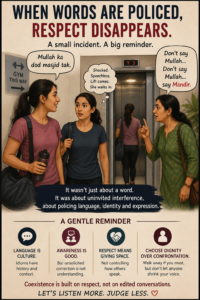
A friend from our society was on her way to the gym when she ran into someone she knew. In the casual rhythm of small talk, she was asked where she was headed. Smiling, she replied with a familiar idiom we’ve all grown up hearing:
“Mullah ka daud masjid tak.”
Before the conversation could move any further, a resident passing by abruptly stopped and intervened.
“Don’t say Mullah… don’t say Mullah… say Mandir.”
There was no context, no conversation, no attempt to understand—just a correction, sharp and unsolicited.
The lift doors opened. My friend stepped inside, stunned into silence.
More Than Just Words
When she reached the gym and narrated the incident, she was visibly shaken—angry, confused, and deeply uncomfortable. And honestly, so was I.
Because this wasn’t just about a phrase.
It was about the growing tendency to police everyday language, to insert oneself into conversations that don’t concern us, and to assume authority over how others should speak or express themselves.
The phrase my friend used is an old idiom—part of our shared cultural fabric. It was not a statement of belief, nor was it intended to offend. Yet, in that moment, it was treated as something inappropriate, something that needed to be “corrected.”
The Problem With Uninvited Corrections
There’s a difference between awareness and imposition.
Yes, being sensitive in a diverse society matters. Words do carry weight. But sensitivity loses its meaning when it turns into unsolicited moral policing.
What happened here wasn’t a conversation—it was an interruption.
It wasn’t dialogue—it was dictation.
And perhaps most importantly, it lacked something essential: respect.
Intent vs. Impact
It’s possible that the resident believed they were promoting inclusivity or avoiding religious references. Intentions can sometimes come from a place of caution or even concern.
But impact matters just as much.
When we correct others without context or invitation, we risk:
- Silencing natural expression
- Creating discomfort instead of understanding
- Turning simple interactions into tense moments
Respect isn’t about controlling language—it’s about allowing space for it.
The Grace of Walking Away
What stayed with me the most wasn’t just the comment—it was my friend’s response.
She didn’t argue.
She didn’t escalate.
She simply walked away.
And sometimes, that is the most powerful response of all.
Not every moment demands a confrontation. Some moments simply reveal who we are—and who we choose to be.
A Thought to Leave With
In a world that is becoming increasingly sensitive, perhaps the real need is not to speak less, but to listen more.
Before correcting someone, we might ask:
- Was this meant to harm?
- Is my intervention necessary?
- Am I adding understanding—or just asserting control?
Because coexistence is not built on edited conversations.
It is built on mutual respect.
Final Reflection
That brief exchange in a hallway may seem small, even forgettable. But it reflects something larger—a subtle shift in how we engage with each other.
And maybe the real question isn’t about what was said.
Maybe it’s about why we feel the need to control what others say at all.