
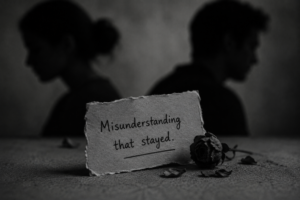
The Day Words Chose Silence
The misunderstanding did not arrive loudly. It did not announce itself with shouting or slammed doors or dramatic exits. It came quietly, disguised as a sentence said in haste, heard in exhaustion, and carried forward by pride on both sides. It was an ordinary evening — the kind people forget when they list turning points in their lives.
She remembered the colour of the sky though. A tired grey, like it couldn’t decide whether to rain or give up entirely.He had been late. Not unforgivably late, not enough to apologise profusely, just late enough to irritate someone who had spent the day waiting. She sat at the café table with her phone face down, telling herself she wasn’t counting the minutes while counting every single one.
When he finally arrived, he looked distracted — not careless, just weighed down by a day she hadn’t been part of.“Sorry,” he said, sitting down. “It’s been one of those days.”
She nodded. She always nodded first.That was how she loved — by accommodating before being heard.
They talked about small things. Work. Traffic. Coffee that tasted burnt. The conversation flowed, but something underneath had already begun to crack. She felt it — that subtle shift where attention drifts but affection remains, confused and unaddressed.
Then she asked the question. It wasn’t dramatic. It wasn’t even sharp.
“Were you ever going to tell me?” He frowned. “Tell you what?” She hesitated — just for a second too long. That hesitation planted the seed. “Never mind,” she said, already withdrawing.
He sighed, tired now. “You do this,” he said. “You expect me to know what you’re thinking.”The words landed harder than he intended. She straightened. “And you do this,” she replied quietly. “You assume I’ll always understand.”
Silence followed — thick, uncomfortable, unfinished.
He looked away. She picked up her phone.
Neither asked the question again.Neither clarified.Neither reached across the table. When they stood to leave, it felt less like the end of an evening and more like the beginning of an absence.That night, she replayed the moment endlessly — rewriting her tone, changing her timing, imagining different endings.That night, he told himself she was overthinking — that tomorrow would smooth everything over.
Tomorrow never came. Because misunderstandings don’t survive on lies. They survive on silence.And this one stayed.
What Was Meant, Not Said
In the days that followed, nothing officially ended.That was the strangest part.
No messages declaring distance. No conversation that named the hurt. Just a gentle thinning of presence, like a voice fading on a bad phone line. She noticed it first in the pauses — the time it took for replies to arrive, the way his sentences grew shorter, more functional, less curious.
She told herself she was imagining it. She was good at that. At convincing herself that absence was temporary, that silence was circumstantial, that love did not evaporate because of one poorly timed conversation. She carried on with her routines, answered emails, smiled at colleagues, cooked dinner for one and pretended it was a choice.
At night, she replayed the café scene.Not the whole thing — just the moment she wished she could re-enter, as if time might allow a revision.
Were you ever going to tell me? She cringed at the question now. It sounded accusatory in memory, heavier than she had intended. What she had meant was simpler, softer: I want to be included. I want to know what matters to you.
I don’t want to find out from somewhere else.
But meaning, she was learning, was fragile. It bent easily under tone, timing, and tiredness. She picked up her phone often, typed messages she deleted before sending.
I didn’t mean it like that.I should have explained. Can we talk?
Each version felt inadequate. Too needy. Too late. Too risky. Pride stepped in quietly, disguised as dignity.If he wanted to talk, he would.If it mattered, he’d ask.
She told herself that waiting was a form of strength.He noticed the distance too, though he named it differently.
To him, it felt like relief mixed with irritation — a confusing combination that made him uncomfortable. He had replayed the conversation as well, but with a different emphasis. Not on her hesitation, not on what might have been said, but on the accusation he believed he had heard.
You expect me to know what you’re thinking. The sentence echoed in his mind, sharper each time.
He wasn’t wrong, he told himself. She did expect that sometimes. She held things in, tested him silently, then seemed disappointed when he failed tests he didn’t know he was taking. He had felt that pressure before — the pressure to anticipate, to intuit, to get it right without being told.
He told himself he was tired of apologising for misunderstandings he didn’t fully understand.And yet.
He missed her in the smallest ways. In moments that caught him off guard — when he reached for his phone with something trivial to share, when he heard a line of dialogue in a film she would have loved, when he stood in a queue and felt the urge to complain about the wait just to make her smile.
He drafted messages too: I didn’t mean to sound harsh.I was just exhausted.Can we reset?
But then he imagined her response — calm, measured, hurt. He imagined having to explain himself, to revisit a moment he wanted to forget. He imagined being told he hadn’t listened enough.
So he waited.Waiting, he believed, would let the tension dissolve on its own.Days turned into a week.
The silence acquired a shape, a routine. It was no longer alarming — just present. Both of them adapted to it with surprising efficiency, as humans often do when something painful becomes familiar.She stopped checking her phone every few minutes.He stopped expecting her name to light up his screen.
What neither admitted was that they were still listening — just for absence instead of sound.She interpreted his quiet as indifference.He interpreted her restraint as withdrawal.And so the misunderstanding deepened, not through new words, but through the absence of old ones.
One evening, she ran into a mutual friend at a bookstore. “Are you two okay?” the friend asked casually, flipping through a novel. The question caught her off guard. She smiled automatically — a reflex she had perfected.“Of course,” she said. “Why wouldn’t we be?” The friend shrugged. “You just seem… quieter.”
Later, alone, she resented the question more than the assumption behind it. Was it that obvious? Had silence already become visible?
That night, she finally wrote a message she didn’t delete. I think we left something unfinished.She stared at it for a long time before sending.The reply came hours later.I don’t know what you mean.She felt the words land, heavy and final in a way she hadn’t anticipated. Exactly, she thought.But she didn’t say that.
Instead, she placed the phone face down on the table and let the quiet return. He reread her message more than once. I think we left something unfinished. It felt vague. Loaded. Dangerous.
What did she want — an apology? A confession? A confrontation? He was tired of decoding. Tired of guessing what was expected of him. So he chose the safest response — the one that revealed the least.
I don’t know what you mean.
Even as he typed it, he felt something close inside him — a door he didn’t fully realise he was shutting.When her reply didn’t come, he told himself it was for the best.Yet later that night, lying awake, he admitted what he hadn’t earlier: he did know what she meant. He had known from the beginning. He just hadn’t wanted to open it.
Because unfinished things demanded effort.And effort required vulnerability.This was how the misunderstanding stayed.Not because either of them wanted distance, but because both were afraid of stepping into a conversation where they might be seen — fully, imperfectly, and perhaps disappointingly.
They loved each other still.But love, unspoken and unexamined, began to turn into something else — something quieter, heavier, and harder to name.
And neither of them realised yet that what they were losing was not each other, but the chance to be understood.
The Space Between Messages
The space between messages began to stretch in ways neither of them acknowledged aloud.
It wasn’t dramatic. No sudden disappearance, no deliberate silence. Just a gentle widening — minutes turning into hours, hours into days. Replies still came, but they arrived cautiously, stripped of warmth, edited for safety. Words that once flowed now queued up, hesitant, unsure of their welcome.
She noticed it first in the mornings.
There had been a time when her phone was the first thing she reached for, when she half-expected a message even before opening her eyes. Now, she woke up slowly, deliberately, as if bracing herself for disappointment. When there was nothing, she told herself it was fine. When there was something, she read it twice, searching for meaning between the lines.
Hope you’re doing okay. Three words. Polite. Distant.She typed back:Yes, all good. Hope you are too.
She stared at the screen after sending it, surprised by how easily she had matched his tone. It felt like self-protection, like learning a new language quickly before you could get hurt by mispronouncing it.Throughout the day, fragments of thought drifted toward him — things she wanted to share, observations she would have once sent without hesitation. A street musician playing an old song. A stray dog curled up near the metro stairs. A line in a book that felt familiar.
She shared none of it.Instead, she saved those moments for herself, letting them settle quietly where excitement used to be.He, too, was learning restraint.
He noticed how quickly he now considered whether something was worth sending. He weighed each message for possible misinterpretation, possible obligation. It surprised him how effortful communication had become, as though every sentence required emotional paperwork.He told himself it was temporary.
That they were simply recalibrating. That distance, if handled carefully, could reset expectations. He believed that if they gave each other space, the tension would dissolve naturally — like steam escaping a room.But space, he was discovering, did not always empty. Sometimes it accumulated.
He typed messages late at night and deleted them before sleep could carry him into honesty.
I miss how easy this used to be.I think we misunderstood each other.I don’t want this silence.
Each sentence felt like an invitation to a conversation he wasn’t sure he was ready to have.So instead, he sent safer messages — factual updates, neutral check-ins.
Busy day.Work was hectic.
She replied in kind.They were still connected, technically. But the connection had begun to feel like a formality — something maintained out of habit rather than desire.
One evening, she waited longer than usual before replying.
Not intentionally. She had been caught up in work, then in traffic, then in the quiet exhaustion that followed. When she finally picked up her phone, his message was already hours old.
Are you upset with me? The question startled her.
She read it again, her chest tightening. This was it — the opening she had been waiting for, the acknowledgment she had hoped would come.
She began typing immediately. I’m not upset. I just feel like—
She stopped.The rest of the sentence loomed uncertain, fragile. She imagined how it might sound to him — like accusation, like complaint, like emotional labour he hadn’t signed up for.She erased the words.
No, I’m fine, she typed instead. She pressed send, then sat back, dissatisfied.The truth had hovered at the edge of her fingers, then retreated.He read her reply and felt a strange mix of relief and disappointment.Relief because conflict had been avoided. Disappointment because something honest had just passed them by.He wanted to believe her. He almost did.
But the distance felt too precise, too carefully constructed to be accidental. He sensed that she was holding back — the same way he was. And the symmetry of it felt unfair, like a game neither of them had agreed to play.He considered pushing further.
You don’t seem fine.
He didn’t send it.
Instead, he put his phone down and turned his attention elsewhere, convincing himself that if something truly mattered, it wouldn’t require so much effort to sustain.Days passed like this — careful, edited, incomplete.
Their messages became functional markers of contact rather than expressions of closeness. Good mornings without warmth. Check-ins without curiosity. Good nights that felt more like conclusions than promises.She began to wonder if this was how relationships ended now — not with final conversations, but with gradual emotional withdrawal masked as maturity.
He began to wonder if this distance was revealing something fundamental — a mismatch in expectations, a gap in communication styles that love alone couldn’t bridge.Neither said these thoughts out loud. Instead, they let the space between messages speak for them. And in that space, the misunderstanding grew more confident, settling in comfortably, as though it belonged there.
Because silence, once normalised, stops feeling like absence. It begins to feel like the truth.
Versions Of The Same Story
By the time other people noticed, the story had already begun to change.It didn’t change dramatically — not all at once. It shifted quietly, shaped by retellings, by assumptions made in good faith, by observations that felt harmless but weren’t. The truth, unguarded, became vulnerable to interpretation.
She heard the first version from a friend over coffee.“You seem lighter,” the friend said, stirring sugar into her cup. “Like you’re finally not carrying everything alone.”She paused, unsure how to respond. Lighter wasn’t the word she would have chosen. Quieter, maybe. Or Emptier.
“I’m just… giving things space,” she said finally.The friend nodded, satisfied. “That’s good. Some people need distance to realise what they’re losing.”The sentence lodged itself in her chest. She hadn’t intended it as a strategy, hadn’t planned silence as leverage. But now, framed that way, her restraint began to feel like a position she had to maintain.
She didn’t correct the assumption.
Later, alone, she wondered if that was how it looked from the outside — like control instead of confusion, like detachment instead of hurt.She wondered if he thought the same.His version arrived from a different direction.
A colleague, noticing his distraction during lunch, asked casually, “Everything okay with you two?”He shrugged. “Yeah. Just busy.”The colleague smirked. “That’s usually what people say when they’re tired of explaining themselves.”
He laughed it off, but the comment lingered longer than it should have: Tired of explaining yourself.
The phrase felt uncomfortably accurate. He had always believed relationships should offer ease — that love was meant to simplify, not complicate. And lately, everything between them had begun to feel like work. Not the rewarding kind, but the kind that demanded constant emotional calibration.
He told himself that maybe this distance was revealing something essential. Maybe the misunderstanding hadn’t created the problem — maybe it had merely exposed it.That thought, once planted, took root quickly.
They each began telling a story — not to the other, but to themselves.
In her version, she had been patient. She had waited, held back, given him room to come forward. She had protected the relationship by not escalating, by not demanding clarity when he seemed unwilling to offer it. Her silence became evidence of her emotional maturity.
In his version, he had been reasonable. He had avoided unnecessary conflict, respected her space, refrained from pushing when she appeared withdrawn. His restraint became proof that he wasn’t the kind of person who forced conversations.
Both versions were true.And incomplete.
The danger wasn’t in the stories themselves, but in how convincingly they replaced curiosity.
Once each of them settled into their respective narratives, the urge to ask questions weakened. Why disrupt a story that already explained the discomfort? Why reopen a moment that had found a convenient conclusion?
She began to notice how easily she framed his actions as choices rather than circumstances.
He hasn’t reached out because he doesn’t want to.If it mattered, he’d try.
Each thought landed with painful certainty.
He, meanwhile, interpreted her calm replies as emotional distance.
She’s moved on.She’s already decided.
And in that assumption, he found justification for his own retreat.The few times their paths crossed socially, they were careful.Polite. Considerate. Almost strangers rehearsing familiarity.They asked about work, commented on weather, laughed lightly when required. Friends observed them and drew conclusions based on these performances.
“They’re being so mature about it,” someone remarked after one such encounter.Mature.The word tasted strange in her mouth later. Maturity had always felt like honesty to her — difficult, sometimes messy, but real. This felt more like avoidance dressed up as grace.He, too, felt unsettled by the praise. If this was maturity, why did it feel like something unresolved pressing against his ribs?
That night, she opened her journal and wrote a sentence she hadn’t allowed herself to think before:
What if we are both wrong?
The thought frightened her because it suggested a third version — one where neither of them was protecting the relationship, but slowly dismantling it.
He lay awake that same night, staring at the ceiling, realising something uncomfortably similar:
What if I stopped listening the moment I felt accused?
Neither acted on these thoughts.Insight arrived, but courage lagged behind.Stories, once told often enough, begin to feel like truth.And truth, when unchallenged, hardens into certainty.
By the time they each noticed the cracks in their own versions, the misunderstanding had already settled deeper — no longer just a moment between them, but a shared history rewritten separately.
A single event now lived two lives.And neither version knew how to make room for the other.
Love Without Clarification
Love did not leave when clarity did.That surprised them both. It would have been easier if affection had faded along with communication — if distance had cooled feeling, if silence had done the work of forgetting. But love, stubborn and uncooperative, stayed behind, adapting itself to the absence of explanation.She felt it in the most inconvenient moments.
Standing in a queue, she reached instinctively for her phone to share an observation, then remembered she no longer did that. Cooking dinner, she caught herself setting aside a portion the way he liked it. Watching a film alone, she paused at a scene she knew would have made him laugh, the memory landing softly and then refusing to move. Love, she realised, did not require permission to exist.It didn’t ask whether it was welcome.But without clarification, it had nowhere to go.She loved him now in private — carefully, quietly, without expectation. She didn’t speak his name aloud as often. She thought of him as a past tense she hadn’t officially learned to use.
He experienced it differently, but no less intensely.For him, love surfaced as irritation first — a restlessness he couldn’t quite place. He found himself comparing new conversations to old ones, noticing how few people understood his pauses, his humour, the way his thoughts curved instead of landing straight. He missed being known.That, more than companionship, was what he missed — the sense that someone could read the unsaid without being asked. And yet, he recognised the irony: this very expectation had contributed to their silence.
Love, in his mind, had always been intuitive. Now he wondered if that belief had been unfair.They didn’t stop caring.They stopped clarifying.She waited for him to explain — to say something that would reframe the moment, soften it, make room for her doubt. She believed that love, if genuine, would find its way back to conversation. He waited for her to be direct — to name what she wanted, to risk sounding vulnerable instead of disappointed. He believed that love should not require so much interpretation.Both waited for proof that love was still active.Neither offered it in the way the other needed. Occasionally, they checked in — brief messages sent with measured care.
Hope you’re well. Just wanted to see how you’re doing.
The messages were sincere, but restrained. Each one carried more unsaid than spoken, more fear than affection.She read his messages slowly, wondering if she was meant to respond with honesty or neutrality. She chose the latter, telling herself that if he wanted depth, he would ask for it. He read her replies and told himself she seemed settled. That she had adjusted more easily than he had. He took this as a sign — not of strength, but of readiness to move on. Both were wrong.There were moments when clarity almost arrived.
Once, late at night, she hovered over her phone, heart racing, ready to send the message she had avoided for weeks.
I wasn’t accusing you. I just felt left out.
The sentence felt raw, exposed. It demanded empathy, not defence.She imagined him reading it — the pause before replying, the shift in tone, the emotional work that would follow. She imagined having to explain more than she had the energy to give.She deleted it. That same night, he drafted a message of his own.
I think I shut down instead of listening.
He stared at the words, surprised by their honesty. They felt like a doorway — narrow, but open.Then he imagined the conversation that would follow — the questions, the revisiting, the possibility that he might be asked to change something fundamental.He deleted it. Two truths, typed and erased within hours of each other.Love, unspoken, began to change shape. It became memory instead of presence.Care instead of intimacy.Affection without direction.They loved each other sincerely, but in isolation — each convinced the other had chosen distance deliberately.The tragedy wasn’t that they stopped loving.It was that they stopped believing love alone was enough to justify the effort of understanding. And so love remained — real, unresolved, and unbearably quiet.Waiting for clarification that never came.
The Apology Practised In The Mirror
At some point, both of them began rehearsing.Not aloud at first — just internally, in fragments, while brushing teeth, while waiting at traffic lights, while lying awake in the dark. Apologies took shape in their minds, carefully worded and endlessly revised, as if the right phrasing might undo weeks of silence.
She practised hers in the mirror.It happened accidentally the first time. She was getting ready for work, tying her hair back, when she caught her own reflection and heard the words form.“I didn’t mean to accuse you.”The sentence sounded steadier than she felt. She tried again.“I just wanted to feel included.”
That one made her throat tighten. She imagined his face — the way he would tilt his head slightly when listening, the crease between his brows when something troubled him. She imagined explaining how the question had escaped her before she had time to soften it, how exhaustion had sharpened her tone, how fear had filled the silence that followed.
She imagined him understanding.Then she imagined him saying, Why didn’t you just say that?The imagined question stopped her cold.Why hadn’t she?The apology fractured there, splintering into explanations she wasn’t sure she was allowed to offer so late.She turned away from the mirror, unsettled.He rehearsed his in the car.
Traffic gave him too much time to think. Red lights became cues for reflection, long stretches of road inviting unwanted honesty. He found himself speaking under his breath, testing words he had avoided saying for weeks.“I shouldn’t have shut down.”The admission felt heavier than expected.“I was tired, but that wasn’t your fault.”
He gripped the steering wheel tighter, surprised by the clarity of the thought. He had confused exhaustion with justification, irritation with truth.He imagined telling her that he hadn’t felt accused — he had felt inadequate. That the expectation to intuit had triggered something old in him, something defensive. That instead of naming that feeling, he had retreated.He imagined her listening quietly.He imagined her saying, I wish you’d told me that.And then he imagined her adding, But you didn’t.The imagined disappointment felt worse than the silence.Apologies, they realised, were not simple acknowledgments of fault.
They were invitations — to reopen a moment both of them had worked hard to seal shut. She worried that apologising now would look like weakness, or worse, like desperation. That it would place the burden of resolution on her, confirming a pattern she feared had existed all along — that she was always the one reaching, explaining, adjusting.
He worried that apologising would require him to accept responsibility for something he hadn’t fully understood at the time. That it would mean confronting the idea that he had chosen comfort over curiosity.Both were afraid of being misunderstood again — this time in their honesty.They practised conversations that unfolded perfectly.In these imagined exchanges, words landed gently. Clarifications were received with grace. There were no raised voices, no defensiveness. Each apology was met with understanding, each explanation with empathy.
Reality, they knew, was rarely that cooperative.Real conversations stumbled. They triggered old wounds. They demanded patience neither of them felt certain they possessed anymore.So they kept practising — refining apologies that remained private, polishing explanations that never left the room.
One evening, she caught herself speaking aloud again.“I wish you had asked.”The sentence startled her with its bitterness.She realised then that her apology had begun to carry resentment — that what she wanted now was not just understanding, but recognition of the effort she had withheld and the vulnerability she had swallowed.
Across the city, he sat alone, staring at his phone, thinking something uncomfortably similar.“I wish you had told me.”The symmetry of it, had either known, might have been enough to break the silence.But rehearsed apologies, unlike spoken ones, offer no resolution.They comfort without changing anything.They clarify without being heard.And so both of them continued practising — standing before mirrors and windshields, perfecting words meant for each other, never quite brave enough to say them aloud. The misunderstanding, patient and unchallenged, stayed exactly where it was — nourished by apologies that existed only in imagination.
When Time Becomes A Witness
Time did not take sides.It simply observed.Days folded into weeks, weeks settled into months, and what had once felt like a temporary pause began to resemble permanence. Life continued around them with an almost insulting normalcy — emails still needed replies, bills still arrived, birthdays still demanded smiles. Time, indifferent to emotional unfinished business, kept moving.She noticed its passing in subtle shifts.She stopped checking her phone first thing in the morning. She stopped rereading old messages, telling herself she already knew them by heart. The café they used to frequent became just another place, stripped of association through avoidance.
She didn’t forget him.She adjusted.That adjustment frightened her more than longing ever had.Because it meant she was learning how to live with unanswered questions — and that skill, once mastered, would be difficult to undo. He experienced time as erosion.Not sharp loss, but gradual wearing down.The urgency he had felt in the early weeks softened into something heavier and duller. He still thought of her often, but the thoughts no longer demanded action. They hovered, unproductive, like background noise he had learned to ignore.
He noticed himself telling fewer stories about her — not because she mattered less, but because mentioning her required context he no longer wanted to provide.
“What happened?” people would ask.Nothing, he’d say. And the truth, as unsatisfying as it was, suited him better than explanation.Time became a witness to their separate evolutions.
She grew more self-contained, less inclined to assume misunderstanding where clarity hadn’t been offered. She became more careful with questions, more deliberate with expectations. Silence, once painful, began to feel protective. He grew more guarded, less willing to engage emotionally unless certainty was guaranteed. He mistook this caution for wisdom, telling himself he was learning from experience.
Both were changing — not away from each other, but away from the versions of themselves that had believed conversation could fix everything. Occasionally, time betrayed them.A song on the radio.A shared joke overheard in a crowd.A sentence in a book that felt uncomfortably familiar.
In those moments, memory surged forward without warning, collapsing months into seconds. The past felt close enough to touch, and the present felt oddly provisional. She would pause, breathe through it, and move on.He would feel a tightening in his chest, dismiss it, and continue.
Time taught them efficiency in avoidance.There came a day when she realised she hadn’t thought about explaining herself in weeks. The realisation unsettled her. Explanation had once felt essential — a way of being known. Now it felt optional, even risky. She wondered when she had decided that being understood was not worth the effort it required.
That same day, he realised he hadn’t imagined an apology in a while.
The rehearsed conversations had faded, replaced by a quiet acceptance that perhaps some moments were not meant to be revisited. He told himself that closure was overrated, that understanding was not always necessary.
Both conclusions felt reasonable.Both were built on surrender.Time, in witnessing all of this, did something neither of them anticipated.It normalised the misunderstanding. What had once felt like an unresolved fracture began to feel like history — something fixed, unchangeable, safely placed in the past. The discomfort dulled, replaced by a resigned familiarity.Time did not heal the misunderstanding.It made room for it.
It gave it a place in their lives where it could exist without protest, without urgency, without challenge. And in doing so, time ensured that when the truth finally approached — as truth often does, late and uninvited — it would have to contend not just with silence, but with habit.
Because when time becomes a witness, it does not testify.It simply remembers.
Almost Meeting Again
It happened when neither of them was prepared.Not emotionally, not practically, not in the careful ways they had trained themselves to be.
She saw him first.Across the street, half-hidden by a line of parked cars, his outline registered before his face did — posture familiar enough to jolt memory awake. For a moment, she was certain she was mistaken. The mind, after all, had a habit of conjuring ghosts. Then he turned.The recognition was immediate and involuntary. Her breath caught, a reflex she hadn’t felt in months. Time collapsed in on itself, and suddenly she was standing in the space between then and now, uncertain which version of herself she was meant to be.
He hadn’t seen her yet.She watched him for a second longer than she should have — noting the unchanged things, the ones that anchored him firmly in her memory. The way he leaned slightly forward when checking his phone. The crease at the corner of his eyes when he smiled at something she couldn’t see. She felt the old instinct surge — the urge to cross the street, to say his name, to let the moment decide for them what they hadn’t.Instead, she froze.He sensed her before he saw her.
A presence — familiar without being visible. He looked up, scanning the street, and there she was.Closer than expected. Realer than memory.For a brief, suspended moment, they simply looked at each other. No smiles. No waves. Just recognition, sharp and unfiltered.
He felt a rush of conflicting impulses — relief, regret, affection, hesitation — all arriving at once, demanding response. He took a step forward without thinking. She did the same.
Traffic surged between them, sudden and loud, a physical interruption that felt almost deliberate. Cars moved through the space they had been about to cross, sealing off the moment with noise and motion.They stopped.
Separated by more than just the street now.She raised her hand slightly — not a wave, not a goodbye, just an acknowledgment. It was tentative, careful, as though she were testing whether this version of him still recognised her.
He nodded in response.The gesture was small, restrained, weighted with everything they hadn’t said.For a moment, she considered calling out. The sound of his name hovered at the edge of her mouth, heavy and unfamiliar after so much silence. She didn’t trust her voice.He considered crossing anyway, weaving through the traffic, forcing the interruption into conversation. The thought thrilled and terrified him in equal measure.He didn’t trust himself.
The traffic light changed.People moved. The world resumed its pace.She felt the moment slipping, the way something fragile does when held too loosely. She could act now or accept that this — this brief collision of past and present — was all she would get.
She turned away first.Not because she didn’t care, but because she did — and care, without clarity, felt dangerous.He watched her walk off, the decision landing heavily in his chest. He told himself it was mutual restraint, not rejection. He told himself it was maturity, not fear. The truth hovered somewhere between.As she walked, her thoughts raced ahead of her steps.
I could have said something.He could have come over.We could have tried.
Each thought arrived with equal force, cancelling the others out.By the time she reached the corner, the intensity had dulled, replaced by a familiar ache — less sharp than before, but no less real.Across the street, he stood still for a moment longer than necessary, watching the place where she had disappeared into the crowd.
He felt the weight of the almost — that particular kind of loss reserved for moments that brush against possibility without ever entering it.Almost meeting again felt worse than not meeting at all.Because it proved that time hadn’t erased anything.It had merely rearranged the distance. And as they walked away in opposite directions, both of them knew the same unsettling truth:The misunderstanding was still there.Waiting.
The Truth Revealed Too Casually
The truth arrived without ceremony.No dramatic confession. No carefully planned conversation. It surfaced the way inconvenient truths often do — unexpectedly, mid-sentence, in a context that made it impossible to prepare for its weight.
She heard it during a lunch break she almost skipped.A colleague, speaking casually about office transitions, mentioned a project she vaguely remembered him being involved in months ago.
“Oh, that one?” the colleague said. “It fell apart because he was supposed to move cities for it, remember? He told everyone he’d mentioned it to you already.”
Her fork paused mid-air.
He told everyone he’d mentioned it to you already.
The words landed lightly in the conversation, then moved on, replaced by chatter about deadlines and logistics. But she stayed frozen, her appetite vanishing in an instant.She hadn’t known.Not about the possible move. Not about the uncertainty. Not about how much pressure he had been under during that time.
The café conversation returned to her with brutal clarity — his distraction, his exhaustion, the look on his face when she asked her question.
Were you ever going to tell me?
The question, she realised now, hadn’t been paranoia.It had been intuition.The truth rearranged memory.
Moments she had replayed for months shifted under this new light. His defensiveness made sense. His withdrawal felt less like indifference and more like overwhelm. The silence that followed was no longer a choice — it was a reaction.She felt a familiar ache rise, but this time it was sharper, edged with something new.
Understanding.It arrived too late to prevent damage, but right on time to hurt.He learned the truth in an equally unremarkable way.A friend mentioned her name in passing, speaking about a difficult period she had gone through.
“She thought you already knew,” the friend said. “That you were aware and had decided not to bring it up.”
He frowned. “Knew what?”The friend hesitated, then explained — how she had heard about the possible move indirectly, how she had assumed he was choosing not to include her, how that assumption had shaped her response.
His chest tightened as the pieces fell into place.She hadn’t been testing him.She had been hurt.
Both of them sat with the truth separately, stunned by its simplicity.
There was no betrayal.No hidden intention.No manipulation.
Just two people reacting to incomplete information, each assuming the other had access to a reality they did not.The misunderstanding, once complex and overwhelming, suddenly appeared almost fragile — held together by timing and silence alone.And that was what made it unbearable.
She considered reaching out immediately.Her fingers hovered over the keyboard, heart racing, the urge to correct history surging with renewed urgency.
I know now.I understand.I wish I had known then.
But clarity brought with it an unexpected hesitation.
What would this truth change now?
Months had passed. Distance had solidified. Habits had formed. They were no longer standing at the café table — they were standing on opposite sides of a life that had continued without explanation.Understanding, she realised, did not automatically demand reunion.
Sometimes it only demanded acceptance.He felt the same pull, the same uncertainty.
The truth explained everything — her restraint, her silence, her calm. It softened the defensiveness he had carried for months. It made his withdrawal feel cowardly in hindsight.
He wanted to call her.But the moment had passed where urgency could justify intrusion. To reach out now felt like reopening a wound she might have already learned to live with.
He wasn’t sure he had the right.Truth, revealed too casually, carried no instructions.
It did not tell them what to do next.It did not promise repair.It did not undo time.It simply stood between them — undeniable, clarifying, and painfully late.And in its quiet arrival, it forced them both to confront the same question:Is understanding enough, when it comes after everything else has already changed?
The Weight Of What Could Have Been
Understanding did not bring relief.It brought weight. The truth, once known, settled heavily into both of them — not as closure, but as consequence. It altered the past without offering the comfort of change. There was no relief in knowing they had not failed each other intentionally. If anything, that knowledge made the loss sharper.
She felt it first as regret — a precise, unrelenting ache. Not the kind that comes from making the wrong choice, but the kind that comes from realising how close you were to making the right one. She replayed moments now with a new cruelty, seeing exactly where a different response might have changed everything.
If she had asked one more question.If she had waited one more minute.If she had trusted discomfort instead of silence.The possibilities crowded her mind, relentless and exhausting.
He carried the weight differently.For him, it arrived as responsibility. He could no longer frame the silence as mutual drift or inevitable distance. He had known more than she did — and in that imbalance, he recognised his part. Not in causing the misunderstanding, but in allowing it to deepen unchecked.He thought about the moment she had asked her question, how quickly he had shut down, how little room he had left for curiosity.
He had been afraid of being misunderstood.And in that fear, he had stopped listening.What haunted them both was how ordinary the turning point had been.Not a betrayal. Not a defining argument. Just two tired people standing at the wrong moment, expecting the other to bridge the gap.
They realised now how fragile love was — not because it lacked strength, but because it depended on timing, attention, and courage in moments that didn’t announce their importance.
She imagined reaching out again, this time armed with understanding.The thought was tempting — intoxicating even. The fantasy of a conversation where everything finally made sense, where apologies landed correctly, where the past could be acknowledged without reopening pain.
But fantasy collapsed quickly under reality.What would she be asking for?A rewind?A reconciliation?
Or simply relief from regret?
She wasn’t sure.And uncertainty, she had learned, was no longer something she wanted to build a relationship on.
He imagined the same conversation.In his version, he explained himself fully — his fear, his defensiveness, his exhaustion. He acknowledged where he had failed, where he had chosen silence over effort. He apologised without qualifiers.But he also imagined her listening quietly, then saying something that felt both kind and final.
I understand now. But I’ve changed.
The imagined sentence hurt more than rejection would have.The weight of what could have been pressed down on them in different ways.For her, it threatened to pull her backward — to anchor her in regret instead of growth.For him, it threatened to stall him — to trap him in guilt instead of accountability. Both understood that dwelling too long in possibility would prevent them from fully inhabiting the present.And yet, letting go of possibility felt like losing them all over again.They began to see the misunderstanding not just as a mistake, but as a lesson — one that had arrived through loss rather than insight.
A lesson about speaking before certainty.About listening beyond defensiveness.About the cost of assuming love will survive neglect.The lesson was clear. Its price had already been paid.Understanding, they realised, did not offer a second chance.It offered perspective.And perspective, while valuable, was heavy — because it demanded acceptance without the promise of repair.
The weight of what could have been stayed with them, shaping how they loved next, how they listened next, how quickly they spoke when silence tempted them.Because some losses don’t ask to be recovered.They ask to be carried.
The Conversation That Comes Late
The conversation did not begin the way either of them had imagined.There was no careful planning, no emotionally prepared moment. It started simply — with a message sent on an ordinary evening, after a day that had offered no particular courage.
Can we talk?
She stared at the words for a long time before replying.Yes.
No punctuation. No qualifiers. Just consent. They chose a place that felt neutral — a quiet café neither of them had strong memories attached to. That, in itself, felt like an acknowledgment of how fragile they both were.When she arrived, he was already there.They stood for a second, unsure whether to hug. The hesitation spoke louder than any greeting. They settled for a brief smile and sat down across from each other, distance measured and deliberate.
For a moment, neither spoke. Silence, once their shared enemy, returned — familiar, but different. It no longer felt defensive. It felt cautious.
“I know now,” she said finally.He nodded. “I do too.”The simplicity of the exchange surprised them both.
She took a breath. “I wasn’t accusing you. I just felt… left out. I thought you already knew how I found out.”
He looked down at his hands. “I thought you were testing me. I shut down instead of asking what you meant.”
There it was.Not dramatic. Not cruel.Just honest. The words that followed came slowly, carefully, as though they were navigating uneven ground.
She explained how the silence had felt — how waiting had seemed like the only dignified option, how pride had disguised itself as patience. He explained his fear of emotional demand — how he had confused expectation with pressure, how retreat had felt safer than vulnerability.
They listened. Not to defend.Not to correct.Just to understand.
And in that listening, something eased.“I wish we had done this earlier,” she said quietly.“So do I,” he replied. “But I don’t think we could have.”
The truth of that settled between them. They were not the same people they had been months ago. Time had shaped them, taught them caution, given them new boundaries they were no longer willing to ignore.Understanding arrived, full and clear.
Reunion did not automatically follow.“I don’t know what this means now,” she admitted.He nodded. “Neither do I. But I’m glad we talked.”She smiled faintly. “Me too.” It wasn’t the smile of reconciliation.It was the smile of release.They sat for a while longer, speaking of lighter things — work, mutual friends, the small changes in their lives. The conversation flowed easily now, unburdened by expectation.
When they stood to leave, the moment felt complete.He hesitated, then said, “I’m sorry.”The apology was simple. Unqualified. She met his eyes. “I am too.”
And this time, the words landed exactly where they were meant to.They walked out separately.Not because they were unfinished, but because they were.The conversation had come late — too late to change the past, but in time to prevent it from haunting the future.The misunderstanding no longer stayed between them.It stayed as memory.And memory, finally understood, loosened its grip.
EPILOGUE :The Misunderstanding That Stayed
The misunderstanding did not disappear after the conversation.It changed its form.
It no longer lived between them, sharp and unanswered. It lived within them now — quieter, softer, transformed into something reflective rather than accusatory. It no longer demanded repair. It asked only to be remembered.They did not become strangers.
Nor did they return to what they had been.Their connection settled into a gentler shape — occasional messages, shared updates delivered without expectation, a warmth that no longer reached for more than it could hold. The absence of tension felt like relief, even when it carried a faint ache.
She noticed how the conversation altered her.She spoke sooner now.Asked questions even when her voice trembled.Named discomfort before it could harden into silence.
When something mattered, she no longer waited for the perfect moment. She understood now that moments rarely announced themselves — that courage was often required without invitation.Sometimes, when she hesitated, she remembered the cost of waiting.
And she spoke.
He noticed the change in himself too.
He listened longer.Paused before defending.Asked what someone meant instead of assuming what they intended.
He had learned that misunderstanding was not always a threat — that it was often an opening, one that required patience rather than retreat. He learned that intuition was not a substitute for conversation, and that love did not absolve the responsibility to communicate.
When silence tempted him, he remembered how easily it could be mistaken for indifference.And he stayed present.They carried the same memory differently.
For her, it became a reminder that dignity did not require disappearance. That vulnerability, when offered honestly, was not weakness but clarity.
For him, it became a reminder that discomfort was not accusation — that listening was an act of generosity, not surrender.
The misunderstanding stayed — but no longer as regret.It stayed as wisdom.
Years later, she would think of him sometimes — not with longing, but with a quiet gratitude reserved for people who teach us something lasting.He would think of her too, in moments that asked him to be braver, more attentive, more open than instinct allowed.
They were not each other’s future.But they were part of each other’s becoming.
Some misunderstandings are resolved.Some are forgiven.And some — the most human ones — stay.