
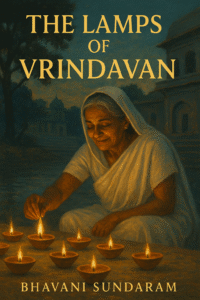
Author’s Note
I wrote Widows of Vrindavan as a tribute to the quiet strength of Indian women who live, love, and rise beyond what society permits them to be.
This story belongs to every woman who has been told that her life ended with loss — and to every friend who helped her find a new beginning.
In the widows’ laughter, I found faith.
In their courage, I found beauty.
And in their defiance, I found light.
May these pages remind you —
that no matter how deep the night, there is always a diya waiting to be lit.
With warmth and gratitude,
— Bhavani Sundaram
Chapter 1: The Tea Stall by the Ghat
Radha made tea like she arranged memory — slowly, insistently, letting small things steep until they meant something. The kettle belonged to her husband’s brother now, a battered tin with a long-handled spout that had survived his and other people’s hands in too many small kitchens. She had learned the meticulous measure of leaves to water, the pinch of green cardamom, a spoonful of brown sugar for the tourists who liked “authentic” spice, and a patient pause for those who preferred plain black. The steam braided with the morning fog off the Yamuna, rising in soft puffs that made the white-painted steps of the ghat look like a stage set for a play she had watched from the wings for years.
Vrindavan in the predawn hours belonged to the ones who could not sleep: the priests polishing brass, the mendicants with their bellies of stories, and the widows who walked here with the improvised reverence of people who had learned to make holiness by repetition. For Radha, the ghat was also work — a thin wooden counter, a kettle, a pile of biscuits, and a steady trade in small confidences. She was, officially, the server of chai to the pilgrims. Unofficially, she was a listener, a discreet ear that collected other people’s need like scraps of paper.
“How many?” a voice asked. Meera’s voice — young where Radha’s had turned into the soft gravel of long years. Radha looked up. The girl stood at the edge of the steps with a coil of cloth around her head, her eyes a little wild from recent travel and sleepless nights. No jewelry; a sari folded into a bundle at her feet. Her wrists were bare where bangles should have been. Widowhood made subtle thieves of habits.
“One,” Radha said. She set the kettle again, pouring the water with the same economy she used on the whole day. There was a moment when the steam hid their faces, and Radha saw what the girl was not quite ready to say.
“You new?” Radha asked, not because she needed to know — the town had ways to announce arrivals — but because she liked the ritual of recognition.
The girl sank on the low step as if the stone had offered itself. “Just come,” she said. “From the village. My husband — he is gone.”
The words were practical and simple, like a government form read aloud. The sky stained a faint apricot.
Radha wiped her hands on her apron. “Vrindavan knows how to gather widows,” she said. “It gives us space, but be warned — it does not give forgiveness. You pay rent in memories and gossip.”
Meera laughed once, sharp and incredulous, a sound that might have been joke or defense. “What else does it give?”
“A place to learn to eat again,” Radha said. “Sometimes, people give us rice or blankets; sometimes they give us pity.” She leaned on the counter. “Come with me. Savitri has a room. It’s small, but it has a shelf that will hold your jar of pickles. That jar is important. You don’t lose a jar.”
Meera followed, legs still weary from the bumpy bus and long road. They passed the temple of Banke Bihari where a boy at the gate was reciting the same phrase again and again until it sounded like music. The bells lifted and slid into the air.
Savitri’s lodging was a tumble of rooms over a tea shop, a place of narrow hallways and thick rag rugs. Savitri herself sat like a carved figure in the doorway, years chiselling dignity into her posture. She had the look of someone who had learned to be stern in order to be kind: the kind of kindness that refused to be eaten.
“Look what the river delivered,” Savitri said, blinking at the new face with the assessment of someone who rests judgment like a closed book for a while. “We’re full, Radha.”
Radha smiled; she had practiced this smile for years. “We always have room for one more.”
Meera’s bed was a pallet with a thin mattress and a blanket folded to the edge. A small brass lamp burned in the corner, its flame steady as a promise. The room smelled faintly of camphor and boiled lentils. Meera sat on the edge, hands folded in her lap like someone waiting for instructions.
“Tell me your name,” Savitri said.
“Meera.”
Savitri’s eyes softened. “At least you have a name that remembers monsoon. It’s good. Names are often what is left.”
The three of them sat in the quiet while the day began to climb. Men came and went, voices and sandals and cart wheels passing like an ordinary tide. Radha made another round of tea. Meera drank slowly, shivering as if the tea had to be a bridge between the town and the fact of her being there at all.
“Do you have kin?” Radha asked, not because she wanted to probe, but because the question had a meaning with each thread: who would come to get you if the town became too sharp?
“No,” Meera said. “My sister. But she is busy. I thought — Vrindavan was better. People look after us.”
Radha looked at her. “Vrindavan looks after people in the way priests look after rituals — with a kind of work that’s circular. The town gives you routines. Routines can be good. But also, there are those who would take.”
“Take what?” Meera asked.
“Your story,” Radha said. “Some will turn your grief into story for their altar. They’ll make your life into a tale to sell priests’ threads and guidebooks.” Radha’s voice made no accusation, only truth. “We have to keep watch.”
Meera’s jaw made a small decision. “I want to work. I don’t want my days to be prayers and pity.”
Radha’s hand, rough with work and steady, surprised them both by sliding a small coin into Meera’s palm. “Then tomorrow, you’ll come early. We’ll go to the lane behind the market. Chameli makes dolls; Lata sews. There is work. You’ll make bracelets. We’ll show you where to stand. We’ll teach you to speak to the tourists. Speak truthfully. Speak simply. Don’t apologize for your grief.”
Meera looked at the coin as if it were a compass. “Will they listen?”
“They listen if you sell something they touch,” Radha said. “They also listen if you tell them the truth. But you must always be ready to close the lid.”
When the first real sun hit the river, the ghats burned brighter — pilgrims, vendors, brass shiners shifting in the light. Radha watched them with the slow care of someone making the board of a chess game.
She tracked faces that gave, faces that took, faces that looked away. When the day swelled into noon, she wiped the kettle, tied her scarf, and set out for the market, Meera close at her heel like a shadow still learning its shape.
Vrindavan had a way of teaching people patience: not the waiting that accepts, but the patient building of a life with what little the river gave. Radha had learned this the slow way — cup by cup, story by story. She had learned too that widows are not only repositories of sorrow; they are a repository of inventions: small economies spun out of prayer beads, dishwater, and defiant laughter.
They were, in their own modest way, making a town — one cup of chai at a time.
Chapter 2 — Meera
The bus had vomited Meera onto the highway before dawn, leaving her standing with her single suitcase and a map folded wrong. The town smelled of jasmine and diesel; the road toward the ghats was still half asleep, vendors arranging their wares like an offering to the morning. She walked because there was nothing else to do but move—move toward whatever place a priest had scribbled on a scrap of paper, toward the promise of a roof that would not ask questions.
In memory, everything before the bus seemed longer: the marriage photograph in the local studio, the mango tree under which they had said their names, the thin voice of her mother saying, “You must go.” Her husband’s face returned in fragments—how he hummed while cutting vegetables, the way his hand would find hers at night, the slight disappointment that had creased his brow when the harvest was poor. The accident pulled a clean line through it all, the way a farmer might draw a sickle through a crop. After that one simple, terrible cleaving, people rearranged their lives around his absence as they would rearrange furniture: the thing was simply not to be spoken of.
When she had told her sister she would travel to Vrindavan, the woman had sighed and given her the bus fare and one small piece of practical advice. “Keep your mouth shut,” she had said. “Say nothing that makes them pity you. And if someone asks, say you are visiting for the rituals.” It sounded rude, but Meera understood it for what it was: protection.
Radha had given her tea before she had given her words. The steam held them both like an invisible shawl; Radha’s hands moved with the economy of someone who had boiled a thousand kettles. Meera watched the older woman measure, pour, wait. The motion was daily scripture—rituals that fit the world into manageable pieces.
“You look tired,” Radha said, the way people say the weather: plainly, with no implication of apology. “Name?”
“Meera,” she said. The syllable felt new when it left her mouth in the town that insisted on sanctity.
Radha nodded, and in that nod there was no pity—only the small, practical interest of someone who had once needed the same things: a place to sleep, a place to work, a place to be counted.
Savitri’s lodging smelled of boiled lentils and camphor. It was a narrow house that leaned politely against the house beside it, a building that knew the usefulness of small rooms. In the doorway Savitri looked like an old tree—scars and all—with an eye that could fell nonsense with one look. She welcomed Meera the way one might invite a sparrow into a safe eave: careful, watchful, not extravagant.
“Another?” Savitri asked, more statement than question.
“We always have space,” Radha answered for her. She took Meera by the elbow and led her into the dim corridor. The room offered a pallet and a metal basin; sunlight came through the window like a promise, not a guarantee. “You’ll sleep. In the morning we’ll see where you can work.”
Meera lay on the thin mattress and listened to the house: an old woman’s cough from next door, the slap of sandals in the lane, a priest’s bell that had no right to be so loud this early. Loneliness was not the empty space she had feared; it was the way sound seemed to shrink when you expected company and found none.
Her mind sent her back, unwillingly, to the day of the funeral. Women had pressed themselves into the small parlor as if their bodies alone could cover grief like a blanket. There were words—ceremonies—an expanse of ritual that was supposed to make the absence tolerable. Her brother-in-law had kept a careful face throughout, dividing the possessions between his household and the neighbors as if grief were a ledger. When the last guest left she had sat on the cot that used to be their bed and felt only the enormous, confusing silence of a house that had been emptied of the person who made it a home.
Here, in Savitri’s room, the silence had company: an old radio in the corner that played devotional songs and a woman next door who hummed while she rolled chapatis. It was closer to living than the silence in her old house, which had been a silence of absence. This was ordinary noise: a kettle, a broom, a voice calling out the day’s errands. It felt, horrendously, like possibility.
The next morning, Radha took her to the market. The lanes opened like a mouth, bursting with color: garlands hanging like living necklaces, racks of bangles that chimed when a hand brushed them, brass lamps polished until they shone like coins. Lata, who called herself Lata but had once been someone else on a different stage, was already at work, folding a sari with the concentration of a person who bathed her grief in discipline.
“Stand here,” Radha told Meera and pointed to a place near the temple entrance, shaded and close enough to the pilgrims. “Chameli will show you the knots. Don’t look too young and don’t look too hopeful. Hope invites chatter.”
Meera learned to make a garland the way you learn a prayer—by repetition. Chameli’s fingers moved with the nimbleness of someone who had counted beads her whole life. “Tight,” she said. “Don’t let it sag. Show them it’s precious.” The work steadied Meera in a way she hadn’t expected. It was small, honest labour; tourists liked its authenticity, priests liked its usefulness. Coins clinked into her palm and felt heavier than the silence she had carried inside her luggage.
At first, people looked at her like one looks at a picture in a book: quickly, with an air of study rather than engagement. A German woman photographed her with the casual interest of someone collecting images for an album. An elderly pilgrim pressed half a rupee into her hand and said a blessing that sounded like a benediction for a life that had not finished.
Between customers the women talked. Lata swore in a dozen languages and made jokes about the priests’ insistence on propriety. Chameli told a story about a boy who’d learned to braid jasmine flowers so well that he now sold them better than anyone. Savitri, when she spoke, said only small things—practical advice and sharp truths.
“Don’t let anyone tell you what a widow must be,” Savitri said once while they rested in the shade. “We are not ornaments for someone else’s pity.”
Meera listened and felt something like a muscle she had forgotten begin to flex. To be seen as more than a category—that was the first small revolution.
There were other lessons. Radha taught Meera how to bargain with the shopkeepers without losing her temper, how to accept a compliment with a soft “dhanyavaad” that did not invite further intrusions, how to tie a sari so it would not slip during a long day in the sun. There were practicalities—where to eat cheaply, which priest took less and gave more, which lane to avoid that smelled of old jealousy and stale oil.
At night, after they closed the stall and swept away the fallen petals, the women gathered at Radha’s tea stall. The kettle gave a familiar sound, and with each sip the world shrank to the table between them. They told stories: about sons who had taken to the cities, about lovers who had behaved badly, about the small comforts—cheap soaps and secondhand books—that had saved them on unremarkable days. Meera found herself laughing when Lata mimed a tourist’s exaggerated devotion; the sound surprised her, bright and brittle.
That evening, Meera dreamed of the mango tree. In the dream she sat beneath it and someone called her name like a searching instrument. She woke with the taste of cardamom in her mouth and the certainty that she would, at least for now, stay.
When she walked back to Savitri’s that night, Radha fell into step beside her. “You did well today,” she said simply.
“You think so?” Meera asked, suddenly insecure about praise.
Radha looked at her—a look that had the steadiness of a ledger—and said, “You worked. That’s the first thing. The second is that you smiled without being asked. That is worth more than a coin.”
Meera’s hands—small, callused already in places—felt less foreign to her own body. The market had given her a place to stand. The small exchanges, the shared jokes, the way a pilgrim had asked her name without the old quick pity—these were the first stitches in a new garment.
They passed the ghat where lamps bobbed in the water; a group of children chased each other in the shallow, shrieking and clapping like birds. Meera watched them and felt, for the first time since the accident, a lightness that was not guilt but an honest recognition that life could continue. It would keep its shadows; grief was not a thing to be thrown away. But the market, the kettle, the small, stubborn work—these were tools she could use to build something that would allow her to breathe.
When she lay down that night, the room’s small lamp made a pool of light on the floor. She took the coin Radha had given her that morning and placed it on the bedside. It was not much. It was everything.
Outside, the river moved in its slow and unremarkable course, carrying boats and lamps and the small confessions of people who came looking for God and sometimes found each other instead. Meera folded herself into sleep like a map folding along long-ago creases, knowing that tomorrow she would wake and tie another garland—and that someone would be there to teach her the next knot.
Chapter 3 — Savitri’s House
The house had no name.
It was simply called Savitri’s place — and everyone in Vrindavan knew what that meant.
It stood a little away from the main road that led to the temple, hidden behind a neem tree so old that it bent low, as if listening to secrets. The building was two floors of uneven brick and lime, with iron grills that had long forgotten their paint. On its terrace, papads dried in the sun next to potted tulsi plants, and strings of wet clothes fluttered like prayer flags — the white saris of a dozen widows swaying together in a wind that smelled faintly of incense and dust.
It was both home and halfway house, sanctuary and cage.
A House of Rules
On Meera’s second morning in Vrindavan, Savitri gathered all the women in the small open courtyard. She sat on her cane chair — her throne of quiet authority — while the others stood around her with their steel mugs of tea.
“There are few rules here,” she began, her voice thin but steady. “And those few, I will not repeat.”
Everyone went silent. Even the sparrows on the clothesline seemed to pause.
“Rule one,” she said, lifting one finger. “We do not beg near the temples. We work, or we pray. But we do not beg.”
“Rule two — we keep what is given and never envy what is not.”
“Rule three — no crying after sunset.”
At that, a few of the new arrivals exchanged confused glances.
Savitri smiled, the faintest crinkle at the corner of her lips. “You will learn. Tears belong to the daylight. At night, we must rest. Otherwise, the walls begin to echo too loudly.”
Radha caught Meera’s eye and gave her a small reassuring nod.Savitri clapped her hands once. “Now — breakfast!”
And just like that, the solemnity evaporated. Women began chatting, the kettle hissed, someone laughed. The day’s work began as naturally as the temple bells chiming across town.
Routines and Rhythms
Life in Savitri’s house followed a rhythm that didn’t need clocks.
At dawn, the sound of conch shells rose from the riverbanks, and someone in the next room would start humming bhajans. The air would fill with the smell of boiling rice, soap, and turmeric.
After prayers, the women scattered — some to the ghats to collect flowers, others to the market to sell garlands or beads. A few stitched quilts on the verandah.
Meera began learning to make small clay lamps — diyas — from Chameli, who shaped them with a precision that came from patience more than skill.
“Use the heel of your palm,” Chameli said. “The fingers are for gentleness, the palm is for strength. That’s how you mould life — with both.”
Meera nodded, smearing clay on her forehead without noticing. Chameli laughed softly. “Now you look like the goddess herself.”
By afternoon, the house turned quiet except for the whirr of ceiling fans and the rustle of saris drying in the courtyard. Most of the older women slept — their naps shallow, as if afraid of dreaming too long.
Meera used those hours to watch Radha write numbers in a small notebook — earnings, expenses, lists of materials to buy. Radha’s handwriting was careful, teacher-like.
“You still keep accounts?” Meera asked one day.
“It helps me remember that we matter,” Radha said simply. “When things are written down, they exist.”
The Visitors
That week, a new arrival came — a frail woman in her sixties, carrying only a cloth bag and a framed photograph of her husband. Her name was Kamini, though Savitri quickly shortened it to Kammu, the way she did with everyone she loved a little.
Kammu cried on her first night — breaking the rule.
Savitri didn’t scold her. She simply placed a hand on her shoulder and said, “All right. Once. But only once.”
Meera watched the scene quietly and realized something: Savitri’s strength didn’t come from harshness. It came from surviving enough to know what kindness cost.
The Weight of Memory
One evening, as they all sat shelling peas, the conversation turned — as it often did — toward the past.
Lata began: “I was a dancer once. Kathak. My husband loved the stage until people began to love me on it more than him. Then he didn’t.” She laughed, a little bitterly. “Now I dance only when no one’s looking.”
Chameli said softly, “I was married at fourteen. My husband went to Mumbai and sent money for a year. Then he stopped. His brother sent a telegram: He’s gone. Gone where, no one said.”
Savitri listened, eyes half-closed.
When Meera’s turn came, she hesitated. The words were still raw, too sharp to touch.
Finally, she said, “He was good to me. He liked my cooking. One day he went to the fields. It was raining. A power line had fallen.”
Silence settled, tender and awkward.
Savitri nodded once. “And now you are here. That’s enough story for today.”
Savitri’s Private Ritual
That night, unable to sleep, Meera went to the verandah for water. She stopped at the sight of Savitri — sitting cross-legged by the tulsi plant, her head bowed, a lamp flickering beside her.
She was murmuring something — not the loud, rhythmic chants of the temple priests, but a whisper, half-prayer, half-conversation.
Meera waited, not wanting to intrude.
When Savitri noticed her, she smiled. “Can’t sleep?”
“I didn’t mean to disturb you,” Meera said.
“You didn’t,” Savitri replied. “I talk to my husband before I sleep. Habit, I suppose.”
Meera hesitated. “Does he… answer?”
Savitri chuckled softly. “Oh, all the time. In the way my knees ache when I climb stairs, in the way this house refuses to collapse, in the way these girls keep arriving. He answers enough.”
She adjusted the wick of the lamp. “You’ll see, Meera. The world forgets us quickly. So we must learn to remember each other loudly.”
Morning Again
By the third morning, Meera woke before the bells. She went to the roof and watched Vrindavan wake up — the sky turning from indigo to honey, the Yamuna reflecting tiny floating lamps, the first vendors calling out for pilgrims.
Below her, Savitri’s courtyard was alive again — laughter, gossip, the clatter of steel plates.
Radha waved from below. “Come down! The chai’s ready!”
Meera smiled. The word home still felt foreign in her mouth, but for the first time since the accident, she wanted to say it aloud.
Closing Scene
That evening, when the women gathered after dinner, Savitri surprised them by taking out a small clay idol of Krishna — worn smooth by age.
She placed it on the table and said, “We will celebrate Janmashtami next week. Not for the gods — for us. We’ll decorate this house as if it were a palace.”
Lata grinned. “The priests will faint!”
“Let them,” Savitri said, her eyes glinting. “We’ve spent enough years being invisible. Let them see us shine.”
Meera looked around — at Radha’s calm face, Lata’s laughter, Chameli’s gentle nod, Savitri’s fierce pride — and felt something rise in her chest, warm and unnameable.
Hope, perhaps. Or maybe faith — not in gods, but in women who had decided to build their own.
Chapter 4 — The Market
The market in Vrindavan was a living creature—part chant, part chaos. It began breathing before sunrise, when the vendors unrolled their canvas mats, and it didn’t fall silent until the temple bells announced the night’s last aarti. The narrow lanes overflowed with everything the town worshipped and sold: brass lamps, prayer beads, plastic toys for tourists, marigold garlands, cheap sweets, and promises.
Meera followed Radha and Lata through the maze, her eyes wide. It was her first full day working outside Savitri’s walls.
“Walk like you belong,” Radha advised, her voice calm amid the din. “If you look lost, someone will either rob you or bless you—both will cost money.”
Lata snorted. “Or they’ll ask you to pose for a photograph and pay you with philosophy.”
Radha rolled her eyes. “You talk too much.”
“I sell better that way,” Lata said, flicking the end of her sari dramatically.
A Place to Stand
They reached a shaded corner beside a small shrine. Radha set down the basket of flowers she’d carried; Lata spread a faded cloth and arranged bracelets, anklets, and tiny idols with the precision of a performer setting a stage. Meera helped Chameli unpack strings of prayer beads.
“Here,” Chameli said, handing Meera a small bundle of thread and petals. “You’ll make garlands. Tight knots, no gaps. The tourists don’t buy imperfection; they like the idea of our devotion being tidy.”
Meera sat cross-legged, threading jasmine and tulsi leaves, her fingers clumsy at first, then steadier. She had never sold anything before. Her palms smelled of flowers and nervousness.
The first customer was a tall Bengali pilgrim in white dhoti. He pointed at the garland and asked, “How much?”Meera hesitated. Radha’s voice came from behind her. “Ten rupees. Twelve if you want it blessed.”
The man smiled, amused by the boldness, and paid ten. Meera handed him the garland carefully. When the coins dropped into her hand, they felt heavier than their weight—proof that she could still earn her way in a world that had tried to make her invisible.
The Politics of Piety
Around noon, the crowd thickened. Pilgrims moved like a single restless tide. Priests from the nearby temple circled through, their saffron robes bright against the dust. Among them walked Pandit Anand, tall, well-fed, and perpetually smiling—the kind of man whose politeness made people nervous.
Radha noticed him before Meera did. “Keep your head down,” she whispered.
“Why?”
“Because he owns half the temple stalls and thinks the other half owe him gratitude.”
Pandit Anand stopped at their corner. “Radha Devi,” he said smoothly. “Still selling outside the temple boundary?”
“I sell where people come, Panditji,” she replied, her tone respectful but firm.
His smile tightened. “Women of your age should spend more time in prayer than profit.”
Lata, unable to resist, muttered under her breath, “Prayer doesn’t pay rent.”
He ignored her, turning his gaze toward Meera. “New face?”
Radha stepped between them. “Yes. She helps with garlands.”
“Ah.” His eyes flickered with amusement. “Keep your young ones modest, Radha. Vrindavan has its temptations.” Then, with the air of someone granting permission, he added, “Make sure you offer a portion of your earnings to the temple. God appreciates gratitude.”
He left before Radha could reply. Lata let out a long whistle. “Temptations, he says! The only temptation here is to hit him with a coconut.”
Chameli whispered, “Don’t anger him, Lata. He’s powerful.”
Lata shrugged. “So is gossip. And we have plenty of that.”
Meera said nothing, but she could feel Radha’s restraint like a taut thread between her words. The moment lingered, sticky and hot.
Afternoon Lessons
After the priest’s visit, Radha decided it was time for a tea break. They retreated to her small stall near the ghat—a patch of shade, two benches, a kettle, and an endless queue of thirsty pilgrims.
Meera poured water into the brass pot, still thinking about Pandit Anand’s warning.
“Do you think he’ll cause trouble?” she asked.
“He already does,” Radha said. “He’s polite about it, that’s all. Politeness is how power hides.”
Lata sat beside her, fanning herself with a newspaper. “Forget him. We’ll deal with him when we must. The important thing is to keep selling.”
Radha nodded. “And to keep accounts properly. No borrowing from the box, no mixing personal money. That’s how they trap us later—say we’re dishonest.”
Chameli smiled faintly. “You talk like a banker.”
“I was a teacher,” Radha said. “Numbers were always loyal to me, even when people weren’t.”
Meera admired the quiet authority in her voice. She wished she could speak that way—without apology, without fear.
An Unexpected Ally
Later that week, a man in a khadi shirt stopped at their stall, watching the women work. He had an easy manner, the look of someone who noticed details for a living.
“I’ve seen you here before,” he said to Radha. “You run this group?”
Radha hesitated. “We work together, that’s all.”
“I’m Brijesh, from the women’s development office in Mathura. We’re helping small self-help groups register. Have you considered formalizing? It could give you protection—and maybe better prices.”
Lata laughed. “We can barely protect our tea cups.”Brij smiled. “Even small beginnings count. Here, this card has our office number.”
Radha took it carefully. “We’ll think about it.”After he left, Chameli said, “He seemed kind.”
“Kind is good,” Radha said, folding the card. “But careful is better.”Still, that night she tucked the card into her notebook.
Evening and Resolve
When the market closed, the women counted their earnings on Radha’s wooden counter. The coins made a neat little pile; Meera’s share was small but honest. Lata hummed an old film song; Chameli poured tea.
Savitri arrived just then, leaning on her cane. “You’ve been noticed,” she said.
Radha looked up sharply. “By whom?”
“The priest’s assistant came to the house today. He asked how many of you work. He said it’s against the temple’s rules.”
“Rules that only exist when women make money,” Lata said bitterly.
Savitri sighed. “I’ve seen this before. The temple doesn’t mind when widows sing bhajans for free, but they don’t like us selling garlands outside their gate.”
“So what do we do?” Meera asked.
Radha’s voice was steady. “We keep working. And we keep our books clean. The day will come when they’ll need to prove we’re wrong—and they won’t be able to.”
Savitri studied her, then nodded slowly. “You’ve grown braver, Radha.”
Radha smiled faintly. “No, Didi. Just older. Age makes you careless about fear.”
Closing Scene
As the lamps along the ghat flickered to life, Meera sat by the river, her day’s coins clutched in her hand. Around her, life in Vrindavan moved in rhythmic prayers: the chants, the bells, the laughter of pilgrims.
For the first time in months, she felt her days had shape again—a pattern forming like beads on a string. Work gave her dignity; laughter gave her courage; friendship gave her home.
Above, the temple bells echoed across the water. She thought of Pandit Anand’s warning, of Radha’s calm defiance, of Savitri’s silent watchfulness.
And she whispered into the gathering dusk, “We’re not begging anymore.”
The river carried her words away, soft and sure.
Chapter 5 — The Festival of Holi
By early March, Vrindavan shimmered with color.
The air itself seemed powdered in anticipation — clouds of crimson and gold drifting over temple roofs, music spilling into lanes, and laughter rising like incense. Holi, the festival of color and divine mischief, had arrived.
For most of the city, it was a time of joy.
For the widows of Savitri’s house, it was the day the world told them to stay indoors.
The Colorless Ones
The morning of Holi began with the sound of drums outside. From the terrace, Meera could see the streets flooded with pink and green. Men danced, women shrieked with laughter, even the cows wore garlands of marigolds.
But at Savitri’s house, the courtyard was quiet.
The women sat together, their white saris brighter than usual, their faces drawn. Savitri had already declared: “We don’t go out today. We pray, we rest, we let the world have its fun.”
Radha sat by the window, polishing brass lamps. Chameli shaped dough for puris. Lata tried to hum but the tune fell flat.
Meera watched the festival unfold through the iron bars of the window. A boy threw a handful of gulal at another, and the powder exploded into pink smoke. Something in her chest stirred — an ache for color, for touch, for laughter unmeasured.
“Why can’t we play?” she asked suddenly.
Savitri looked up from her book. “Because we don’t. It’s not for us.”
“Why not?”
“Widows don’t play Holi,” Lata said dryly. “It’s bad luck. The gods don’t like it.”
Meera frowned. “Krishna himself threw color on Radha. Isn’t that what Holi is for?”
Radha smiled faintly. “And you think the priests here remember that part?”
A Spark in White
By noon, the sound of laughter outside grew unbearable.
A group of children ran past their courtyard, their buckets splashing rainbow water through the gate. Meera stood, impulsively.
“I’m going out,” she said.
Savitri’s head snapped up. “You will not. You’ll be dragged into the crowd.”
“Then let them drag me,” Meera said. “If this is Krishna’s city, he will protect me.”
“Meera—”
But she was already gone, barefoot, sari clutched high, running into the street.
The sunlight hit her like applause. The colors came at her all at once — blue, pink, green, laughter. The first handful of powder struck her cheek, and she gasped, blinking as the world turned rose-tinted.
For the first time since her husband’s death, someone had touched her without pity.
She laughed. The sound startled even her.
A group of women nearby — younger widows from another ashram — stared in shock. Then, one by one, they joined her.
Radha appeared at the gate, torn between outrage and awe.
Lata groaned. “That girl will be the death of us.”
Radha’s eyes softened. “Or the rebirth.”
Defiance in Bloom
By afternoon, the lane outside Savitri’s house looked like a page from mythology — white saris streaked with color, bangles glinting, laughter echoing.
The other widows had joined too — Chameli, giggling as she sprinkled color on Radha; Lata dancing like a girl from her long-forgotten stage; even Savitri, muttering curses as pink powder clung to her hair.
Someone began singing a bhajan, the rhythm quick and joyous. A tourist stopped to take photos, confused and enchanted by the sight of widows drenched in color.
Then the drums came. The sound rolled down the lane like thunder.
And behind them — Pandit Anand.
The Priest’s Wrath
He stood at the end of the lane, his white dhoti pristine, his expression livid.
“What is this?” he thundered. “Have you lost your shame?”
The laughter died instantly.
Meera, breathing hard, her face streaked with red, stepped forward.
“We are celebrating Holi, Panditji.”
“You?” His voice dripped with disbelief. “Widows? You mock the gods!”
Radha moved beside her. “No, Panditji. We honor them. You speak of Krishna — does he not love laughter and color?”
“Silence!” he barked. “You forget your place!”
Lata crossed her arms. “We remember it too well. That’s why we’re done staying in it.”
A crowd was gathering. Some villagers looked scandalized, others amused. Children giggled, throwing more color into the air.
Pandit Anand raised his voice. “You bring bad luck to this town! You defile the festival!”
Radha’s tone turned calm, almost tender. “No, Panditji. We are the festival. The color you fear is not ours — it’s yours, leaking out.”
The crowd gasped.
For the first time, the priest had no reply.
The Photograph
As the confrontation hung in the air, a young woman with a camera stepped forward — Farah, a journalist from Delhi, who had been wandering Vrindavan collecting “stories of faith.”
She clicked once — the sound sharp and final.
In her lens: Meera, face radiant, eyes defiant, streaked in crimson and gold.
Behind her, Radha and Lata — laughing, proud.
Around them, the widows of Vrindavan, no longer shadows.
The photograph would later travel far beyond the city.
But for now, it simply captured the moment the women reclaimed their color.
The Aftermath
That evening, silence settled over Savitri’s house. The women sat in the courtyard, their saris drying on ropes, pale ghosts of the day’s rebellion.
Savitri broke the silence. “You have invited trouble,” she said.
“Yes,” Radha admitted softly. “But also life.”
Meera’s cheeks still glowed faintly pink. “I only wanted to feel human again.”
Savitri sighed. “The world punishes women who remember they are human. But—” she smiled faintly, “you looked beautiful.”
They all laughed then — tired, relieved, a little scared.
Outside, the town still pulsed with distant music. Inside, Savitri’s house pulsed with something greater — the first heartbeat of change.
Closing Scene
Late that night, when everyone had gone to bed, Radha stepped out to the verandah.
The moonlight caught a smear of blue on her wrist — Meera’s color.
She didn’t wash it off.
Instead, she whispered to the quiet street, “Let them say what they will. Vrindavan has seen gods in every form. Tonight, it saw us.”
The Yamuna shimmered faintly in the distance, carrying with it the laughter of women who had finally, fearlessly, come back to life.
Chapter 6 — The Pact
The Holi colors faded from the walls of Vrindavan within days, but in Savitri’s house, the color had sunk too deep to wash away.
The white saris were scrubbed until the fabric thinned, yet faint pinks and blues clung stubbornly to the cotton — a quiet rebellion stitched into every fold.
Savitri scolded them half-heartedly for “inviting gossip,” but everyone could tell she was secretly proud.
For a few days, people came to the courtyard just to stare — priests, pilgrims, curious locals. Then, as the city’s attention shifted to the next festival, life in the lanes returned to its rhythm.
Except for the widows themselves.
Something in them refused to return to the old silence.
After the Colors
Radha’s tea stall became the unofficial council chamber of their small revolution. Every evening, after the pilgrims thinned and the lamps floated down the Yamuna, the women gathered there — tired, sunburnt, alive.
On that particular evening, the wind carried the scent of fried pakoras and wet clay. Meera was counting her day’s coins when she spoke, almost casually,
“Pandit Anand stopped my stall today.”
Radha looked up sharply. “What did he say?”
“That I’m not registered, that I can’t sell without his permission.”
Lata scoffed. “His permission? Who made him the registrar of God?”
Chameli said softly, “He’ll make trouble, Radha.”
“He already is,” Radha replied. “First it was charity cuts, now this.”
Savitri sipped her tea and said quietly, “The temple wants us to depend on it again. It can’t stand the sight of us surviving without its blessings.”
There was a long silence before Meera spoke again, her voice low but certain.
“Then let’s stop surviving. Let’s start living — on our own terms.”
The First Idea
It began with laughter — as most dangerous ideas do.
Lata was the first to say it aloud. “If the temple won’t let us sell near the gate, we’ll open our own stall near the river. We’ll make the crafts ourselves — garlands, bracelets, diyas — and sell them to the pilgrims. Let them come to us.”
Radha hesitated. “That means rent, supplies, permits—”
Meera interrupted. “And freedom.”
Chameli added, “I can handle the lamps. I know the clay merchants.”
“And I’ll dance for customers!” Lata grinned.
Savitri gave her a sharp look. “Dance quietly, Lata.”
Everyone laughed.
Then Radha said, “If we do this, we do it properly. No chaos. We share profits, keep accounts, and save for emergencies.”
“Like a business?” Meera asked, intrigued.
“Like a cooperative,” Radha said, surprising herself with the word. “A partnership. Equal hands, equal voices.”
Savitri leaned back, studying her. “You sound like a leader.”
Radha shook her head. “No. Just a woman tired of asking permission.”
The Naming
That night, under the banyan tree behind Savitri’s house, the women gathered again. A small oil lamp flickered between them.Lata said, “If this is a business, it needs a name.”“Not business,” Radha corrected. “A beginning.”
Chameli smiled. “Then let’s call it Nayi Kiran — ‘New Light.’”Savitri nodded slowly. “Fitting. The world will scoff, but names are prayers too.”
And so it was decided.Nayi Kiran Mahila Samuh — The Women’s Collective of New Light.They sealed it not with signatures or ceremony, but with laughter, tea, and a shared belief that something small could be sacred.
The Visit from Brij
he next morning, as they set up their modest stall by the river, a familiar voice called out,
“So it’s true! The revolution has begun.”
It was Brijesh, the NGO worker they’d met weeks ago in the market. He carried a cloth satchel full of pamphlets and an amused expression.
“Radha Devi, you didn’t tell me you’d start a business before I finished my paperwork!”
Radha smiled. “We were impatient.”
Brij walked around their stall — a wooden plank on bricks, covered with fresh marigold garlands, clay lamps, and bead necklaces. “Beautiful work,” he said sincerely. “But you’ll need registration. Otherwise, the temple or municipality can shut you down anytime.”
“Can you help us?” Meera asked.
“That’s why I’m here.” He handed Radha a form. “Self-help group registration. It’ll protect your earnings. I’ll guide you through it.”
Radha scanned the paper with narrowed eyes. “Forms always look simple before the struggle begins.”
Brij laughed. “True. But this time, the struggle will be worth it.”
A Day’s Work
By afternoon, they had their first customers — a group of South Indian pilgrims. Meera explained how each diya was handmade by widows, her voice steady despite her nerves.
The women bought five, left a tip, and said, “You have brave hands, beti.”
When the last of the lamps were sold, the widows counted their money together. It was not much — maybe two hundred rupees each — but to them, it felt like the first page of a new story.
Savitri came in the evening, pretending indifference. “How much?”
Radha handed her a few coins. “Enough for tonight’s vegetables.”
Savitri examined the notes, then said softly, “It begins.”
Gossip and Blessings
Word spread fast. By the next day, people in the neighborhood were whispering:
“Did you hear? The widows from Savitri’s house are running a stall!”
Some called it inspiring. Others called it improper.
Pandit Anand called it disobedience.
He sent a message through his assistant: The temple disapproves. Cease at once.
Radha read it aloud, then folded it neatly and used it to light the evening lamp.
The flame caught instantly.
“Let him disapprove,” she said. “We’ll build something that burns brighter.”
The Pact
That night, the women gathered in Savitri’s courtyard, the same place where Meera had once cried herself to sleep.
One by one, they placed their right hands over the diya between them.
“No one works for herself alone,” said Radha.
“We share our earnings,” added Chameli.
“We stand together,” said Meera.
“And we don’t stop,” Lata finished, grinning.
Savitri watched them with pride and fear mingled in her eyes. “Remember,” she said softly, “every woman who stands will be pushed. When that happens, you must hold each other up.”
Radha nodded. “That’s what the pact is for.”
They sat in silence, listening to the crickets and the faraway temple bells.
Somewhere across the river, a storm gathered — the kind that always follows when women begin to change the rules.
But for now, their world was calm.
The lamp flickered once, twice, then glowed steady.
It was small, but it was theirs.
Chapter 7 — The First Sale
The morning began with the smell of marigolds and ambition.
By sunrise, the courtyard of Savitri’s house had transformed into a workshop. The widows of Nayi Kiran moved with a rhythm born of purpose — laughter mixing with the scrape of scissors and the rustle of saris.
Chameli kneaded clay for diyas. Meera threaded beads into bracelets, her fingers steady and swift. Lata hummed an old film song as she brushed off petals, her bangles jingling rebelliously. Even Savitri, who pretended disapproval, oversaw the chaos like a proud general.
Radha was at the center of it all, her notebook open, her pen ticking off items like a conductor guiding an orchestra.
“Ten garlands, twenty diyas, fifteen bracelets,” she murmured.
Then louder, “Meera, remember the tulsi leaves — tourists love those. Lata, don’t scare the customers with your singing!”
Lata grinned. “They’ll buy more to make me stop.”
The Stall by the River
By mid-morning, they carried their baskets down to the Yamuna ghat, where the steps glowed golden in the light. The new stall stood near a banyan tree, decorated with strings of orange flowers and a hand-painted board that read:
🪔 Nayi Kiran Mahila Samuh
“Made by the Widows of Vrindavan — With Love and Dignity”
Brij was already there, setting up a small cloth awning to shade them from the sun. “There,” he said, wiping his forehead. “You look like a real enterprise.”
Radha handed him a cup of chai. “Thank you. Now pray that someone actually buys something.”
“They will,” he said. “Faith is good for business.”
The First Customer
The first hour passed in nervous waiting.
Pilgrims drifted by, curious but hesitant. A few glanced at the women, then looked away — unsure if buying from widows was auspicious.
Then a little girl broke the spell. She tugged her mother’s hand toward the stall. “Ma, I want that lamp!”
The mother hesitated, looked at Radha, then smiled and nodded.
“How much?”
“Ten rupees,” Meera said, her voice calm but her heart hammering.
The woman paid. The girl clutched the diya as if it were treasure.
When they left, Radha exhaled. “The first one,” she whispered.
Lata grinned. “Only ten rupees, but it feels like ten thousand.”
Faith and Fortune
By afternoon, word had spread among the pilgrims — the widows who make lamps.
An old man bought five for his family altar. A Gujarati couple asked if they could ship some home. A priest’s wife, disguised under her veil, slipped in quietly to buy bracelets for her daughters.
Each sale came with a blessing, a smile, a shared story.
When one man asked if touching their wares would bring bad luck, Meera looked him straight in the eye and said, “Only if you believe kindness is a curse.”
He bought three.
Counting the Coins
By dusk, their box was half-full. Radha counted carefully — notes smoothed, coins stacked.
“Three hundred and seventy-five rupees,” she announced.
A small cheer went up. Chameli clapped her clay-stained hands. Lata performed a mock bow.
Brij laughed. “Congratulations, ladies. That’s what success smells like — sweat, sunlight, and marigold dust.”
Savitri appeared at that moment, leaning on her cane. “Three hundred and seventy-five?” she said. “You’ll be rich by the next century.”
Radha grinned. “We’re not selling lamps, Savitri-ji. We’re selling proof.”
Savitri’s eyes softened. “Then keep selling. The world always needs proof that women can build light.”
A Shadow at Sunset
Just as they were packing up, a shadow fell across their stall.
Pandit Anand stood there, his expression a practiced mixture of politeness and power.
“So it’s true,” he said. “The widows of Savitri’s house have become businesswomen.”
Radha’s smile didn’t waver. “We’re only earning our living, Panditji.”
He picked up one of the diyas, turning it between his fingers. “Pretty. But you know, the temple prohibits unlicensed sales near the ghats.”
“Does the temple also prohibit hunger?” Radha asked.
The priest’s lips thinned. “You mock sacred traditions.”
“No,” she said quietly. “We live them. We work hard, we speak truth, and we light lamps for everyone — even those who would rather we stayed in darkness.”
A small crowd had gathered, watching the exchange. The priest sensed it, straightened his shoulders, and smiled thinly. “Be careful, Radha Devi. The gods watch. So do men.”
Radha bowed slightly. “Then they will see women standing.”
He left, his sandals clicking like punctuation marks of disapproval.
Brij murmured, “You just made a powerful enemy.”
Radha replied, “Then it means we’re doing something right.”
The Celebration
That night, the widows gathered by the riverbank.
They lit one of their own diyas and placed it on the water, watching it float away, its flame steady despite the current.
“It’s strange,” Meera said softly. “The same river that carries ashes also carries light.”
Radha smiled. “Maybe that’s the point — we carry both.”
Lata poured sweetened tea for everyone. “To Nayi Kiran! May our light blind all the busybodies.”
They laughed, clinking cups. The reflection of the lamp danced across their faces — a circle of women once written off by the world, now rewriting their story, one diya at a time.
Closing Scene
Later, back at Savitri’s house, Meera opened her notebook and wrote in shaky Hindi:
Today we sold our first lamp.
The light was small, but it reached far.
Even God, I think, smiled.
She blew on the ink until it dried, folded the page, and slipped it under her pillow.
Outside, the wind off the Yamuna carried faint echoes of temple bells — not warnings anymore, but applause.
Chapter 8 — The Outsider
The first mention of Nayi Kiran in the outside world arrived quietly — folded in the middle pages of a Sunday newspaper, between an advertisement for detergent and a political scandal.
The headline read:
“The Widows Who Lit Their Own Lamps: Vrindavan’s Forgotten Women Find New Dignity.”
It was written by Farah Khan, a journalist from Delhi who had been in Vrindavan during Holi — the same woman who had photographed Meera standing radiant in color.
None of the widows knew her name then.
They would soon enough.
The Article
Radha read the article aloud that evening, sitting in the courtyard while the others listened like schoolchildren.
“They were once invisible — widows in white, walking shadows in the holy city of Krishna.
But this Holi, they played with color.
And last week, they opened Nayi Kiran, a small cooperative by the Yamuna where widows make lamps and garlands with their own hands.
In a town that profits from their pain, they have chosen work over worship, courage over charity.
Vrindavan’s widows are no longer waiting to be saved.
They are saving themselves.”
When Radha finished, the courtyard was silent.
Then Lata whispered, “She made us sound like revolutionaries.”
Chameli grinned. “We are revolutionaries.”
Savitri, ever cautious, said, “Words are like fire. They can warm, or they can burn.”
Farah Returns
A week later, she returned.
Farah arrived at Nayi Kiran’s stall carrying a camera bag and a notebook. She was in her late twenties, sharp-eyed and restless, her hair tied back in a loose bun that looked accidental but wasn’t.
“Radha Devi?” she asked, smiling. “I hope you’re not angry with me for writing about you.”
Radha smiled politely. “Why would we be angry? You wrote truth.”
Farah looked around at the lamps and garlands. “Truth — and something more. Your story has moved people. NGOs are calling. Donations are being pledged. Even Delhi wants interviews.”
Lata clapped her hands. “Finally, we’re famous!”
Savitri’s tone was dry. “Fame feeds no one, Lata.”
Farah laughed. “Still, you deserve recognition.”
She hesitated, then added, “May I take more photos? Real ones this time — for a feature.”
Radha nodded. “As long as you don’t ask us to pose like saints.”
The Photo Shoot
The next morning, the courtyard of Savitri’s house was alive with energy.
Farah arranged the women in the sunlight, their saris clean and white, their hands busy shaping lamps and garlands.
“Don’t look at the camera,” she said. “Just do what you do.”
Meera laughed nervously. “What if I blink?”“Then blink beautifully,” Farah replied.
The camera clicked, over and over — capturing not sorrow, but light: Radha’s calm eyes, Chameli’s clay-streaked fingers, Lata’s laughter mid-song, and Meera’s shy, determined smile.
When she was done, Farah said softly, “You have no idea how powerful you look.”
Radha tilted her head. “Powerful? We’re just working women.”
Farah shook her head. “That’s exactly what makes it powerful.”
Echoes from Afar
Within days, the feature appeared online.
Emails began arriving at Brij’s office: from women’s organizations, social workers, and curious readers.
A local college invited Radha to speak about “women’s empowerment.”
A television crew wanted to film the workshop.
Lata basked in the attention, teasing everyone: “When I’m on TV, remember you all knew me first!”
Savitri grumbled, “You’ll get makeup on your sari and catch pneumonia.”
But beneath the laughter, a new current ran through Nayi Kiran — pride mixed with unease.
Because with fame came visitors.
Some brought cameras.
Others brought questions.
And a few brought jealousy.
The Backlash Begins
One afternoon, as Meera was arranging lamps on the stall, a man in saffron robes stopped and sneered. “So now widows are models?”
“Just workers,” Meera said calmly.
“Workers who disgrace the temple!” he spat. “The priest says you women are selling your purity for publicity.”
Radha stepped forward, unflinching. “If purity means silence, we’re happy to lose it.”
The man muttered a curse and stormed off.
Chameli looked shaken. “He’ll tell Pandit Anand.”
Radha nodded. “Let him. We’ve already lit our lamps — too late for darkness to win.”
Farah’s Dilemma
That night, Farah sat by the river with her notebook.
She had come to tell a story — but now she was part of it.
Her editor in Delhi wanted more drama: “Give us the conflict! The priest, the scandal, the politics!”
Farah stared at the reflection of her camera in the water.
Did she have the right to turn their lives into spectacle again?
She thought of Meera’s laughter, Radha’s dignity, Savitri’s quiet leadership.
No, she decided.
This time, she would not sell their sorrow.
She would write about their strength.
A Gift
Before she left Vrindavan, Farah visited the house one last time.
She handed Radha a small envelope. “For the cooperative — a donation from a reader.”
Radha opened it — ₹10,000 in crisp notes. She looked up, speechless.
“It’s not charity,” Farah said. “It’s investment. The world believes in you now.”
Radha smiled gently. “Thank you. But we believed in ourselves first.”
Farah laughed, hugged her, and whispered, “Keep shining, Nayi Kiran.”
After She Left
When Farah’s train pulled out that evening, the women stood by the riverbank, waving until the smoke vanished.Lata sighed. “Do you think she’ll come back?”Radha said, “Maybe not. But her words will.”
They watched as the lamps floated down the Yamuna, carrying their reflections with them.For the first time, the city saw them not as widows — but as women who had found a way to live, work, and dream without permission.
And for the first time, they dared to believe that their story mattered.
Closing Scene
That night, Meera sat by her window, reading the newspaper clipping again.
Her own face stared back — serene, strong, streaked with the colors of Holi.
Below it, the caption read:
“In Vrindavan, where widows once wept, they now work — lighting not just lamps, but lives.”
She smiled, folded the page carefully, and placed it beside her pillow.
Outside, the wind carried the faint scent of marigolds and clay — and the sound of the city whispering their names.
Chapter 9 — The Sabotage
The night it happened, Vrindavan was asleep under a blanket of mist.
The temples had gone silent after the last aarti, the pilgrims long returned to their lodges. Only the soft lap of the Yamuna against the ghats, the rustle of neem leaves, and the distant call of a night bird broke the stillness.
At Nayi Kiran’s stall, the lamps that had not sold that day glowed faintly in their crates, tiny pockets of warmth against the chill. Meera had insisted on covering them with a tarp before leaving — the clay was delicate, she said, and the river air too damp.
None of them knew that someone else had been watching from the shadows.
The Night of Fire
It began with a hiss — a sound too sharp for the night.
Then came the flicker.
The tarp caught first, melting like wax. Within seconds, the crates began to burn. The flames leapt up greedily, licking at the garlands, the wooden shelf, the bright banner that read Nayi Kiran Mahila Samuh.
By the time the night guards on the ghat noticed, the stall was already a skeleton of flame. The air filled with the acrid scent of burning clay and cloth — and the faint, almost sacred crackle of destruction.
A few men ran for water, others shouted for help. But by the time the widows arrived, summoned by a panicked rickshaw puller, it was too late.
Their little stall was gone.
Ashes and Shock
The women stood in silence as the last embers died.
The ground was blackened, the air smoky, the ashes still warm underfoot.
Meera knelt down, touching the charred remains of a diya — its rim half intact. Her fingers smeared black. “It’s all gone,” she whispered.
Radha crouched beside her, staring at the ruin. “Not all,” she said softly. “We’re still here.”
Lata’s face was streaked with soot and fury. “Who did this?!” she shouted. “Who would burn lamps meant for God?”
Chameli, trembling, said, “Gods don’t need lamps. Men do.”
Savitri arrived last, leaning heavily on her cane. She didn’t ask what happened — one look at the stall told her enough. She simply stood there, eyes shining wet in the firelight, and said, “This was no accident.”
Everyone knew who she meant.
The Rumors Spread
By morning, the news had spread through the lanes of Vrindavan faster than any prayer.
Some said it was an electrical spark.
Others whispered of temple men sent by Pandit Anand, angry that the widows had “defied tradition.”
The police came — Inspector Karan Singh, a weary man with paan-stained lips. He made notes in his pad, asked a few routine questions, and left saying, “We’ll investigate.”
Radha knew better. Investigations in Vrindavan were like diyas in the rain — bright for a moment, then gone.
But that evening, when the women gathered in Savitri’s courtyard, she stood up.
“They tried to burn what we made,” she said quietly. “So tomorrow, we begin again.”
Wounds and Resolve
Meera’s hands were blistered from pulling at the hot wood that night. She sat with Chameli, wrapping them in cloth dipped in turmeric paste.
“It hurts,” she said softly.
Chameli smiled. “That means you still have feeling left. That’s good.”
Meera looked at her, eyes glinting through pain. “I’ll make new diyas. Better ones. Stronger clay.”
Radha overheard and said, “Then that’s what we’ll do. We’ll rebuild — bigger, brighter.”
Lata muttered, “And this time, I’ll keep a stick ready for the priest’s cronies.”
Savitri sighed but didn’t stop her. “Sometimes,” she murmured, “sticks are necessary.”
Help Arrives
The next morning, Brij appeared at the door, breathless. “I heard,” he said. “I’m so sorry.”
Radha handed him a half-burned diya. “They left us this.”
He turned it over in his hand, expression grim. “You should file a formal complaint.”
“We already did,” Radha said. “The inspector will file it under ‘Act of God.’”
Brij nodded. “Then forget the police. I’ll get you supplies. Clay, thread, paint — enough to start again.”
Radha’s eyes softened. “We’ll repay you.”
“You already are,” he said simply.
The Rebuilding
By the following week, the courtyard was alive again.
The women shaped new lamps from the earth, the smell of wet clay mingling with the sound of chanting from the nearby temple.
Meera worked despite her bandages, her movements slow but sure. Lata painted the diyas in bright reds and golds — colors of defiance. Chameli strung garlands again, humming under her breath.
Even Savitri joined in, her cane tapping rhythm as she carried trays of drying lamps to the terrace.
When Farah heard about the fire, she called from Delhi. “Do you want me to publish it?” she asked.
Radha thought for a long moment. “No,” she said finally. “Don’t write our pain again. Write our persistence.”
A Visit from Pandit Anand
A week later, the priest himself appeared — this time in broad daylight.
He arrived with his assistant and a false smile. “I came to offer condolences,” he said smoothly.
Radha didn’t rise from her stool. “Save them. We’ve already moved on.”
He looked around at the rows of freshly made diyas drying in the sun. “So you continue?”
“Yes,” Radha said simply. “Fire purifies. We took it as a blessing.”
Pandit Anand’s expression faltered for a moment, then hardened. “Be careful, Radha Devi. Pride is dangerous.”
Radha met his gaze. “So is fear. We’ve had enough of it.”
He left without another word, the sound of his sandals fading into the lane.
The Night of New Light
That night, the women carried their freshly painted diyas to the ghat.
They lit them one by one — dozens of tiny flames floating on the Yamuna, their reflections trembling like stars.
Meera whispered, “Do you think he’ll try again?”
Radha smiled faintly. “Let him. Every time he burns one, we’ll light ten more.”
Savitri raised her cane like a blessing. “May the river remember our stubbornness.”
The lamps drifted away — a procession of small, steady lights against the current.
For every flame that had died, ten now burned.
And in the quiet glow, they made a vow — not of vengeance, but of endurance.
They would not be silenced.
Not by fire.
Not by fear.
Not by men who mistook devotion for submission.
Chapter 10 — The River’s Blessing
The Yamuna had its moods.
Some mornings it lay still, silver as a mirror; other days, it churned like a restless thought. But that morning, the river was calm — a ribbon of gold under the sun.
The air smelled of wet clay and sandalwood. Birds dipped low over the water. A temple bell rang from across the ghats, its echo soft as a heartbeat.
For the women of Nayi Kiran, it was not a day of work.
It was a day of thanks.
The Morning After the Fire
It had been two weeks since the burning of their stall.
Two weeks of rebuilding, reworking, reshaping — of blistered palms, clay-streaked saris, and sleepless nights.
But the lamps were ready again — more beautiful than before. Rows of them sat on trays near the river, painted with bright reds, saffron, and turquoise. Each carried the fingerprints of a woman who refused to surrender.
Savitri stood on the steps of the ghat, her cane tapping lightly as she surveyed their handiwork. “Every diya looks different,” she said.
“They should,” Radha replied. “Each one has its own maker’s story.”
Chameli added shyly, “We made them with what was left — ashes mixed into the clay. That’s why they shine better.”
Lata laughed. “So now our lamps are half earth, half rebellion.”
Even Savitri smiled. “That’s the right mixture.”
The Ceremony
They had decided to hold a small prayer at the river — not for the gods of the temples, but for themselves.
As the sun climbed higher, the women arranged the lamps along the steps. Radha filled a brass pot with water, sprinkling it over the diyas as a blessing.
Brij joined them quietly, carrying flowers and incense. “You’ve become famous, you know,” he said with a grin. “Half of Mathura talks about the widows who fought fire with light.”
Radha chuckled. “Let them talk. Talking spreads faster than truth.”
Meera lit the first lamp. “This one’s for the old stall,” she said softly.
Lata lit the second. “For the one who tried to burn it. May he see our glow in his dreams.”
Chameli lit the third. “For every woman who never made it here.”
And Radha — lighting the fourth — said, “For tomorrow. May it always find us working.”
They lit dozens more until the ghat shimmered with light.
The breeze from the river lifted the flames gently, as if acknowledging them.
Farah’s Return
Just before dusk, a familiar voice called from the steps above.
Farah had come back — unexpected, unannounced, camera in hand.
“I heard about the fire,” she said. “I had to see what you did after.”
Radha gestured toward the glowing river. “We answered with light.”
Farah’s eyes widened. “It’s beautiful. You’ve turned loss into prayer.”
“Not prayer,” Savitri corrected. “Proof.”
Farah took photographs quietly — no posing, no dramatics. Only the women, their faces radiant against the twilight, the river cradling their light.
When she was done, she said softly, “This isn’t a story anymore. It’s history.”
The Blessing
As darkness gathered, the women began releasing the diyas onto the water.
One by one, they floated downstream — a procession of glowing lives moving together, carrying pieces of sorrow and hope in equal measure.
Meera watched her lamp drift away. “Do you think the river will remember us?” she asked.
Radha said, “It remembers everything. The ashes, the prayers, the laughter — it carries them all to the ocean.”
Savitri’s voice was low but steady. “The river doesn’t bless with words. It blesses by taking what you give and making it part of something larger.”
Lata leaned close to Meera. “Then I hope it carries our fire straight to the temple steps.”
Radha laughed softly. “It will. The river has better aim than we do.”
The Prayer of Work
After the last diya had floated away, they sat together on the cold stone steps, watching the flickering trail of lights fade into the horizon.
Chameli broke the silence. “What now?”
Radha looked toward the distant town, where the temples glowed faintly. “Now we work again. The festival season is coming. We’ll need more lamps, more garlands.”
Lata groaned. “You never rest, Radha.”
“I rest when the lamps are lit,” Radha said simply. “That’s when the world is safe for a few hours.”
Meera smiled. “You sound like a poet.”
Radha shook her head. “No. Just a shopkeeper who knows how fragile light is.”
Closing Scene — The River’s Blessing
When the others had gone back to the house, Radha stayed behind for a moment.
The river shimmered softly under the moon, carrying the diyas farther and farther away until they were no more than stars on the water.
She bent down, dipped her fingers into the river, and whispered —
“For those who came before us, and for those still finding their way.”
The current tugged gently at her hand, cool and certain, as if in reply.
She rose, wiped her hands on her sari, and walked back toward the lane where laughter waited — Meera’s bright voice, Lata’s teasing, Savitri’s scolding.
Behind her, the Yamuna kept flowing, the lamps still glowing long after they were out of sight — tiny, stubborn flames refusing to die.
CHAPTER 11 — REGISTRATION
The Yamuna was already shimmering with summer heat when Brij arrived at Savitri’s house, clutching a file so thick it looked like a minor deity of paperwork.
Behind him trailed a scent of sweat, printer ink, and mild optimism.
“Good morning, ladies,” he said, wiping his forehead. “Are you ready to become official?”
Radha looked up from her account book. “We were official the day we decided to feed ourselves,” she said. “But go on, show us your magic.”
Brij laughed. “Magic? No, no. This is government work — the opposite of magic.”
The Office of Cooperative Affairs
Vrindavan’s Cooperative Registration Office was on the second floor of a crumbling building between a sweet shop and a travel agency. The ceiling fan turned lazily, its blades sighing with exhaustion.
A man behind a wooden desk looked up as they entered — four women in white saris, one young social worker, and a plastic folder full of dreams.
“Name?” the officer asked without looking up.
Radha stepped forward. “Nayi Kiran Mahila Samuh.”
The man’s eyebrows rose slightly. “Widows?”
“Yes.”
He paused. “And you want to register… a business?”
“A cooperative,” Brij corrected politely. “Self-help, for sustainable income generation.”
The officer smirked. “You people come every week — SHGs, NGOs, NPOs. You’ll start with lamps and end with loans you can’t repay.”
Radha’s voice was calm. “We don’t take loans. We take responsibility.”
That made him look up. “Hmph. And who’s the secretary?”
Radha hesitated, then said, “I suppose that would be me.”
He examined her — her gray-streaked hair neatly oiled, her eyes steady, her hands calloused.
“You read and write?”
“I used to teach,” she said simply.
The officer shuffled papers. “Fine. Fill these forms, bring passport photos, address proof, and two witnesses who are not widows.”
Lata’s mouth dropped open. “Not widows? What’s that supposed to mean?”
He shrugged. “Rules.”
Radha folded the forms carefully. “We’ve lived under worse rules.”
Signatures and Stubbornness
Back at the house, the courtyard turned into a bureaucratic battlefield.
Radha read every clause aloud. Chameli fetched pens. Lata joked that she should sign as ‘CEO of Clay Lamps International’.
Meera hesitated over the paper. “What if they reject us?”
Radha smiled. “Then we go again. And again. Until they run out of ink.”
Savitri, watching from the verandah, said, “Make sure your names are clear. The world likes to erase women who don’t write firmly.”
One by one, they signed —
Radha Devi.
Meera Sharma.
Lata Joshi.
Chameli Devi.
Each signature looked like a tiny victory.
The First Bribe
When Brij returned the next day with the completed file, the officer leaned back in his chair.
“Good work,” he said. “Everything seems… almost right.”
“Almost?” Brij asked.
“There’s a small processing fee.”
Radha frowned. “We paid the registration charge.”
“This is different,” the man said, tapping the table. “You understand, extra effort, extra blessings.”
Lata muttered, “Blessings, my foot.”
Radha’s voice was calm but sharp. “We light lamps for the gods, not for greedy clerks.”
The man shrugged. “Then maybe your file will wait.”
Brij sighed. “Radha-ji, maybe we should—”
“No,” she said firmly. “If our light is meant to shine, it doesn’t need his permission.”
She turned to leave. “Come, girls. We’ll wait.”
The officer looked after them, half amused, half irritated. “You’ll come back,” he said.
They didn’t — not for a week.
The Unexpected Ally
Seven days later, a woman in a government khadi sari arrived at the office — Mrs. Iyer, an official from the Women’s Welfare Department. She had read about Nayi Kiran in Farah’s article.
When she saw their pending file, she smiled tightly. “Why is this delayed?”
The officer stammered something about “missing documents.”
Mrs. Iyer opened the file, saw the neat forms and signatures, and said crisply, “Approve it today.”
By evening, a peon brought the stamped certificate to Savitri’s house.
Certificate of Registration — Nayi Kiran Mahila Samuh, Vrindavan.
Authorized Cooperative under the Women’s Self-Help Group Development Program.
Lata danced around the courtyard, waving the paper like a flag. “We’re legal!”
Chameli laughed. “Now even the gods have to pay taxes!”
Radha folded the certificate reverently. “No,” she said softly. “Now we belong to no one but ourselves.”
The Celebration
That night, the women cooked halwa and shared tea under the neem tree.
Savitri, who rarely smiled in public, raised her cup. “To ink and stubbornness,” she said.
Meera added, “And to patience.”
Radha lifted her lamp. “And to Nayi Kiran — our light, our work, our home.”
As the women cheered, a warm breeze swept through the courtyard, stirring the neem leaves. The flames danced brighter, as if the city itself had paused to listen.
Closing Scene
Later, when everyone had gone to sleep, Radha sat alone with the certificate under the lamplight.
The paper crackled as she smoothed it with her hand.
Her name was printed there — Radha Devi, Secretary.
She traced it gently, the way one might trace a scar that had finally healed.
Then she whispered, almost to herself, “We are written into the world now. They can’t erase us anymore.”
Outside, the Yamuna shimmered faintly in the moonlight — steady, silent, eternal — carrying the reflection of every diya they had ever made.
Chapter 12 — The Visitor
Summer pressed down on Vrindavan like a hand too heavy to refuse. The Yamuna had shrunk to a slow ribbon of silver, the ghats cracked and pale. The streets smelled of mango peel, incense, and dust. And through that shimmering heat came Farah Khan, once again—her camera slung over her shoulder, her steps sure, her eyes searching.
She wasn’t alone this time.
Behind her walked a man carrying a tripod, and another with a sound recorder and a puff of gray hair sticking out from under his cap. Together, they looked like an invasion of curiosity wrapped in equipment.
Lights, Camera, Questions
The widows of Nayi Kiran were working in the courtyard when the trio arrived. Meera was arranging lamps, Lata was singing as she painted, and Chameli was sorting marigolds into baskets. The sudden flash of sunlight on Farah’s lens made them all look up at once.
Radha wiped her hands and walked forward. “You again,” she said, smiling gently. “We thought you’d gone back to your big city.”
“I did,” Farah said, grinning. “But your story came with me. People keep asking about you. So, we’re making a short documentary.”
“About what?” Savitri asked from the verandah, one eyebrow raised.
“About how Nayi Kiran is changing the meaning of womanhood,” Farah said quickly, sensing the caution in the air.
Lata leaned on her brush. “Careful, beti. That’s a big meaning for such a small courtyard.”
The man with the tripod chuckled nervously. “We’ll only film for two days. Just daily life, work, maybe an interview or two.”
Radha nodded. “You can film. But not our prayers. Those are ours.”
The Filming
By noon, the house looked like a set. Cables coiled across the courtyard, microphones hung from bamboo poles, and the widows tried to pretend it was a normal day.
“Just act natural,” Farah said.
“Natural?” Lata laughed. “With three men staring at me and a wire up my nose?”
The crew laughed. Meera blushed, hiding behind her tray of lamps.
Radha, however, worked calmly, ignoring the cameras. She moved between the women, giving quiet instructions—how to stack the diyas, how to talk to customers, how to balance the books. Her poise fascinated the director.
“Can we interview you?” he asked.
Radha hesitated. “I have nothing to say that the work doesn’t already say.”
“That’s exactly what we want,” Farah said softly. “Say it anyway.”
The Interview
They sat Radha on a low stool, a soft gold light falling across her face. Farah’s voice came gently from behind the camera.
“Radha Devi, what does this work mean to you?”
Radha thought for a long moment before answering.
“It means I wake up with purpose,” she said. “For many years, I woke up only because the day came. Now, I wake up because the lamps must be made. Because the women depend on me. Because the world watches and waits for us to fail—and we don’t.”
The director whispered to Farah, “That’s perfect.”
Radha continued quietly, “But don’t call us brave. Brave is what people call you when they expect you to die. We’re not dying anymore. We’re living.”
For a heartbeat, even the fans seemed to stop turning.
A Taste of Fame
The next week, the documentary aired on national television. It was called Women of Light: The Widows of Vrindavan.
The opening shot was the river at dusk. Then came Radha’s voice, calm and sure, layered over scenes of Meera shaping clay and Savitri lighting a lamp. The film ended with the women releasing diyas into the water.
Viewers all over the country watched and wept.
Donations flooded in. NGOs called. Tourists arrived, clutching phones, asking for selfies.
“Look, Amma!” a young woman said one morning. “You’re on Instagram!”
Lata squinted at the screen. “I look thinner in that box.”
Radha laughed. “The camera lies kindly.”
Money and Motives
With fame came money. Brij handled most of it, but soon envelopes began arriving—donations, orders, letters of admiration.
One day, a car stopped outside Savitri’s gate. A woman in a silk sari stepped out—Mrs. Iyer from the government office.
“Congratulations,” she said, handing Radha a bouquet. “The Chief Minister’s office has noticed your work. They’d like to award you during the Women’s Empowerment Week.”
Radha blinked. “Award us? For what?”
“For showing courage. For inspiring others.”
Savitri murmured, “Awards are like sweets—they attract ants.”
But the invitation came with a cheque and a promise of a new workspace near the temple. Brij was thrilled. “This could make Nayi Kiran permanent, Radha-ji!”
Radha looked at the paper quietly. “And what will they want in return?”
Brij hesitated. “Just a speech. Maybe a photo.”
Radha sighed. “Photos have a way of turning us back into stories for other people’s glory.”
Doubts and Divisions
Fame began to divide them.
Chameli wanted to expand—hire younger women, produce more.
Lata wanted to open a shop near the temple.
Meera wanted to learn to read English to handle the tourists.
Only Savitri seemed uneasy. “I’ve seen it before,” she warned. “When people start taking your name in their mouths, it’s never for your sake.”
Radha said nothing, but that night she sat by the river, thinking.
The reflection of the diyas trembled on the water.
She could feel pride—and fear—in equal measure.
For the first time since Nayi Kiran began, she wondered if the light they’d created might also blind them.
Closing Scene
Later that week, Farah returned to say goodbye. “You’ve changed everything, Radha,” she said softly.
Radha smiled faintly. “The world changes in headlines, Farah. We change it in small steps and clay bowls.”
Farah pressed a small envelope into her hand. “A copy of the film. For you.”
When she left, Radha watched her go, then turned to Meera, who stood in the doorway holding a half-finished diya.
“Meera,” she said, “make sure tomorrow’s lamps are ready early.”
“For an order?”
“No,” Radha said. “For whatever’s coming next.”
Meera nodded, understanding that the winds in Vrindavan were shifting again.
Chapter 13 — The Scam
The fame of Nayi Kiran had begun to glow brighter than any of their lamps—too bright, perhaps, for a town accustomed to keeping its widows in the shadows.
Their story had traveled beyond Vrindavan. It was now on social media, in glossy magazines, even whispered by bureaucrats looking to showcase “grassroots success.”
But as every flame draws moths, so too did Nayi Kiran.
It started quietly—an imitation so small, no one noticed at first.
And then, before anyone could stop it, the light they had built was being stolen.
A Stranger’s Donation
One morning, a courier arrived at Savitri’s house with a parcel and a letter.
It was addressed to “The Trustees, Nayi Kiran Women’s Foundation.”
Radha frowned. “Foundation? We’re a cooperative, not a foundation.”
Inside was an envelope of money—₹50,000—and a typed letter:
We are honored to support your noble cause of rehabilitating widows through craft and spiritual upliftment. Kindly use this grant for the Vrindavan Widow’s Welfare Home under your banner.
— Global Harmony Trust, London
Lata’s eyes widened. “Fifty thousand rupees! We could fix the roof, buy better clay—”
Radha cut her off. “We didn’t ask for this.”
Meera read the letter again, slowly. “But… it’s our name.”
Savitri’s voice hardened. “Which means someone’s using it.”
The Duplicate Nayi Kiran
Within a week, the mystery grew deeper.
Brij came running to the courtyard one morning, waving a pamphlet. “Radha-ji, look at this!”
The leaflet read:
‘Nayi Kiran Women’s Foundation — Registered NGO, supported by the Temple Committee. Donate for the welfare of widows and orphans of Vrindavan.’
And at the bottom, in bold letters:
Authorized by Pandit Anand.
Chameli gasped. “That’s our name!”
Radha read the pamphlet twice, her hand trembling. “He’s stolen our identity.”
Brij nodded grimly. “He’s using your fame to collect money from tourists. He’s already raised thousands.”
Lata slammed her fist against the table. “That snake! First he burned our stall, now he’s selling our story!”
Savitri’s eyes flashed with controlled fury. “He couldn’t silence you, so now he’s speaking for you.”
Confrontation at the Temple
That afternoon, Radha, Lata, and Brij went straight to the temple.
The courtyard was packed with pilgrims. Pandit Anand stood near the sanctum, accepting donations with his habitual smile.
“Panditji,” Radha called, her voice carrying clearly through the marble hall.
He turned, his smile tightening. “Ah, the women of Nayi Kiran! I was just praising your work to the devotees.”
“Our work,” Radha said evenly, “not your collection.”
He raised an eyebrow. “Collection?”
“You’re using our name. Without consent. Without truth.”
He laughed lightly, but his eyes were sharp. “I’m helping your cause. People want to give. I’m giving them a channel.”
“You’re giving yourself money,” Brij said, stepping forward.
Pandit Anand folded his arms. “Be careful, young man. Accusations without proof are sin.”
Lata snapped, “And stealing in the name of God isn’t?”
The crowd had begun to whisper now. Some were recording on their phones.
Radha’s voice cut through the murmurs. “You tried to burn what we built. Now you try to buy it. But the women of Nayi Kiran are not for sale.”
Pandit Anand’s smile froze. “You forget where you stand, Radha Devi. This is sacred ground.”
She met his gaze steadily. “So is truth.”
Backlash
The confrontation made headlines the next day.
Farah’s old article resurfaced, now paired with a new one:
“Temple Trust Faces Fraud Allegations: Widows Demand Justice.”
The town buzzed with gossip. Half supported the widows; the other half accused them of “disrespecting the priesthood.”
Anonymous notes began to appear at the stall: “Stay in your place.”
A brick was thrown through their gate one night, breaking one of Meera’s lamps.
Chameli cried. “They’ll ruin us again.”
Radha gathered the broken pieces carefully. “No,” she said quietly. “We’ll take this to the law this time.”
The Police and the Press
At the police station, Inspector Karan Singh sighed when he saw them. “Again, Radha Devi?”
“Yes,” she said. “But this time we have proof.”
She laid the pamphlet, the forged documents, and the donation letter on his desk.
He read them slowly, then rubbed his forehead. “You understand how powerful Pandit Anand is?”
“Powerful enough to lie in God’s name,” Radha said. “And we’re powerful enough to expose him.”
The inspector hesitated, then picked up his pen. “I’ll file a preliminary report.”
“Good,” Brij said. “And we’ll go to the press.”
The Interview
Farah returned within two days, camera in hand.
“This is bigger than before,” she said. “The world should see what happens when power steals virtue.”
Radha was weary but resolute. “Don’t make us martyrs. Just tell the truth.”
Farah nodded. “I will.”
The next day’s paper read:
“Theft of Light: Vrindavan Widows Accuse Temple of Misusing Their Name.”
It went viral. News channels debated it; hashtags trended.
Suddenly, everyone wanted to know who these widows were—and what they would do next.
After the Storm
The temple’s fake NGO was shut down within a week. The government ordered an inquiry. Donations were frozen. Pandit Anand retreated from public view.
The widows had won—technically.
But the victory left them exhausted.
That evening, they gathered on the terrace, drinking tea in silence.
Lata broke it first. “We fought a priest and lived to tell the tale. I think that deserves sweets.”
Savitri chuckled softly. “You’ll get diabetes from victory.”
Radha stared at the river in the distance. “We fought lies with truth, but truth costs more. Every time we rise, we lose a little peace.”
Meera asked gently, “Do you regret it?”
Radha smiled faintly. “No. Peace is for people who’ve stopped living. We’re still alive.”
Closing Scene
Before bed, Meera walked down to the ghat alone.
She carried the broken lamp whose shards she had saved.
She placed the largest piece on the water’s edge and whispered, “You burned once, but you still reflect the light.”
Then she lit a small diya, set it afloat, and watched it drift—one tiny flame moving steadily against the current.
Chapter 14 — Meera’s Choice
The monsoon came softly that year—less a storm than a sigh.
Vrindavan, washed clean, smelled of wet earth and neem.
The Yamuna spread wide and calm, and the sound of rain on the tiled roof of Savitri’s house was a kind of music that made even sorrow pause to listen.
It was on one such evening that Meera’s letter arrived—thin, cream-colored, damp at the edges.
A letter that would test her heart, and the fragile balance of everything Nayi Kiran had built.
The Letter
Radha found it first, tucked under the door. The envelope was stamped “Delhi School of Social Work.”
She stared at it for a moment before calling out, “Meera! There’s a letter for you.”
Meera came running, her sari half-tucked, hands smeared with clay. “For me?”
She wiped her palms and tore it open, eyes moving quickly over the page.
Then she froze. Her lips parted.
“What is it?” Chameli asked, curious.
Meera looked up, dazed. “I’ve been offered a scholarship. A full one. They want me to study social work… in Delhi.”
The courtyard fell silent.
Only the rain kept speaking, a steady whisper against the roof.
Lata let out a low whistle. “Well, look at our little widow becoming a scholar!”
Savitri’s expression softened but her tone stayed practical. “Delhi’s far. And dangerous.”
Radha said nothing. She just looked at Meera—the same way she had the first day the girl arrived, fragile but full of will.
The Weight of a Dream
That night, the rain didn’t stop.
Meera sat by the window with the letter in her lap.
She had dreamed of this once—of studying, learning, speaking English without fear, understanding the world beyond Vrindavan’s narrow lanes. Yet now that it was real, her chest felt heavy, not light.
Radha entered quietly, carrying two cups of tea. “Still awake?”
Meera smiled faintly. “I can’t sleep.”
Radha sat beside her. “Then drink. Thinking is thirsty work.”
They sipped in silence for a while.
Finally, Meera said, “I want to go… but I feel guilty.”
“Why guilty?”
“Because of Nayi Kiran. Because of you. You gave me a place, a name. How can I leave now?”
Radha looked at her, eyes warm but firm. “We didn’t build Nayi Kiran so you’d stay trapped. We built it so you’d know how to walk free.”
Meera’s eyes filled. “But what if I fail there?”
“Then fail beautifully,” Radha said, smiling. “Just don’t stay where you’ve already succeeded.”
Different Reactions
By morning, everyone knew.Chameli cried openly. “Who will help me with the lamps?”
Lata scoffed, though her voice shook. “Delhi will eat her alive. Big city, big lies.”
Savitri was silent for a long time before saying, “Every river must leave the bank someday. Just promise you’ll remember where the water came from.”
Brij arrived later with sweets. “This is wonderful, Meera! A government scholarship, three years, full support. You could come back and help us expand!”
Radha said quietly, “She doesn’t owe us her return. Only her truth.”
Farewell Preparations
In the following days, the courtyard turned into a whirlwind of activity—packing, planning, parting.
Chameli stitched a new sari for Meera.
Lata bargained in the market for a sturdy bag.
Savitri tucked a tulsi leaf inside her purse “to keep your heart clean.”
Radha prepared a small envelope with money and a letter of her own.
On the night before departure, they held a small dinner under the neem tree.
The lamps flickered softly in the humid air.
Lata sang an old folk song—half teasing, half tender.
“Ja ri re, chhoti chhoti nadiya,
le ja sapne bade bade…”
(Go, little river, take away your big dreams…)
When she finished, even Savitri’s eyes glistened.
The Departure
The next morning, Brij took Meera to the Mathura railway station.
All the women went to see her off, their white saris bright against the gray sky.
The train waited, hissing like a restless beast.
Meera hugged each of them in turn.
Chameli clung to her. “Write every week, or I’ll come drag you back.”
Lata pressed a packet of sweets into her hand. “For courage. Sugar helps.”
Savitri placed her palm on Meera’s head. “Don’t forget the prayers, even if the gods forget you.”
When Meera turned to Radha, she couldn’t speak.Radha pressed the envelope into her hand. “Open this only when you’re afraid,” she said. “And remember—there is no shame in missing home.”
The whistle blew. The train began to move.Meera leaned out of the window, waving, her eyes bright with tears.
Radha stood still, her face calm but her fingers trembling.
As the train disappeared, she whispered, “Go live, child. Go live for all of us.”
The Envelope
That night, in a small train compartment somewhere between Mathura and Delhi, Meera opened Radha’s envelope.
Inside was a short note in careful handwriting:
“Dear Meera,
You were never meant to stay small. Learn everything they can teach you. Speak loudly when they ask you to whisper. When you miss us, light a lamp and you’ll see our faces in its glow.
— Radha”
And beneath the letter was a single ten-rupee coin—the same kind Radha had once given her on her first morning in Vrindavan.
Meera held it tightly and smiled through her tears.
Outside, the world rolled by—new, unknown, alive.
Closing Scene
Back in Vrindavan, Nayi Kiran’s courtyard felt emptier that evening.
The rain had stopped; the lamps flickered softly.
Radha sat at her tea stall, looking out toward the river.
Meera’s laughter still echoed faintly in her ears.
Savitri joined her quietly. “You did the right thing,” she said.
Radha nodded. “Yes. But sometimes the right thing hurts more than the wrong one.”
They sat in silence, watching the first stars appear.
Somewhere in the distance, a train whistle echoed through the night—long, lonely, and full of promise.
Chapter 15 — The Rally
The mornings in Vrindavan had changed since Meera left.
Her laughter no longer echoed through the courtyard, her voice didn’t rise in song over the whirr of the pottery wheel.
The house was quieter now, heavier.
Even the Yamuna seemed slower — a river missing one of its ripples.
Radha noticed it most in the silence between chores.
Meera had been more than a helper; she had been a kind of mirror — one that reflected youth, defiance, and the courage Radha had thought she’d left behind long ago.
And so, when the chance came to join something bigger — something that felt like Meera’s spirit still lingering — Radha said yes.
The Invitation
It came through Brij one evening, as he arrived dusty from Mathura, his khadi shirt creased and his voice urgent.
“Radha-ji,” he said, “there’s a rally next week — a women’s rights march from Mathura to Vrindavan. NGOs, teachers, students, widows, all together. They’re demanding fair wages and protection for informal workers. You should come.”
Savitri looked up sharply. “Rallies end in police lathis.”
Lata leaned forward, eyes gleaming. “And headlines.”
Chameli hesitated. “But what would we even do there?”
“Show them that widows work too,” Brij said. “You sell lamps, you earn your living — that’s the message.”
Radha thought for a long time. “Will they listen?”
Brij smiled faintly. “They will if you speak.”
The Preparation
In the week that followed, Nayi Kiran prepared for the march like it was a festival.
Chameli made placards with careful handwriting: “WORK IS WORSHIP,” “WIDOWS ARE WOMEN TOO,” “DIGNITY IS OUR DEVOTION.”
Lata painted slogans in bright colors while pretending to be a fiery politician:
“We want justice, not pity!”
“We want wages, not blessings!”
Savitri rolled her eyes. “If shouting solved problems, the gods would have retired by now.”
Radha smiled faintly. “Sometimes shouting is the prayer that finally gets heard.”
They decided to send four women: Radha, Lata, Chameli, and Brij as escort. Savitri stayed behind, muttering, “Someone must guard the lamps — and the gossip.”
The Journey
The bus to Mathura was crowded — a patchwork of women in saris and jeans, students with banners, and NGO workers with clipboards.
Radha sat by the window, watching the landscape roll by — dusty fields, half-flooded roads, and clusters of banyan trees.
A college girl beside her smiled shyly. “Aunty, are you from that widow group on TV?”
Radha nodded. “Nayi Kiran.”
The girl’s eyes lit up. “You’re famous! My mother says you’re braver than most men.”
Radha chuckled softly. “Tell your mother bravery doesn’t feel brave when you’re living it. It just feels necessary.”
The March Begins
By mid-morning, the rally gathered near the Government College in Mathura. Hundreds of women stood together, holding placards and chanting slogans.
“Haq chahiye! Nyay chahiye!”
“Kamgar mahila zindabad!”
Lata took to the rhythm instantly, her voice booming with joy.
Chameli, shy at first, began to clap in time.
Radha walked quietly among them, her sari damp with sweat, her face calm.
When they reached the central square, a local leader handed her the microphone. “Speak, Maaji,” he said. “Tell them what you do.”
She hesitated, then began.
“We make lamps,” she said simply. “We sell them. Not for charity — for livelihood.
We were told widows must live in silence, but silence doesn’t feed you.
We found our light in work, not in pity.
And we will not let anyone dim it again.”
The crowd erupted in applause. Even the students, who had come for slogans, went quiet.
Brij watched from the side, pride glinting in his eyes.
The Clash
It began quietly — a scuffle at the edge of the crowd.
A few men, local goons from the temple’s committee, had arrived waving saffron flags.
“Stop this nonsense!” one shouted. “Widows should pray, not protest!”
Someone threw a bottle. Someone else pushed back.
The slogans turned to shouts.
Within minutes, police vans arrived — sirens cutting through the air. Officers formed a line, lathis raised.
Brij shouted, “Stay together!”
Lata yelled, “Don’t run!”
But panic had already begun.
A stone flew. A baton came down.
Chameli screamed as the crowd surged.
Radha grabbed her hand, pulling her behind a fruit cart. A lathi struck the ground inches away.
The air filled with dust and chaos — banners torn, slogans drowned by sirens.
After the Violence
When it was over, the square lay littered with broken placards and scattered shoes.
The women sat in small groups, nursing bruises, wiping tears.
Radha’s arm bled where a baton had grazed her, but she said nothing.
Chameli’s bangles were shattered.
Lata, despite a cut on her forehead, grinned shakily. “Well,” she said, “they can’t say we’re timid anymore.”
Brij crouched beside them, furious. “They had no reason to attack unarmed women!”
Radha said quietly, “They never need a reason. Only fear.”
Back in Vrindavan
When they returned, Savitri was waiting at the gate. One look at their faces and she said, “So it was as bad as I feared.”
Radha nodded. “Worse. But it woke people up.”
That evening, the women sat in the courtyard with bruised arms and swollen feet.
Chameli lit a lamp and placed it in the center. “For those who couldn’t march,” she whispered.
Radha added softly, “And for those who will next time.”Lata poured tea into tin cups. “You know,” she said, “it felt good to shout, even if no one listened.”
Radha smiled faintly. “Oh, they listened. That’s why they hit us.”
Closing Scene
Later that night, Radha stood by the Yamuna, her reflection wavering in the dark water.
The moon hung low, its light rippling like a blessing and a warning.
She thought of Meera — of what she would have said, what she would have done.
Then she whispered into the night, “You’d be proud of us, child. We made noise.”
Behind her, from the direction of Savitri’s house, came the sound of laughter — tired but real, bruised but alive.
And in that laughter, Radha heard the truth:
The light they had lit was no longer fragile.
It had become a fire.
Chapter 16 — Backlash
The morning after the rally, Vrindavan woke to a storm that wasn’t made of rain.
It came instead through newspapers, radio chatter, and cheap news scrolls flashing on dusty television sets in chai stalls and police stations.
The headline in bold letters read:
“Chaos at Women’s Rally — Temple Devotees Attacked by Protestors.”
Below it, a grainy photo showed a crowd of women running, some holding banners, others shielding their heads.
And at the center, the image of Radha Devi — her arm raised mid-speech, her expression fierce.
The caption read: “Leader of the controversial widow group Nayi Kiran incites unrest.”
By breakfast time, the city had turned against them.
The Media Turns
At Savitri’s house, the women gathered around the tiny television in disbelief.
Lata slammed her cup down. “They’re calling us rioters!”
Chameli gasped. “They said we attacked the police!”Savitri muttered bitterly, “And they’ll say the rain was our doing next.”
Radha sat quietly, her eyes fixed on the screen.
She watched her own face twisted by the camera’s lens into something harder, angrier than it was.
The anchor’s voice dripped with false sympathy.
“One must ask — should widows, meant for a life of devotion, engage in such activism?”
Lata threw her towel at the screen. “Devotion, my foot! We were defending ourselves!”
Radha said softly, “Don’t waste your anger on the television. Save it for the truth.”
The Temple Strikes Back
By noon, the priest’s men were at it again.
Posters appeared across Vrindavan:
“Protect our culture. Stop the immoral widow collective.”
“Nayi Kiran = Nayi Bhrashtata (New Corruption).”
Pandit Anand held a press conference on the temple steps, his voice full of solemn righteousness.
“We respect these women,” he said to the cameras, “but they have lost their path. They are being used by outsiders to insult our traditions. Vrindavan is a holy place, not a political ground.”
Farah called from Delhi within hours.
“Radha, don’t talk to anyone without me. They’re framing you.”
Radha sighed. “They’ve been framing us since we learned to read.”
The Summons
Two days later, a letter arrived from the Vrindavan Municipal Committee.
“You are hereby directed to appear before the local board to clarify allegations of unlawful assembly and incitement of unrest under Section 144.”
Lata read it aloud and laughed bitterly. “Incitement? We were incited by batons!”
Brij’s face was grim. “This isn’t a joke. They want to scare you into shutting down Nayi Kiran.”
Savitri said, “Then we’ll go. With heads high and saris clean.”
Radha nodded. “We’ll go and we’ll tell the truth. Let’s see who trembles first — us, or their lies.”
At the Committee Office
The committee building smelled of old paper and older politics.
Inside, a long wooden table separated the women from a row of men in khadi jackets.
The chairman adjusted his glasses. “You are the leader of this widow group, yes?”
Radha answered calmly. “We are all leaders. But yes, I represent Nayi Kiran.”
He shuffled papers. “You were seen at a protest that turned violent.”
“We were attacked,” Radha said. “We defended ourselves.”
“And who authorized your participation?”
“Do men need authorization to walk?”
The room went silent for a moment.
Then another official leaned forward. “You’ve caused a disturbance. The temple authorities have filed a complaint. You are advised to cease all public activities until further notice.”
Chameli whispered, “Cease all…?”
Radha stood. “We will not cease to exist because you’re uncomfortable with our existence.”
The chairman frowned. “Mind your tone.”
Radha’s voice stayed calm. “No, sir. I’ve minded it all my life. Today, I’ll use it.”
She placed the Nayi Kiran registration certificate on the table.
“Legally registered. Law-abiding. Tax-paying. And still—suspect? You don’t want peace. You want obedience. We stopped being obedient the day we lit our first lamp.”
The room crackled with tension.
Finally, the chairman said, “You may go. We’ll review the matter.”
Radha bowed slightly. “You review your conscience too.”
The Aftermath
Outside, the crowd waiting near the gate cheered quietly as they emerged — local women, NGO workers, even a few students who had come to support them.
Lata whispered, “Maybe we didn’t lose.”
Radha said softly, “Not yet.”
But that evening, back at the house, they found a notice pinned to their gate:
“Eviction Order — Unauthorized use of property for commercial and political activity. Vacate within 30 days.”
Chameli’s voice trembled. “They’re throwing us out?”
Savitri tore the paper down, her cane striking the ground. “Let them try. They’ll have to drag my bones first.”
Radha’s face stayed composed, but inside her chest, the weight of fear pressed hard.
The Night of Resolve
That night, no one could sleep.
Rain tapped softly against the windows, echoing the ache in every heart.
Radha sat in the courtyard, the lamps burning low.Lata joined her, holding two cups of tea.
“Do you ever get tired of fighting?” she asked quietly.Radha smiled faintly. “Every day. But stopping feels worse.”
Chameli appeared, carrying a diya. “Should we light them? Even tonight?”Radha nodded. “Especially tonight.”
They lit one lamp for every woman who had ever been told to be silent.The light filled the courtyard, soft but steady, defiant in its simplicity.
Savitri stepped out, her eyes glistening. “Let them evict us,” she said. “We’ll carry our lamps to the street. We’ll sell from the dust if we have to.”
Radha looked at her and smiled. “We’ve lived in darkness before. We know how to survive it.”
Closing Scene
As midnight fell, the rain stopped.
The last lamp flickered and steadied.
Radha whispered to it, “They think we’re fragile because we glow softly. But they forget — fire doesn’t have to shout to burn.”
From afar, the temple bells rang again — deep, solemn, and uneasy.
For the first time, the sound didn’t bring peace to Vrindavan.
It brought warning.
Because the widows were no longer praying.
They were preparing.
Chapter 17 — The Hearing
The summons came folded in an official brown envelope with the government seal stamped crookedly in red.
A familiar pattern by now — a letter that looked small but carried enough weight to move mountains or crush souls.
“Notice of Public Hearing — Cooperative Inquiry Board vs. Nayi Kiran Mahila Samuh”
Allegations: Unauthorized commercial activity, incitement of unrest, misuse of funds.
Radha read it once, then again.
Her hand didn’t tremble — not outwardly.
But deep inside, her bones felt the cold edge of exhaustion.
This was not a fight of fists or slogans.
This was bureaucracy — the quiet, bloodless war that kills with delay, paper, and ink.
Preparation
Brij was the first to speak. “We’ll need documentation — receipts, the registration certificate, donation records. Everything clean.”
“Everything is clean,” Radha said.
“I know,” Brij replied. “But they don’t want truth, they want technicalities.”
Chameli frowned. “Will they send us to jail?”
Lata laughed. “Maybe they’ll give us three meals and electricity. Not a bad deal.”
Even Savitri smiled faintly. “Careful, Lata. They’ll make you Minister of Mischief.”
The laughter helped — it always did — but the anxiety sat under their words like a stone under water.
For the next few days, the women worked in silence, sorting papers, labeling envelopes, cleaning ledgers as if the gods themselves were auditors.
At night, Radha reread everything under the dim light of her desk lamp.
Numbers blurred, words danced.
Every receipt felt like proof of survival, every signature like a small rebellion.
The Courthouse
The day of the hearing dawned gray and sticky.
The courthouse in Mathura was a crumbling colonial building, its walls the color of old turmeric. Ceiling fans wheezed lazily overhead.
In the corridor outside the hearing room, women in white saris looked out of place among the lawyers in crisp shirts and the smell of stale paan.
Radha adjusted her sari pleats, her spine straight.
Chameli held the registration file like it was a holy book.
Lata chewed nervously on a strand of her hair.
“Don’t fidget,” Savitri said. “We’re not beggars here.”
Radha smiled faintly. “No, we’re witnesses — to our own truth.”
Inside the Hearing Room
The Board sat behind a long table — three officials, their expressions a blend of boredom and self-importance.
Pandit Anand sat in the corner, pretending piety, his eyes cold.
The lead officer began, “We have received complaints that your organization, Nayi Kiran, has been misusing charitable funds and disturbing social order.”
Radha rose. “With respect, sir, we are not a charity. We are a cooperative of working women.”
He raised an eyebrow. “Widows engaging in commerce? That itself disturbs order.”
Lata whispered sharply, “Order, my foot.”
Radha continued calmly, “We sell lamps. We earn with our hands. We keep records. All income and expenses are transparent.”
Brij stepped forward, placing the files on the table. “Verified receipts, sir. Registered under Cooperative Act 1973, approved by Women’s Welfare Department.”
The second official flipped through the papers lazily. “Hmm. Still, public disturbances— you were seen leading a protest.”
Radha’s gaze didn’t waver. “We walked for our rights, not against the law.”
“And you admit participating?”
“I don’t deny living.”
A murmur rippled through the room. Even the clerk looked up.
The Defense
The third official — a woman, older, with a streak of silver in her hair — finally spoke.
Her tone was measured. “Mrs. Radha Devi, tell us plainly — what is it you want?”Radha turned to her.“What every citizen should have. The right to work without shame. The right to speak without permission. The right to light a lamp and call it ours.”
The woman studied her quietly. “And what do you fear?”Radha hesitated, then said softly, “That people like us will always be punished for refusing to stay invisible.”
The silence that followed was deep, the kind that even bureaucracy couldn’t fill.
The Verdict (Pending)
After hours of questioning, the chairman closed the file. “The Board will review and deliver its verdict in due course. Until then, all commercial activity by Nayi Kiran shall remain suspended.”
Chameli gasped. “Suspended?!”
The officer nodded. “Yes. You may not sell or produce goods until cleared.”
Lata clenched her fists. “So, they starve us politely now.”
Radha simply said, “We understand, sir.”
Her voice was steady, but when they walked out of the room, her hands trembled slightly — not from fear, but fury held in check.
After the Hearing
Outside, the sky had turned dark again, a storm gathering over Mathura.
The women walked toward the bus stand in silence, their slippers splashing through puddles.
Finally, Chameli said in a small voice, “Did we lose?”
Radha shook her head. “No. We were heard. That’s the first victory.”
Savitri muttered, “Let’s see if hearing brings justice.”
As thunder rolled overhead, Radha whispered, “Even thunder begins as a whisper. Let them hear us again.”
A Letter from Delhi
That night, back in Vrindavan, as the lamps remained unlit and the shelves empty, a postman arrived at their gate.
He carried a letter addressed to Radha Devi, Nayi Kiran Mahila Samuh.
The sender: Meera Sharma, Delhi School of Social Work.
Radha opened it under the dim verandah light.
“Radha-ji,
I saw the news. Don’t lose heart. We’re studying advocacy this term. My professor says cooperatives like ours deserve legal aid. I’ve spoken to her — she’s willing to represent you pro bono.
Please don’t stop the work. I’m coming home during the break.
*With love,
— Meera”
Radha’s eyes filled as she read the last line again.
Savitri looked over her shoulder. “What does it say?”
Radha smiled softly. “It says our child is coming home — and she’s bringing justice with her.”
Closing Scene
That night, the women gathered in the dark courtyard.
No lamps, no business, no sales — but still, they sat together.
Radha held Meera’s letter like a promise.
“We’re suspended,” she said, “but not silenced. Tomorrow, we begin drafting our defense.”
Lata grinned. “You mean our offense.”
Chameli giggled through her tears. “Maybe both.”Radha looked at their tired faces — bruised, hopeful, unbroken.
“We’ve lit lamps for the gods all our lives,” she said. “Now it’s time to light one for ourselves.”
And even though they weren’t supposed to, they did.Just one.
A single diya on the courtyard floor — small, illegal, beautiful.It burned until dawn.
Chapter 18 — Loss
The morning the light went out, Vrindavan was unusually still.
Even the Yamuna seemed to move slower, as if holding its breath.
The air was thick with the smell of rain that hadn’t yet fallen, and somewhere in the temple lanes, a conch blew softly — too soft, too long, almost mournful.
At Nayi Kiran, the women woke to an absence they couldn’t name yet — a silence that felt wrong.
It was Savitri who didn’t answer when they called for her.
The Discovery
Lata was the first to notice.
She had gone to fetch Savitri for morning tea, muttering as usual about her “old bones and older opinions.”
But when she pushed the door open, the muttering stopped.
Savitri sat on her cot, upright, her hands folded in her lap, her cane resting beside her.
Her eyes were half-open, as if she had just paused mid-thought.
Lata froze. “Amma…?”
No answer.
The only movement was the curtain swaying in the morning breeze.
She whispered again, “Amma?”
And then she screamed.
The courtyard filled within minutes — Radha, Chameli, Brij from next door, neighbors.
No one said the word dead, not yet. They didn’t need to.
Radha touched Savitri’s wrist — cool, still, gone.
She closed her eyes gently and whispered, “You kept your promise, Amma. You left sitting straight.”
The Weight of Grief
The rest of the day moved like a dream — slow, blurred, heavy.
The women washed her body, dressed her in a clean white sari, placed tulsi leaves in her hands.
Chameli sobbed openly, her cries raw and childlike.
Lata tried to help, but her hands shook too much to tie the garland.
Brij arranged the pyre by the Yamuna ghat.
Radha oversaw everything — not because she wasn’t grieving, but because she didn’t know how to stop doing.
When everything was ready, they carried Savitri’s body down the narrow lane where she had lived, worked, and fought.
People stood silently at their doors — some in respect, some in curiosity.
Even the temple bells rang slower that afternoon.
The Pyre
At the ghat, the priest recited the mantras, his voice echoing faintly against the river.
Radha stepped forward to light the pyre.
Her fingers trembled, but her voice did not.
“May you find peace, Amma,” she whispered. “And may you haunt anyone who tries to break what we built.”
A ripple of quiet laughter broke through the tears — the kind of laughter Savitri herself would’ve approved of.
As the flames rose, Lata whispered to Meera’s photograph pinned on the stall board nearby, “You should’ve been here. Amma would’ve scolded you for crying.”
The wind shifted, carrying the smoke toward the river.
Chameli said softly, “Even the fire bends toward her.”
After the Fire
By evening, the ashes cooled.
The women sat together near the ghat, their faces streaked with sweat and tears.
The sky opened finally, rain falling gently over the embers — steam rising like a benediction.
Radha whispered, “She always wanted the sky to cry at her funeral.”
Lata managed a faint smile. “Of course she did. She loved drama.”
They walked home in silence, drenched but lighter — because grief had no choice but to flow somewhere.
The Night of the Empty Chair
Back at the house, Savitri’s cane still leaned against her chair.
No one moved it.
Radha sat there for a long time, staring at the empty seat.
The others cleaned quietly, cooked quietly, even breathed quietly — as if afraid to disturb her memory.
Finally, Radha spoke. “She was our beginning.”
Chameli nodded through her tears. “She taught us to fight.”
Lata added, “And to rest between fights.”
Radha smiled faintly. “And to shout at me when I took too long to answer.”
They laughed — softly, painfully.
The Letter
Later that night, Brij knocked on the gate.
He held a small envelope, yellowed at the edges. “I found this in her cupboard,” he said. “It’s addressed to you.”
Radha took it with trembling hands and opened it slowly.
Inside was a short note in Savitri’s neat, angular handwriting.
“Radha, if you’re reading this, it means I have finally gone to argue with God directly. Don’t waste tears. Use them to water the clay.
You’re stronger than you think, and softer than you admit. Keep both.
And remember — lamps don’t mourn the darkness; they outshine it.
— Savitri”
The ink had faded, but the words glowed brighter than any flame.
Closing Scene
That night, the women gathered in the courtyard, the rain still falling softly on the roof.
Radha placed Savitri’s cane in the center and lit a diya beside it.
“She said not to mourn,” Chameli whispered.
Radha nodded. “Then let’s obey her one last time.”
They lit more lamps, one after another, until the whole courtyard shimmered.
No prayers, no chants — just the sound of rain and the soft hum of togetherness.
Above them, the clouds broke slightly, revealing a sliver of moonlight — white and unwavering.
And for a moment, it felt as though Savitri herself was standing there again, her cane tapping, her voice scolding, her eyes full of pride.
Chapter 19 — Rebuilding
The days after Savitri’s death passed in slow motion — one quiet sunrise melting into the next, one cup of tea cooling untouched after another.
The courtyard that had always been filled with her voice now seemed to echo with its own emptiness.
But grief in Nayi Kiran was never allowed to grow roots.
As Savitri had once said, “If you don’t move, sorrow will sit beside you and never leave.”
So they moved.
First slowly. Then together.
The First Morning Without Her
On the first morning, Radha lit the courtyard lamp herself.
The flame sputtered once, then steadied — small but determined, just like Savitri had been.
She turned to the others.
“Work begins today.”
Chameli hesitated. “So soon?”
Radha nodded. “She’d scold us if we didn’t. Remember what she wrote — lamps don’t mourn the darkness.”
Lata sighed, tying her hair back. “Fine. But I’m painting one black diya for her. Let her haunt me for that.”
They laughed — the first real laughter since the funeral.
And just like that, the day began — grief still heavy, but hands already busy.
The Return to Work
The workshop smelled of clay again.
Chameli kneaded the wet earth with quiet care.
Lata mixed bright pigments — vermilion, turquoise, gold.
Radha sat by the books, balancing ledgers and letters, her pen moving with renewed purpose.
When Meera’s second letter arrived from Delhi, it was read aloud like a prayer:
“Radha-ji,
I cried when I heard about Amma. I wish I could have been there. I’m applying for internship credit to work with you this summer — legally. My professor says your cooperative should be a case study for self-managed women’s enterprises.
We’re studying advocacy and microfinance. I’ll bring knowledge; you keep the courage.
Love, Meera.”
Chameli’s eyes filled. “She’s really coming back.”
Radha smiled. “And this time, not as a widow — as a woman with purpose.”
A New Beginning
A week later, Brij brought news:
“The suspension order has been lifted. The committee found no wrongdoing. You can resume sales.”
Lata whooped so loudly she startled the pigeons. “So they finally realized the gods were on our side!”
Brij grinned. “Or that they couldn’t fight widows with better paperwork.”
Radha took the official notice quietly, pressed it against Savitri’s cane, and whispered, “You see, Amma? Your stubbornness paid off.”
The Expansion
The first thing they did after reopening was build a new shed at the back of the house — a proper workspace, shaded and wide enough for everyone to sit comfortably.
Chameli designed the layout herself.
Lata painted the walls in soft yellow and stenciled “Nayi Kiran” in bold blue letters above the entrance.
They placed Savitri’s old chair in one corner, draped with her shawl, her cane resting beside it.
Radha said, “She’ll sit there forever. Our silent supervisor.”
A Visit from Help
When Meera returned from Delhi that summer, she brought more than hugs and stories — she brought forms, contacts, and a laptop.
“I can’t believe you’re back!” Lata cried, crushing her in an embrace.
Meera laughed. “I said I’d come home. I just added a degree to my suitcase.”
She introduced the women to the concept of digital recordkeeping.
Radha listened carefully, nodding as Meera explained spreadsheets and online orders.
Soon, Nayi Kiran had its own small website, made by Meera and Brij:
“Handmade lamps and garlands by the widows of Vrindavan — crafted with dignity.”
Orders began to arrive — small ones, then bigger.
A temple in Varanasi ordered five hundred diyas for Diwali.
When the payment came through, Chameli danced barefoot in the courtyard.
“Amma’s blessing,” she said, laughing through her tears.
Letters and Memories
Every evening, as the day’s work ended, Radha wrote a line in a diary she had begun after the funeral.
“Today, we rebuilt the roof.”
“Today, Meera taught us to type our names.”
“Today, we laughed for a full minute without guilt.”
The diary grew thick with small victories.
Lata peeked once and teased, “You’re writing history, Radha-ji.”
Radha smiled. “No. Just proof we lived it.”
A Visit from the Past
One afternoon, as they were sorting new clay, a familiar figure appeared at the gate.
Pandit Anand.
He looked thinner, older. The power in his gait had dulled.
He folded his hands and said quietly, “I came to offer condolences for Savitri Devi.”
Lata muttered, “How generous. The gods must be impressed.”
Radha said evenly, “Condolences are for those who regret. Do you?”
He looked down. “I was wrong to underestimate you.”
She raised an eyebrow. “We’re not enemies, Panditji. You made us one. But if you truly regret it — light a lamp in her name tonight. That’s all she’d ask.”
He nodded slowly. “I will.”
And for the first time, he left without argument.
The Day of Light
By autumn, Nayi Kiran was busier than ever.
The courtyard overflowed with clay lamps and marigolds.
Children from the neighborhood came to help; tourists began to visit again.
On Savitri’s death anniversary, they held a small ceremony by the Yamuna.
Each woman carried a lamp — hand-painted, bright, unique.
Radha said, “She built this house for widows. We’ll build the world for women.”
They released the lamps together.
The river caught the flames, carrying them gently downstream, dozens of tiny suns floating away toward the horizon.
Chameli whispered, “Do you think she sees us?”
Radha smiled. “No. She is us.”
Chapter 20 — A Victory
Morning came golden and loud. The Yamuna shimmered under sunlight like a sheet of glass, the city’s temple bells clanging with a rhythm that sounded almost celebratory. But at Nayi Kiran, the day began quietly, as always—tea on the stove, clay on the hands, prayers whispered between tasks.
They didn’t know yet that this would be the day the world finally said yes to them.
The Messenger
It was almost noon when a motorbike sputtered to a stop outside the gate.
A young courier, helmet under his arm, handed Radha a large brown envelope stamped with the government emblem.
Subject: Final Order — Cooperative Inquiry Board
To: Nayi Kiran Mahila Samuh, Vrindavan
Status: Cleared of all allegations. Reinstated as legal and compliant entity. Recognized for outstanding contribution to women’s self-help movement. Eligible for state development grant of ₹5 lakh.
For a moment, Radha couldn’t speak. The courtyard blurred.
Then she laughed—half sob, half disbelief—and shouted, “We’ve won!”
Lata dropped her brush, splattering orange paint on her sari. “What did you say?”
Radha held up the paper. “Cleared! Everything. The case, the suspension—gone. And they’re giving us a grant!”
Chameli shrieked, “A grant? We’re rich!”
“Not rich,” Savitri’s old voice seemed to echo in Radha’s memory, “just not begging anymore.”
The Celebration
Within an hour, the news spread through Vrindavan.
Neighbors came with sweets, children with flowers.
Even the tea vendor at the corner called out, “Long live Nayi Kiran!”
Someone brought a radio; someone else found drums. The courtyard filled with color and laughter.
Lata started dancing again, arms flung wide, bangles jingling like small bells.
Chameli tried to stop her, laughing. “We’ll get evicted for noise this time!”
Radha watched them with shining eyes. “Let them hear us. Let the whole city know the widows refused to stay quiet.”
The Courtroom Aftermath
Two days later, they went to Mathura to collect the official copy of the judgment.
The courtroom that had once felt heavy and hostile now looked almost kind.
The presiding officer—the same silver-haired woman who had asked Radha what she feared—handed her the certificate personally.
“You reminded us,” she said softly, “that law without humanity is just paper.”
Radha bowed. “And you reminded us that not every chair of power forgets to listen.”
Outside the building, reporters were waiting.
Microphones, cameras, flashes.
“Radha Devi, what does victory mean to you?”
She smiled. “It means we can finally go back to work without asking anyone’s permission.”
Return to the River
That evening, the women went to the Yamuna ghat carrying a basket of lamps.
Each diya was painted with the word “Azadi”—freedom.
Brij was there too, grinning like a proud brother. “The government wants to visit next week. They’ll announce the grant publicly!”
Lata rolled her eyes. “So they’ll take our picture and our credit.”
Radha chuckled. “Let them. We’ll still keep the light.”
They placed the lamps gently on the water.
The river shimmered with dozens of tiny flames drifting away together—like an army of stars that refused to die out.
Recognition
The next week, they were invited to the State Women’s Empowerment Awards in Lucknow.
For most of the women, it was their first time leaving Vrindavan.
When they arrived, the hall blazed with chandeliers and silk saris.
They stood out in their simple white cotton, but no one could look away.
When Radha’s name was called, the applause was thunderous.
She walked to the stage slowly, Savitri’s cane in her hand, and accepted the award—an engraved silver lamp.
In her speech, she said:
“We came from silence.
The world gave us sympathy, but never respect.
So we made our own.
This lamp,” she held it high, “belongs to every woman who has ever been told to stay in the dark.
And to every man who chose to see her light instead of fearing it.”
The hall stood in ovation.
Even the minister on the dais wiped his eyes discreetly.
After the Applause
When they returned home, garlands hung across the gate, children ran beside their rickshaw shouting, “Radha Amma! Hero!”
Lata joked, “Next election, we’ll stand for office.”
Radha replied, “Only if I can replace the temple bells with sewing machines.”
Inside, Chameli placed the silver lamp beside Savitri’s chair. “For her,” she whispered.
Radha touched the lamp gently. “For all of us.”
Reflection
That night, when the crowd had gone and the house was quiet, Radha stepped out to the verandah.
The award glowed faintly beside her—silver catching moonlight.
She thought of the years before Nayi Kiran—the begging, the pity, the silence.
She Savitri’s laugh, Meera’s bright eyes, the smell of wet clay, the ache of rebuilding after loss.
A tear slipped down her cheek, but she didn’t wipe it away.
“Amma,” she whispered, “we did it.
You told us not to mourn the darkness.
We turned it into light.”
From the river below, the wind carried the faint scent of marigolds and clay—the scent of their work, their faith, their stubborn survival.
Chapter 21 — Pilgrims & Profit
Success arrived in Vrindavan like monsoon rain — noisy, uninvited, and impossible to ignore.
Within weeks of the award ceremony, Nayi Kiran was no longer just a story of survival; it was a brand.
Their lamps, once sold quietly by the river, were now displayed in craft fairs, temple gift shops, and online marketplaces with glossy labels that read:
“Handcrafted by the Widows of Vrindavan — A Light Beyond Darkness.”
Orders poured in. Money followed.
And with it came the first true test of freedom:
how to keep your soul when the world suddenly starts paying for it.
The Boom
The courtyard that once echoed with chanting and laughter now buzzed with the sounds of commerce — phone calls, packaging tape, and endless calculations.
Chameli had become the manager of production.
Lata handled designs, painting each diya with vibrant patterns — flowers, swirls, sometimes English words she didn’t understand but liked the look of.
Meera managed the website and accounts, tapping confidently on the laptop she’d once been afraid to touch.
“Look at this!” she said one morning, beaming. “An export order from Singapore — two thousand diyas for Diwali!”
Chameli gasped. “Two thousand? We’ll need another ten hands!”
Lata grinned. “Maybe we can hire the priest’s men. They owe us.”
Even laughed. But inside, she felt the first faint stirrings of unease.
Growth, she knew, was a double-edged sword.
The New Math
Within months, Nayi Kiran had tripled its income.
The cooperative’s name was whispered in government offices and written in glossy NGO reports.
Brij, now officially their advisor, said one day, “You should open a proper bank account, Radha-ji — not just the cooperative one. For expansion, for payroll.”
Radha frowned. “Expansion is one thing. But we must stay what we are — a community, not a company.”
Meera nodded. “But Amma, we can still be both — ethical and efficient.”
Radha smiled wryly. “Ethics don’t fit neatly in Excel sheets, Meera.”
Lata muttered, “As long as the sheets mean money, I’ll find space for ethics somewhere in the corner.”
Everyone laughed — but the laughter had a nervous edge.
The Outsiders Return
With success came attention — and attention always brought opportunists.
One afternoon, a polished man in a suit arrived, stepping out of a white SUV that gleamed like arrogance.
“Madam Radha Devi?” he said, flashing his visiting card. “I’m Vikram Sethi — corporate partnerships head for the Krishna Heritage Tourism Project. We’d like to collaborate.”
“Collaborate?” Radha repeated, wary.
“Yes, yes! We want to build a spiritual tourist center — craft stalls, local workshops, cultural experiences. Your Nayi Kiran brand would fit beautifully.”
Brij looked interested. “That could bring real visibility.”
Vikram continued, smooth as silk. “You’d make lamps for all our international guests. We’ll handle sales. Fifty percent profit share.”
Radha’s eyes narrowed. “And the other fifty?”
“Operating expenses, of course. Marketing, logistics, permissions—”
“Which means we work, you earn,” Radha said flatly.
He smiled tightly. “You misunderstand. It’s partnership, madam. You bring authenticity; we bring scale.”
Radha’s tone turned sharp. “Authenticity doesn’t come in bulk.”
He left soon after, his smile cracked and his card left behind like a snake’s shed skin.
The Friction
Success began to strain even the friendships that had survived loss and fire.
Chameli wanted to hire more workers — younger women from nearby ashrams.
Lata wanted to invest in color printing and packaging.
Meera wanted to apply for an international women’s entrepreneurship grant.
But Radha wanted none of it.
“We started with hands, not machines,” she said one evening. “If we forget that, we’ll become like the people who once pitied us.”
“Amma,” Meera said gently, “growth isn’t greed. It’s impact.”
“And impact,” Radha replied, “can be just another name for ambition.”
There was a silence after that — not angry, just sad.
The silence that happens when people you love start seeing different horizons.
The First Crack
One day, Radha came into the courtyard and saw that the shelves were filled with diyas in perfect identical rows — machine-finished, smooth, shining too brightly.
“Who made these?” she asked.
Lata hesitated. “We ordered from a supplier in Agra. For the big order. We couldn’t make enough by hand.”
Radha’s face went pale. “You bought them?”
“They’re still ours, Amma,” Meera said softly. “We painted them. We branded them.”
Radha touched one — it was too light, too cold, too flawless.
“No,” she said quietly. “Ours are never perfect.”
That evening, she sat by the Yamuna long after everyone else had gone to bed, the machine-made lamp beside her.
It reflected the moon perfectly — but it didn’t glow.
The Reflection
The next morning, Radha gathered everyone.
“We’ll finish the big order,” she said. “We’ve made promises. But after that — no more machines.”
Lata looked hurt. “But Amma, people want more.”
“Let them wait,” Radha said. “Let them learn patience. That’s what real faith is.”
Brij sighed. “You’ll lose buyers.”
“Maybe,” she replied. “But I’d rather lose buyers than ourselves.”
There was silence again — but this time, it was the respectful kind.
Even Meera, though she disagreed, knew Radha was right in her way.
Closing Scene
That night, Radha returned to the river, carrying two lamps — one hand-molded, one machine-made.
She lit both and set them on the water.
The factory lamp floated far and straight, its light steady, its path mechanical.
The handmade lamp wobbled, dipped, almost sank — then steadied, its flame flickering like a heartbeat.
Radha smiled through tears.
“There you are,” she whispered. “My imperfect miracle.”
Behind her, Nayi Kiran’s courtyard glowed again — noisy, messy, human.
And in the balance between profit and purpose, Radha finally saw what Savitri had meant all along:
“The worth of a lamp is not how far it shines —
but that it still burns when the wind comes.”
Chapter 22 — The River Again
The monsoon had returned.
The air smelled of wet clay and jasmine, and the Yamuna, swollen with rain, murmured against her banks like an old storyteller remembering her best tale.
In the courtyard of Nayi Kiran, the lamps burned as they always did—warm, steady, alive.
But this time, their light fell across a quieter scene.
Radha sat by the open window, her hair now fully silver, her hands resting on a cane that once belonged to Savitri.
Around her, life carried on—laughter, arguments, the rustle of saris, the clink of diyas being stacked for shipment.
Change had come, as it always does.
But Nayi Kiran remained—the house, the light, the work, and the faith.
“Amma, the courier is here!”
Meera’s voice rang out from the courtyard. She was no longer the shy, uncertain widow who had once trembled over clay. She wore confidence now like a second skin—sleeves rolled, pen behind her ear, laptop under her arm.
Radha smiled. “Another export?”
Meera grinned. “Yes. Canada this time. For a Diwali festival.”
Chameli laughed. “Those people will freeze lighting diyas in the snow!”
Lata shouted from the kitchen, “As long as they pay in dollars, let them freeze happily!”
The courtyard erupted in laughter.
Even Radha joined in, though her smile carried the softness of nostalgia.
The Passing of the Flame
That evening, after the day’s work was done, Meera came to Radha’s room.
“Amma,” she said, “the NGO from Delhi wants to register Nayi Kiran as a foundation—officially. I’d be managing it full-time.”
Radha looked at her carefully. “And you’re asking for my blessing?”
Meera hesitated. “Yes. And your guidance. It’s time we think bigger—schools, training centers, health camps for widows. I can handle the paperwork, but the spirit has to stay yours.”
Radha’s gaze softened. “The spirit was never mine alone, Meera. It belonged to every woman who dared to wake up.”
She took Savitri’s cane and pressed it into Meera’s hand. “Take this. You’ll need it to walk through bureaucracy and bruised egos. It hits nicely too, if diplomacy fails.”
Meera laughed through tears. “I’ll make her proud. Both of you.”
Radha nodded. “You already have.”
The Festival of Light
A week later, the courtyard was alive with color.
It was Diwali, and Nayi Kiran was hosting its first public exhibition—open to the whole town.
Garlands hung from the gates, diyas lined the pathway, and music drifted from a small speaker.
Women from other ashrams came, children from nearby schools, even the priest from the temple—Pandit Anand, older now, quieter. He bowed respectfully to Radha as he entered.
“It’s beautiful,” he said simply.Radha smiled. “It always was. You just had to open your eyes.”
At sunset, Meera stood before the crowd with a microphone.
“We started with four women and a handful of clay.
Today, we are thirty-four and growing.
We sell to cities, we teach, we train.
But what we really make are not lamps—they’re second chances.”
Applause filled the courtyard.
Radha watched from the verandah, tears glimmering.
The River Walk
That night, after the festivities ended, Radha slipped away quietly toward the ghat.
The Yamuna shimmered under the moonlight, full and forgiving.
She sat at the edge, the water touching her toes, the sound of temple bells distant but familiar.
For a moment, she could almost hear Savitri’s voice beside her—dry, amused, wise.
“You didn’t just light lamps, girl. You built a sun.”
Radha chuckled softly. “And you gave it the fire.”
She lit a small diya, her hands steady despite her age, and whispered, “This one’s for you.”
The flame flickered once, then caught, bright and calm.
She placed it on the water and watched it drift away, the ripples stretching toward infinity.
The Circle Complete
Back at the house, Meera stood in the doorway watching the flickering horizon.
She felt Radha’s absence in the room but her presence everywhere else—the smell of sandalwood, the echo of her laughter, the gentle order she left behind.
Chameli came up behind her. “She’s at the river again?”
Meera nodded.
“She always said she’d go back there one last time,” Chameli whispered.
Meera smiled faintly. “Not to end—just to begin again.”
Days later, the rains finally ceased, leaving behind a clear sky.
Children played near the ghat, their laughter mingling with the songs of temple bells.
And on the river, just as the sun began to set, a small diya floated past—still burning, though its base had nearly dissolved.
No one knew who had lit it or when.
But everyone paused to watch it pass—
the widows, the pilgrims, even the tourists with their cameras—
and for a moment, silence fell over Vrindavan.
A silence not of grief, but of reverence.
For in that one drifting flame lived every story they had ever told,
every name they had ever carried,
every prayer they had ever whispered.
And as it disappeared into the golden horizon,
the river whispered its eternal promise:
“Light never leaves. It only changes hands.”
Epilogue — The Light That Stayed
Vrindavan never truly sleeps.
Even in the quietest hour before dawn, when the bells have stilled and the last prayer has faded, the city hums softly — a heartbeat made of faith, footsteps, and stories.
Among those stories, one remains whispered, told not by priests or pilgrims, but by the women who lived it.
They call it Nayi Kiran — the new ray.
🪔 The Legacy of Light
It began with four widows and a handful of clay —
women discarded by a tradition that called their silence sacred,
their hunger holy,
their loneliness divine.
They refused all three.
They lit lamps not for gods, but for themselves —
each diya a declaration,
each flame a rebellion wrapped in devotion.
And from their courtyard of cracked floors and clay pots,
a movement was born — quiet, stubborn, radiant.
Over the years, Nayi Kiran grew, not as a charity, but as a circle of dignity.
Widows became teachers, artisans, and leaders.
They taught others that grief could be molded, that hope could be fired, that survival could glow.
Their lamps traveled to homes and temples, cities and countries —
carrying not pity, but pride.
Radha’s House
Today, the house in Bhiwadi still stands.
Children play where the women once argued and sang.
The air smells of turmeric and wet earth.
On the veranda, a plaque reads:
“Here, light learned to stay.”
Inside, a small corner holds three things —
Savitri’s cane, Radha’s diary, and the first clay lamp ever made at Nayi Kiran.
Visitors come often — students, researchers, travelers.
They ask about the widows, the movement, the miracle.
The women who run the place now — Meera among them — always answer the same way:
“We didn’t create a miracle. We just remembered we were human.”
The River Never Forgets
Every year, on the night of Kartik Purnima,
the widows of Vrindavan gather at the Yamuna ghat.
They carry hundreds of diyas — some bright, some chipped, all handmade.
They release them together, singing softly,
their voices rising with the river’s flow:
“Light does not end where darkness begins.
It travels.
It changes hands.
It stays.”
And somewhere among those drifting flames — if you look closely,
if the wind is still and the water kind —
you might see two familiar figures smiling in the shimmer:
Savitri, her cane tapping in rhythm.Radha, her eyes calm and proud.
The river carries their laughter into the distance,
and the lamps follow —
steady, warm, unafraid.
Closing Lines
Widows of Vrindavan is not a tale of pity.
It is a story of reclamation — of light wrestled back from darkness,
of faith reshaped by women who refused to vanish quietly.
In every diya they made, there lives a truth that outlasts temples, newspapers, and laws:
The divine is not in who lights the lamp —
but in the courage it takes to keep it burning.