
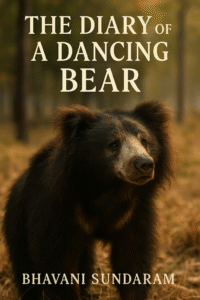
Introduction
Stories often begin with words.
This one began with silence.
It was a silence that carried across Indian highways, through dusty fairs and forgotten villages — the kind of silence that hides behind the sound of applause and the cry of an animal pretending to dance.
When I first read about the “dancing bears” of India — wild sloth bears captured as cubs, their muzzles pierced with hot rods, forced to perform on the streets for tourists and coins — I couldn’t sleep for nights. What haunted me most was not just their pain, but their endurance. Their eyes in those photographs were not angry. They were heartbreakingly patient.
I wanted to tell their story — not as an activist, not as a journalist, but as a listener.
Thus began The Diary of a Dancing Bear, a work of fiction rooted deeply in truth.
It is the imagined diary of one such bear — Bholu — who is taken from his forest as a cub, made to “dance” in captivity, rescued by kindness, and finally returned to the wild. Through his eyes, I wanted to bridge the impossible distance between man and animal — to show that pain, love, and hope are not exclusive to any one species.
Bholu’s voice came to me slowly — hesitant at first, then steady, then soaring. His story, though tragic, is also a hymn of redemption — for him, for those who hurt him, and perhaps for us as well.
This book is both a cry and a prayer:
A cry for compassion in a world that too easily forgets its own cruelty.
And a prayer that one day, no creature will have to dance for survival again.
I dedicate this novel to the people and organizations who worked tirelessly to end the centuries-old practice of bear dancing in India — and to every living being who has ever been silenced, yet still found a way to sing.
If you listen closely, you might still hear Bholu’s song — carried softly by the wind.
Acknowledgment
This book is dedicated to two extraordinary people with whom I had the privilege to work and from whom I learned immensely — Geeta Seshamani and Kartik Satyanarayan, the co-founders of Wildlife SOS, and to their remarkable team of doctors, rescuers, and volunteers.
Their tireless compassion, courage, and commitment to animal welfare have transformed not only the lives of India’s once-dancing bears but also the hearts of everyone who has witnessed their work.
Day and night, this team works selflessly to rescue, rehabilitate, and care for these magnificent creatures, giving them what every being deserves — a life of dignity, safety, and peace.
Their sanctuary in Agra, India, established in 1999, is today the largest sloth bear rescue facility in the world, housing nearly 89 rescued sloth bears. It stands as a living testament to what kindness and determination can achieve.
To Geeta, Kartik, and the entire Wildlife SOS family —
this book belongs to you as much as it does to Bholu.
Chapter 1 — The Beginning
I remember the taste of the first monsoon.
It was not the metallic tang of fear, nor the dry grit of the road. It was the cool, green weight of leaves after rain, the honeyed sweetness of mahua blossoms clinging to my tongue, and the river singing in a voice that matched my bones. I was small then — my belly a soft roll of brown fur, my paws still clumsy with play. Mother would lift me with the slow patience of a tree putting out shade; she knew every trail, every fruiting tree, every place the termites liked to hide. The world was a map made of smells.
We lived in the shade of sal trees and the high, watchful arms of teak. At dawn the forest exhaled mist; deer noses wavered, birds argued over the first mango. Mother taught me to find the sweetness beneath leaves, to listen for the low rumble of an elephant far away, to flatten myself into earth when thunder spiders fell from the canopy. Nights were stitched with our breaths and the soft, rasping songs of owls. I learned names without needing words: the rough-split scent of termite mounds, the bitter aftertaste of jackal berry, the way the soil smelled before rain.
My earliest memory is a sun-warmed log and my brother’s elbow pressed against my shoulder as he tried to climb too high and tumbled with a sound that made me laugh. My name — I had no human name then, only the weight of family and the turn of seasons. We were many: mother and I, a sister who loved to steal mangoes, two boisterous brothers. There was a rhythm to our days that kept everything honest: foraging, wrestling, resting, listening. We were not measured by value then. We were simply. We ate. We slept. We grew.
I never thought humans would ever be anything but shadows between the trees, quick sparks that came and went. The men who walked with backpacks were usually hunters, or the slow travellers the forest accepted as part of itself — a man with a flute, a woman with a basket of grain. None of them had cages.
Then the night came when the stars smelled wrong.
I woke to a noise like the pulling of a net. The forest smelled of smoke and of a metal I had never known: the hard, bright scent of iron. Our den, a place mother had padded with leaves, rang with sudden light. I climbed into Mother’s warmth and felt the world buckle. Men’s voices were a scraping, every one edged with sharp hunger. There were more of them than trees; their feet fell, and the earth answered with a thud that I felt in my ribs.
It happened quick as a falling mango. A loop of rope, rough against my skin, slid over my head and pinched. My brother lunged; Mother roared, and in that sound every memory I owned screamed. Then there was a strike — a hand that hit and did not shy away. A man’s shadow rose above us, and the next thing I knew, the forest had been cut.
They took us in a line. The rope bit into the tautness of my throat and the world narrowed to one hard star: the man’s face, black with a thousand small lies. He smelled of smoke and stale beer and the sweat of too many long days. He carried me like a bundle of grief, and my belly folded into itself as if I could fold back into the earth.
They kept us in a clearing for three days. The sky looked like a question mark. The men argued; sometimes they laughed in a way that made my teeth ache. Food came in scraps: the dry crust of chapati, a smear of ghee, the occasional sliver of meat wrapped in plastic. We were fed enough to be kept alive — not enough to thrive. My sister screamed when the men came too close. She did not sing again.
At night, one of the men — small, with a face like a bent twig — would come and poke at us with a stick. He wanted to see if we remembered how to obey. We remembered, because fear teaches quick lessons. Mother tried to stand between us and their questions. One of the men leaned close and spat something mean that I could not understand. His hand found the soft spot at the base of Mother’s neck.
I still remember the sound of her falling. It is a sound I have learned to hear in later nights: the slow, finalizing silence that arrives after something soft is broken. I was a cub, but I felt the old mathematic of survival — how one less heartbeat frees air for others. They dragged us into a cage that smelled of rust and old straw and human breath. We were stacked like bundles. The air inside moved like a trapped bird. I pressed my muzzle against the wires and tasted nothing but metal.
Later, when the world blurred and I dreamed of home, I would find myself returning to a single image: Mother’s paw, reaching for me through the bars, the moon painting it white. Her eyes told me to hide something in my chest: the small, stubborn light of remembering where I came from. She taught me, without words, that memory itself is a kind of resistance.
A man came in the morning who smelled differently — not of smoke and beer, but of the road. He had a cloth bag slung across his shoulder and a patchwork of noise trailing behind him: the clack of bells, the murmur of a stove, the laughter of children. He looked at us like one inspects coins and then, to my surprise, he did not look angry. He looked curious. He tapped the cage and whistled, and one of the others produced a small flute and made a sound that stilled my heart for a moment because it was so like the wind.
They took me with the man and the flute. He wrapped me in a blanket that smelled of home and grass and kept me on his shoulder like a child. His hands were not cruel; the rope at his waist was knotted with a strange tenderness. He spoke to me in a low murmur, strings of words I could not parse, but the cadence was gentle. He called to the children who followed him, and their faces were open like bowls.
We left the forest at dawn when the world was still a question. The men who came with us were not the hunters; they belonged to the road — a small travelling band, barefoot and laughing like a fire. They called themselves by the sound of the wind. They told stories in the evenings and roasted corn over a flame. The children, who had the bright hard eyes of folk accustomed to long distances, pressed their small palms against my fur as if testing whether it was real. One child — a girl who smelled of turmeric and sugar — gave me a scrap of mango and sang under her breath. Her voice soothed a place in me I did not know could be soothed.
We travelled like that for a while. The man with the flute taught me things by the fierce method of necessity. He would press the tip of a stick into the earth and expect me to do a motion with my paws. When I refused, the stick would come down and the world would narrow to a single, sharp line of pain. He taught me to raise myself on my hind legs, to sway with the music, to put my head into the hollow of his palm for the coin. He taught me the rule that would shape the rest of my days: there is always a price.
What I learned most quickly was the difference between hunger and want. Hunger is a stomach’s complaint; want is a throat’s burning where the world’s expectations live. The children in crowds would throw coins and laugh. The villagers pointed and took photographs that made me feel like a ghost in a glass box. Laughter poured over me like heat; sometimes it was kind, sometimes it was cruel, but it always asked the same thing: perform.
Every time I performed, a small part of my memory slipped. The trees began to recede, not only in distance but in the shape of my dreams. I began to forget the exact pitch of Mother’s humming. Sometimes, on market days, I would close my eyes and pretend I was a sapling taking root rather than a bear being coaxed to dance. That pretending kept a corner of me safe. I would breathe as if under a canopy and count my breaths: one, two, three. The numbers held me like stepping stones across a river.
There were nights when the men slept and a kind of silence came that was not like the forest. The air smelled of coils and cooking oil and old money. I would press my nose to the ground and try to find the scent of home, and sometimes, if the moon was kind, a breeze would carry the faint musk of wet earth and distant leaves. I would lift my face and weep without knowing why. The tears were not always for what I had lost. Sometimes they were for what I did not yet understand had been taken.
And yet, even in the smallness of my cage and the smallness of my life, there were flashes of warmth. A child offered me half a mango. A woman in a thin sari tied the edge of her dupatta into a knot and, when nobody was looking, slipped me a scrap of bread. Once, a boy stroked my flank for so long that his hand smelled of mango and he fell asleep with his head against me. He dreamed, and in his dream I was a thing that could carry someone’s heartbeat to sleep.
I kept the memory of Mother like a talisman. When the pain of the stick came, I would press that memory into my ribs and it would ease. When the crowd’s laughter wanted to hollow me out, I would count the names of the trees. I would remember the river’s cadence. These small things knit me into a creature who could endure.
The road stretched long and the tribe moved on, leaving behind markets and festivals and villages that thought themselves merciful for the sight of a dancing bear. They never asked me what I wanted. They measured me in coins and in the way the bell on my neck sounded when I turned. Each day ended on the same bitter note: another small humiliation, another coin, another day survived. And when the campfire dimmed and the children fell into sleep, I would press my face to the earth and stare at the stars until they blurred and rearranged themselves into a new constellation made only of loss.
If you ask me, now, what it felt like to be taken from the forest, I will tell you simply: it felt like learning an unfamiliar language in the dark. I learned it anyway, because that is what survival asks of you. But some nights, when the moon lays its head on the world, I still hear the river and the leaf-music, and for a moment the road fades and I am a cub again, and the forest is a thing that could be found if only I remember how to follow the scent.
That is how my diary begins — with the slow remembering of an ordinary light that was broken, and the stubborn smallness of hope, held like a seed against my ribs. The world I knew had been stolen, but the memory of it persisted, a small ember that would not go out.
Chapter 2 — The Trap
They tell stories of traps like they are clever things — a loop of rope, a bit of honey smeared on a branch, a hollow dug in the earth. In those stories the trap is simple and quick. The truth is messier. The trap is patience. It is the slow practice of learning your habits and then unmaking them. It is a season of waiting until you forget the rhythm of your own home.
After the men with the ropes took us, we were not shown the world all at once. They put us in a thicket of cages, one beside the other, and for a while the world narrowed to straw and wire and the dull bright of human eyes. The men moved like weather — sometimes they were stormy and sudden, sometimes they were patient, and in that patience the real danger grew. They fed us scraps and watched to see who begged first, who fought, who broke. They traded glances like children who have learned that owning things is a way to be safe.
There was a man among them who smelled older than the rest, whose face had the many cracks of maps. He had a slow way of looking, the sort of look that has learned to measure a life in the blink of an eye. He would press his thumb to the pads of my paws and say nothing. He took me aside one day and spoke to my keeper in that soft, crooked voice that respects a business already concluded. They spoke in words I could not hold, but I could hear the small shift — the price counted out, the clinking of coins, the trading of me from one hand to another like a good that could be carried.
When the new man folded me into his blanket and strapped me to his back, I thought of being taken away from the forest as a single wound. Later I would learn it was many small cuts stitched together. This man — not the hunter who had taken us in the clearing, nor the little troupe of road-people who first carried me — was different. He smelled of city dust and curry and a hard kind of need. His name, I would later hear, was Ganpat. He had hands that could break or soothe, and he chose them carefully.
We travelled in a cart that rattled like a mouth full of stones. The road sang in a way I could not forgive. Villages thinned then grew thick; the trees became smaller and the sky changed its way of leaning. People stared and laughed and sometimes spat at us as though we had dishonored them by existing loud. Children clapped at our cages. Dogs barked with the particular hate of city strays who see anything out of its place.
At night the men lit small fires and told stories that smelled of dried fish and old arguments. They drank and argued over routes and over the best way to make a bear “useful.” There were old maps pinned to their dreams: the fairs, the temple festivals, the market days where coins came thick and the crowd’s appetite for wonder was raw. They spoke of owners who had been ruined by a bad season, of wives who had left with a son and a string of unpaid debts. These stories were the soft shell inside which cruelty is bred — need, they said, need, and then the chorus of justification followed.
The first time they forced me to stand on my hind legs I thought the world had split its horizon. A boy — not much older than the children who had stroked my flank in the beginning — shoved a stick under my forepaws and yelled. The stick was a simple geometry of pain. It pushed me up and then pressed so that my shoulders held a new weight. When I resisted, the man with the cracked face would tap the stick with iron and the sound would wrap around my ears like a noose. I learned quickly that resistance cost more than aching bones. Resistance cost sleep. Resistance cost food.
They taught me methodically. They taught me to sway with the whistle of the flute that the troupe kept for this purpose, to drop my head into their palms, to hold my paw out in a way that seemed polite. The motions were small; the humiliation was vast. People called it dancing because they had no words for the other things — the fear, the hunger, the way the world had been recast as an object for the market.
There were days the men would strip the fur along my neck to sew a bell or a cord. They would grind herbs into the wounds to keep infection from slowing the business. I learned the human names for things I already knew — pain, commerce, calculation. I learned to read the moods of my captors: when the youngest smiled, the stick would be gentler; when the grey-faced owner drank too much, the stick bit harder.
I remember one market day because a child reached up and touched my mouth. It should have been tender; instead it felt like the moment before a storm. The child’s father laughed and slapped the boy’s hand away, and the laughter sounded like an auctioneer. Coins rained near my paws and the men counted them like a blessing. Every coin was a small erasure; every coin was a vote for my captivity.
At night, under tarpaulin and the half-glow of a lamp, the troupe spoke to me as though to a stubborn tool. But sometimes, late when their words thinned into snoring, there were softer moments. The youngest girl — Radha, who was no more than ten and had knees like broken things and a laugh that sometimes broke in the middle — would sit by my cage and tell me things.
She told me about the river she had never seen, about how her mother’s hands smelled of the laundry soap used in temple basins, and about a future she imagined that did not include the road. She dropped scraps of chapati like breadcrumbs of mercy. Her small hands combed the tangles from my fur. I cannot pretend such small mercies erase the larger wrong, but they are threads, and threads hold.
Radha once whispered a secret into my fur: “You must remember.” I could almost feel her voice nestle into the fibers of my skin like a seed. “Remember you are more than what they teach you. Remember the trees.” It felt shameful and glorious to carry that whisper away from her; it was a contraband that tasted of guilt and a strange new kind of comfort.
There were other nights that tasted like iron. The troupe’s fights were the kinds that made the ground tremble, and sometimes a hand would swing and find my ribs. Sometimes I was punished for nothing more than being slow to learn. Sometimes punishment had nothing to do with me at all — it was an argument that the men had about the price of rice, and my body was the ledger on which debts were settled. I learned not to ask for explanations. They are rarely given when one is owned.
Once, between two stations where the trees held their breaths, the troupe stopped near a temple fair that smelled of roast maize and lamp oil. The air was thick with incense and the kind of joy that arrives when many people gather to forget. They brought me out on a raised wooden platform, and the crowd came close, faces bright with expectation. A priest tossed a coin and the sound of it was the sound of a promise. The flute began to sing.
I danced because my body had become a map of conditioned responses. I did not know then that what I was doing had a name beyond its immediate demand; I did not know the word “performance” in the way the men did. My every movement was a duty extracted by pain or the suggestion of reward. The crowd laughed, some children wept with delight, a couple of young men recorded the show with their phones and never once looked me in the eye. The applause felt like a skinless thing that slid across me and left nothing in return.
That night, when the lamps were guttering, the cracked-faced man counted the coins with a slow satisfaction. He set aside a little for the children, a little to pay a debt, and kept the rest. Radha pressed her fingers into my fur and slept with her head against my side. In the dark, her breathing was a small metronome that made my ribs ache less. The trap had many forms: the rope, the stick, the bell, the coin. But the most dangerous of all was the way the world learned to look at me and see only what it required.
Even so, memory continued to burrow. Late at night I would close my eyes and see the river’s bend and the crooked mango tree where my sister used to climb. Sometimes, in the shade of illusions, I would pretend the cart’s rattle was the forest’s song and fall asleep counting the beats as if they were rain. In those invented moments I could still be the cub at play: rolling in the mud, tugging at a sibling’s ear, learning which fruits were bad. I would wake and the smell of tar and frying oil would batter me into recognition. The trap was not only in the rope around my neck; it was in the slow forgetting of how to be beyond usefulness.
I write this now with hands that remember the curl of mother’s paw and the shape of the river. The trap taught me many things: how to steady myself for a blow, how to make a man’s laughter feel like winter, how to find the smallest kindness and horde it like a last coin. But within that learning, underneath the scraping of rope and the teaching of pain, a seed of something stubborn sleeps — the stubbornness that Radha named and that my mother watered: the memory of a life that once was.
The trap holds, but a trap is not a prison until the prisoner believes there is nothing else. I do not yet believe that.
Chapter 3 — Chains of Sound
The first time they called it music, I thought they were joking.
It came from a flute that whined like a hungry bird — thin, trembling, and cruelly persistent. The man who owned it, Ganpat, called it his soul. He said the sound would make me dance. He said it with such faith that I almost believed him.
But to me, that flute was not music. It was a leash.
They began with smaller things.
A tug on the rope around my nose.
A whistle.
A word I could not understand.
The rope had a ring — cold and heavy, threaded through the tender flesh between my nostrils. I remember the moment it went in: the sting that became a scream, the scream that became silence. They called it training. I called it forgetting how to breathe.
They heated the ring on a coal before pushing it through. The pain was not a sharpness that came and went; it was an ache that grew and settled, like something alive, gnawing from inside. I remember trying to rub it off against the earth, scraping my face until blood mixed with dust. Ganpat shouted, pulled me upright by the rope, and blew into the flute until the air around me cracked with noise.
“See,” he told the others, “he listens already. The sound teaches him.”
The sound did not teach me. The pain did.
Each morning began with a pattern:
Flute.
Pull.
Step.
Pull.
Flute again.
When I failed, the stick came down. When I swayed, even from dizziness, the stick eased. And so, I learned to sway — not to dance, but to survive.
The others cheered him on. They called me “Bholu,” the dancing bear, as if giving me a name would make the cruelty smaller, more bearable. Bholu — a word meaning gentle, naïve. It was not who I was, but they needed me to be that: a harmless fool in a world of coins and cruelty.
“See how he moves!” Ganpat told the crowd in the marketplace. “He knows the rhythm of the gods!”
The people clapped. Children laughed.
And somewhere between one pull of the rope and another, I began to hate the sound of applause.
At first, I could still smell the forest on my own skin.
The faint sweetness of mahua, the musk of my mother’s fur. But day by day, the smell faded, replaced by smoke, sweat, and the metallic tang of iron. The city’s scent was thick and hot — a constant hum of dust, frying oil, exhaust, and human noise.
Ganpat would smear oil on my fur to make it shine, to make me look “presentable.” The children would reach out to touch me, and I would flinch — not from them, but from what they did not know they were part of.
I hated the flute most when it played in minor tones, when it sounded almost like the forest wind. For a heartbeat I would believe it — believe that I was back home, that my mother’s paw was resting on my shoulder, that the earth beneath me was real. Then the rope would jerk, and the illusion would break.
The flute’s song became the chain I could not see.
At night, when the world finally quieted, Ganpat would talk to himself. He’d drink cheap liquor and stare into the small fire. His voice softened, grew slow, almost human.
“Don’t hate me, Bholu,” he’d say, as if I could answer.
“I’m a poor man. You dance, I eat. That’s how the world works. We all dance for someone, don’t we?”
I didn’t understand his words then, but I understood the tone. It was the voice of someone who had made peace with his own cruelty.
He’d sometimes hum a tune — the same one he played for me — and fall asleep mid-verse, the bottle slipping from his hand. In those hours, I would watch the stars through the torn tarpaulin above.
Sometimes they looked like the eyes of other bears — watching, remembering. Sometimes, I imagined they were holes in the sky through which my mother peered down, searching for me. I wanted to tell her I hadn’t forgotten. That even though the rope had replaced her warmth, I still carried the sound of her heartbeat somewhere deep, under all the noise.
Once, after a long day of dancing under the scorching sun in a dusty roadside fair, Ganpat’s wife, Leela, came to me. She was younger than him, her hands calloused from washing clothes and cooking. She looked at me for a long moment — not with pity, not even with guilt, but with exhaustion.
She dipped a rag in cool water and pressed it gently against my snout, near the wound where the ring rubbed raw. I flinched, but she didn’t pull away.
“Poor thing,” she whispered. “You don’t even know why you suffer.”
Then, after a pause, she added softly,
“Neither do we.”
The road stretched endless.
Cities bled into towns, towns into villages, and each place had the same pattern — music, movement, money. Sometimes people gave sweets or garlands, but mostly they gave coins and laughter. Once, a boy threw a stone instead, shouting, “Dirty animal!” and everyone laughed harder.
I learned not to react.
Pain, after a point, becomes a language you no longer need to translate.
There was another bear once, tethered beside me durin a village fair. She was older, her fur thin, her eyes milky but kind. Her name was Tara, and her owner was rougher than mine. She had scars where her rope had cut deep.
At night, when our masters drank and the fires burned low, we would sit close, the air between us thick with quiet. Sometimes, if the wind carried the smell of fruit, we would both raise our heads at the same time — instinct, memory, yearning.
“I was born near Satpura,” she murmured once, her voice like a sigh. “We had rivers, Bholu. Do you remember rivers?”
“I remember,” I whispered back.
She smiled — a small, broken curve of lips and fur. “Then you still belong to the forest. Don’t let the music take that from you.”
That night, I dreamed of water for the first time in months.
They say every prisoner makes peace with his cage eventually.
That’s not true.
We only learn how to stop bleeding.
I didn’t stop dreaming of freedom.
I only stopped believing I would see it again.
But something in Tara’s words lingered, like a scent that refuses to fade.
“Don’t let the music take that from you.”
So I began to fight — not with claws, not with teeth, but with memory.
Every time the flute played, I would close my eyes and imagine another song:
the rustle of leaves, the hum of bees, the sigh of my mother as she slept.
That was my rebellion.
Silent, invisible — but mine.
And one day, long after Tara was gone, a different kind of music came — not from a flute, but from a voice that did not belong to my captors.
A voice soft and clear as rain.
A girl’s voice.
Calling from beyond the crowd, camera in hand, eyes full of something I hadn’t seen in years — sorrow.
But that, as they say, was another story.
Chapter 4 — The Man with the Flute
They said the flute was his fortune.
Ganpat carried it the way a priest carries a god — reverently, carefully, like it held the secret of his survival. It was carved from bamboo, smooth from years of hands and spit and sweat. When he blew into it, the air itself seemed to obey him.
To the crowd, that flute was magic.
To me, it was the sound of my captivity.
We were in a small temple town in Uttar Pradesh, where the dust never settled and the air smelled of ghee, incense, and burning oil. The festival of lights had begun — stalls selling sweets, plastic toys, and gods made of clay lined the streets. Children ran barefoot, their laughter rising like smoke. Somewhere, the temple bell clanged every few minutes, echoing through the chaos like a heartbeat trying to be heard.
Ganpat stood at the edge of the fair, his chest puffed like a drum.
Leela held the basket for coins.
The flute rested at his lips.
When he played, I felt my body move before my mind agreed.
The rope tugged.
The rhythm returned.
Sway.
Lift.
Turn.
Bow.
The crowd clapped, the coins fell, and I — the bear they called Bholu — danced in the square, a parody of joy.
It was then I saw her for the first time.
A girl with a camera — young, maybe twenty, wearing jeans and a kurta, her hair tied back but coming loose with the wind. She wasn’t laughing like the others. She was watching.
Not the performance — but me.
Our eyes met once, and in that single moment, something shifted.
Her gaze didn’t look at me. It saw me.
She lowered her camera, as if ashamed. Then, hesitantly, she raised it again and took a picture. The click of that camera — that small, mechanical whisper — felt louder than the flute.
After the crowd dispersed, she approached Ganpat.
He wiped his flute on his kurta and smiled the smile he used for strangers with shoes.
“You are the owner?” she asked in Hindi, her tone calm but firm.
“Owner? No, no, behenji,” he chuckled. “He is my family! My child. We work together. He dances, people are happy. God blesses everyone.”
Her eyes darkened. “You mean he suffers, and you earn.”
Ganpat’s smile faltered for a moment. “You city people don’t understand,” he said, his voice dropping. “What will we eat if he doesn’t dance? You’ll give us work?”
The girl — her name, I would later learn, was Ananya — said nothing. She just looked at me.
Her lips trembled slightly before she spoke again.
“I’ll make sure you don’t have to dance anymore.”
Ganpat laughed, but uneasily. “They all say that, madam. But no one ever returns.”
Ananya did not laugh. She took another picture, this time of the ring in my nose, the rope, the welts along my chest.
Then she turned and walked away.
For days after that, I felt something strange. Hope — that small, dangerous ember — flickered inside me.
Ganpat noticed the change. He grew harsher.
The rope tightened.
The stick came more often.
“Dance, Bholu,” he hissed. “You’ve grown lazy. Don’t forget — we both die if you don’t.”
I didn’t understand his words, but I understood his fear. The crowds were smaller now. People didn’t give as much. Perhaps they were changing too. Perhaps Ananya’s eyes had reached others.
But for Ganpat, change meant hunger. And hunger turns even pity into cruelty.
One night, under the cold, cracked moon, Leela came to me again. She was silent for a long time, just sitting near the dying fire. Then she said quietly,
“That girl came back.”
I lifted my head.
“She came with two men — said they were from some organization. Wildlife… something.” Leela sighed. “They asked questions. Ganpat sent them away, said you were his. But they said they’ll come again.”
She looked at me the way one looks at a child one cannot protect.
“I don’t know what’s right, Bholu. Maybe freedom. Maybe death. But whatever comes, may it be kinder than this.”
She reached out and touched my paw, once — gently.
The days that followed were thick with tension. Ganpat stopped sleeping well. He drank more, played the flute less. The flute’s sound — that old, terrible chain — grew rarer, replaced by muttering, arguments, and fear.
The troupe avoided us. They had heard rumours: the government was banning dancing bears, that the Wildlife Protection Act was being enforced, that people were being arrested.
For me, the news was wind — invisible, distant. But I could smell change coming, the way a forest smells rain before the first drop.
And then one afternoon, as we prepared to leave the fair, a white jeep rolled up the dusty road.
Inside were men in uniforms — forest officers — and behind them, Ananya.
The world turned to chaos.Ganpat shouted, Leela cried, people gathered. The officers argued, papers waved, voices rose. I didn’t understand the words, but I understood the fear.
One of the officers approached me. He had kind eyes and spoke softly, “Don’t worry, friend. We’re here to take you somewhere safe.”
I wanted to believe him, but after years of ropes and flutes, “safe” was not a word I trusted.
When they cut the rope from my snout, I flinched as though struck. My body, trained for punishment, braced for pain that didn’t come. The air on my face felt strange — raw, unfamiliar.
Ananya stood nearby, tears streaking her face.
She whispered something — too soft for the others to hear.
“You can stop dancing now.”
That night, for the first time in years, I slept without a rope around my neck.
The stars above the rescue truck were unfamiliar, but vast — a forest of light.
Ganpat stood by the roadside as we drove away. His flute hung limp in his hands. He looked smaller than I’d ever seen him.
I didn’t hate him in that moment.
I just felt something deep and tired inside me whisper, Let him learn silence.
That was the last time I heard the flute.
But its sound stayed with me — not as music anymore, but as memory.
And sometimes, even now, when the wind moves through the trees in just the right way, I think I hear it again — only softer, sadder.
Not a command.
A confession.
Chapter 5 — The Last Dance
Morning came with a strange quiet.
No flute. No shouting. No crowd. Only the sound of the cart wheels creaking and the wind whispering through dry grass. It felt like the world was holding its breath.
Ganpat had not spoken all night. He sat near the fire, his eyes hollow, the flute lying beside him, untouched. Leela moved like a shadow — wordless, efficient, as if preparing for an ending she didn’t want to name.
I could feel the tension, heavy and invisible, like a rope that hadn’t been tied yet.
The air itself seemed to know: something was about to break.
By mid-morning, the troupe was gone. The festival had moved on, the traders had packed their wares, and only the dust remained — the kind of dust that settles over endings.
We stood near the old banyan tree by the roadside. The same spot where I had danced a hundred times before.
Ganpat looked at me — not like a master looks at an animal, but like a man looks at something he is about to lose forever. His eyes were bloodshot. His shirt was torn. In his hand, the flute trembled.
“Once more,” he whispered. “Just once more, Bholu.”
The words were not an order. They were a plea.
He looked toward the horizon, where a white jeep shimmered in the distance. The forest officers. The NGO van. They were coming.
“Let them see,” he muttered. “Let them see what we are without this. What they’re taking away.”
He lifted the flute to his lips.
The sound that came out was cracked, unsure, like the dying breath of an old habit. I felt the air tremble against my fur, and my body — trained for years to obey that sound — began to move.
But this time something inside me resisted.
I swayed once, awkwardly, my limbs heavy. The rope hung loose around my neck, no longer tied to anything.
Ganpat blew harder, desperate.
His music turned frantic, shrill.
I stood still.
He shouted, “Dance, Bholu!”
The stick flashed in his hand — but he didn’t strike.
He just held it there, frozen. His lips quivered. The flute fell to the ground.
For the first time, I saw tears on his face.
The jeep stopped beside us.
The officers stepped out.
Ananya followed, carrying a small metal box and a camera around her neck.
“Ganpat,” said one of the officers, “it’s over. You know the law. We’ve spoken to you before.”
Ganpat didn’t answer. He just stared at me — and then at the flute lying in the dust.
Leela stepped forward. Her voice broke as she said, “Take him. Please. Before my husband breaks completely.”
The officer nodded. Two men approached me slowly, their hands steady, their voices calm. I didn’t struggle. Something in their smell — clean, earthy, like the forest after rain — told me this was different.
One of them cut the rope from my nose. The old wound opened slightly, but the pain was softer this time. A wound remembering it could heal.
They covered my eyes with a cloth and led me to the truck. I heard the hum of an engine, the shuffle of papers, the low murmur of voices.
And then — a sound that startled me.
The flute again.
But not from Ganpat.
From Ananya.
She held it carefully, then — with quiet finality — snapped it in two.
The sound of the breaking was small, but in it was everything: the end of a life built on pain, and the fragile beginning of another built on mercy.
As the truck pulled away, I turned my head once.
Ganpat stood where I had danced so many times before. His hands were empty, his eyes lost. Leela stood beside him, holding his shoulder, both of them shrinking in the rearview mirror until they became part of the dust and sky.
For a long time, I could still hear the echo of the flute — not as music, but as a ghost.
Inside the truck, it was quiet except for the hum of the road.
The men spoke softly to each other. One of them offered me water from a bowl. I hesitated, then drank. The water was clean — cold against my tongue, startling in its honesty.
Ananya sat beside me, scribbling notes, wiping her eyes every few minutes. When she caught me watching her, she smiled — a trembling, uncertain smile.
“It’s all right now,” she said softly. “You’re going home.”
Home.
The word felt too big. Too beautiful.
Could there still be such a thing for me?
That night, they stopped near a forest outpost. The men made a small fire, shared tea, and watched me with the cautious tenderness of people trying not to frighten a ghost.
Ananya sat nearby, writing in her notebook by lantern light.
Every so often, she would look up and whisper, “Almost there, Bholu. Tomorrow you’ll see trees again.”
Trees.
The word shivered through me. I had forgotten what that meant — to stand under something that gave shade without asking for anything in return.
At dawn, I smelled it first — long before I saw it.
The sharp sweetness of wet leaves, the hum of insects, the faint musk of earth alive.
The forest.
Not the forest of my childhood — smaller, fenced, quieter — but still a world that breathed.
They called it a sanctuary.
For me, it was a resurrection.
As they opened the cage door, I hesitated. The sunlight looked too vast, too bright, like freedom itself was a thing that could burn.
Then I stepped out.
Grass brushed against my paws.
The earth gave beneath my weight, soft and welcoming.
I could hear birds — real ones, not trapped for show — and somewhere, water running.
My nose twitched. My heart trembled.
Behind me, I heard Ananya’s voice whisper, “Go on, Bholu.”
And I did.
I didn’t look back.
Not at the truck, not at the broken flute, not at the life I’d left behind.
Every step forward hurt — but it was a new kind of pain. The kind that comes from healing.
Somewhere in the distance, another rescued bear called out — deep, throaty, wild. I answered.
The sound was not music.
It was freedom.
Chapter 6 — The Sanctuary
The first thing I learned about freedom is that it doesn’t feel like joy.
It feels like confusion.
When the gate of the cage opened, I did not rush out, as they might have expected. I hesitated. The open space frightened me. There was too much air, too much sky, too many sounds I could not name. My world until that moment had been measured by ropes, sticks, and flutes. Freedom had no edges, and I did not yet know how to live without edges.
The sanctuary was green — not the wild, endless green of the deep forest I remembered, but a softer, safer kind of green. Fences in the distance, trees in tidy clusters, pools of water shimmering under filtered sunlight. The air smelled of wet soil and fruit. It was heavy with the hum of insects and the sighing of leaves.
The humans called it The AGRA BEAR RESCUE FACILITY.To me, it was a place of noise and kindness in equal measure.
There were other bears there — many like me. Some limped, some blinked through one eye, some had deep scars across their snouts where the ropes had bitten too long. A few were younger, still trembling, still waking in the night to phantom flutes.
When I first entered, they watched me quietly. Bears, like humans, can smell fear. And I was drenched in it.
The man who greeted me was called Dr. Ravi, the chief vet. He spoke gently, always slow, as though each word needed to earn my trust before landing. His hands smelled of antiseptic and bananas — a strange combination that meant both healing and food.
Beside him was Meera, the caretaker assigned to me.
She had kind eyes and a voice like the forest after rain.
She did not try to touch me immediately. She simply sat a few feet away, humming softly, writing notes in a small, brown book.
Her scent was calm. Her silence was better than pity.
That night, when she left, I found myself watching her walk away — her figure small against the lantern light, her shadow stretching like a promise.
The next morning began with a ritual of strange mercies.
They cleaned my wound. The old ring, rusted and ugly, was gone — but its memory pulsed beneath the skin. Meera spoke to me the entire time, not expecting answers.
“It will hurt for a bit,” she said softly. “But only for a little while. Then it will stop.”
Pain that promised to end — I didn’t know such a thing existed.
They applied balm. The smell was strange — herbal, sweet. For the first time in years, pain didn’t feel like punishment. It felt like care.
For the next few days, I was quiet. I didn’t eat much. I idn’t sleep much either. The sanctuary was full of sounds I didn’t understand — the squeak of gates, the chatter of staff, the laughter of visitors who came to volunteer.
But at night, when everything went still, the forest behind the fences began to breathe.
Crickets.
Owls.
The whisper of leaves in wind.
I found myself pressing my nose against the earth, closing my eyes, and remembering the forest of my cubhood. The scent wasn’t the same, but close enough. Close enough for healing to start.
One evening, Meera came with something wrapped in a banana leaf.
“Banana and honey,” she said, placing it gently on the ground near me. “Dr. Ravi says it helps with the throat.”
I looked at it suspiciously. For years, every gift had come with pain.
She waited.
Did not move closer. Did not rush.
After a long while, I stepped forward and tasted it. Sweet.
The flavor burst across my tongue — sticky, warm, alive.
Meera smiled. “Good boy, Bholu,” she whispered.
The sound of my name no longer hurt.
Days passed. Then weeks.
Routine replaced fear.
Morning walks inside a fenced forest area.
Feeding time — fruits, porridge, sugarcane.
Checkups. Playtime. Quiet.
I began to see the other bears not as strangers but as mirrors. Each of us carried stories written in scars. We didn’t need words.
When one of us roared at night — in pain or in memory — the others would respond, a low, rumbling chorus of reassurance.
Freedom, I learned, isn’t the absence of fear. It’s the space to heal from it.
Ananya visited once every few weeks.
She came with notebooks and a camera, talking to Dr. Ravi and Meera, taking pictures — not for a newspaper now, but for a book she was writing.
She always came to see me last.
She would sit cross-legged outside the enclosure, talk to Meera, and then quietly say, “Hello, Bholu.”
Sometimes she brought fruit, sometimes she just sat. Once, she read aloud — something from her journal.
“I used to think I was saving you,” she said one afternoon. “But I think you’re saving me. I see you learning to live again, and it makes me want to do the same.”
Her voice trembled, but she smiled.
Humans, I realized, carried their own invisible ropes.
One evening, after months of routine, Meera opened the small gate to the larger, semi-wild section of the sanctuary.
She looked at me and said softly, “It’s time.”
I hesitated.
Old habits clung like ghosts.
Freedom, even after healing, still frightened me.
Meera nodded, as if she understood, and took a step back. “You don’t have to go today. But when you do, it will be yours. Not because we told you. Because you choose.”
She left the gate open.
That night, I couldn’t sleep. The forest beyond the gate whispered to me — the sound of leaves, the hum of crickets, the faint call of another bear.
Near dawn, as the first light broke through the canopy, I walked forward.
Through the open gate.
Into the forested enclosure.
The earth felt cool and alive beneath my paws.
I heard Meera’s voice faintly behind me, whispering,
“Go on, Bholu. You’ve earned it.”
In the forest clearing, I found a pool of still water.
When I looked into it, a bear stared back — older, scarred, but free.
For the first time, I didn’t see a captive creature.
I saw someone who had survived everything meant to destroy him.
And as I stood there, the wind moved through the trees — a soft, haunting tune that almost sounded like a flute.It wasn’t a command. It was a song. My song.
Chapter 7 — The Girl Who Stayed
Ananya didn’t plan to stay.
When she first came to the Agra Bear Rescue Facility, it was meant to be for one article — a story for her digital magazine about “rehabilitated wildlife.” She was supposed to take notes, shoot a few photographs, get her quotes, and leave.
But life has a strange way of rearranging itself when you come face to face with something raw and unguarded.
And Bholu — the bear who had stopped dancing — became her rearrangement.
After that first visit, Ananya couldn’t sleep. She kept seeing his eyes — dark, heavy, quiet with history. They haunted her in the way truth does when it refuses to let you rest.
She returned the next weekend. Then again. Then again.
At first, she came as a journalist. Notebook in hand, recorder in her bag, neat questions prepared. But the questions never made sense anymore. How do you ask a creature who has been beaten into obedience, “How do you feel now that you’re free?”
Freedom doesn’t translate into language. It breathes. It limps. It heals one cautious step at a time.
And so, slowly, Ananya put away the camera.
And picked up a broom.
Dr. Ravi smiled when she showed up one morning, hair tied back, sleeves rolled up.
“You’re back?” he said, amused. “No story this time?”
“No story,” she replied. “Just… work.”
Meera, who was stacking buckets nearby, raised an eyebrow but said nothing. She handed Ananya a broom, a pair of gloves, and pointed toward the enclosures. “Start with sweeping. The bears won’t mind as long as you don’t stare too long.”
And just like that, the girl with the camera became the girl with the broom.
Days blurred into a rhythm of work and silence.
Cleaning enclosures, chopping fruits, checking fences, carrying water. The labor was physical, grounding. At night, her hands smelled of bananas and disinfectant; her clothes were streaked with mud. But her heart felt steadier.
Meera taught her how to move among the bears — not as a savior, but as a presence.
“Don’t talk too much,” Meera said. “They understand tone, not words. Just be calm. They can smell your intentions.”
It took Ananya weeks to understand what that meant. She used to think empathy was a feeling. Here, it was a scent. A rhythm. A shared breath.
Bholu, meanwhile, watched. From his favorite spot under a tamarind tree, he would lift his head when Ananya came with the food cart. At first, he stayed distant, cautious. He had learned that humans who smiled could still hurt.
But Ananya never rushed. She placed the fruits — papaya, sugarcane, honey cubes — near the feeding zone and stepped back.
Sometimes she talked softly. Not to him, but near him.
Little fragments of her own thoughts.
“I quit my job,” she murmured one afternoon, tossing a banana gently over the fence. “My editor said I’m wasting my time here. Maybe I am. But… this feels like the first honest thing I’ve done.”
Bholu tilted his head, watching her carefully, then went back to eating. But that evening, for the first time, he didn’t retreat when she lingered nearby.
Weeks turned into months. The sanctuary’s rhythm became her own.
She learned to read the moods of the bears — how Tara’s namesake (a new rescued cub they named after the late one) hid food in corners; how the old male, Ketu, liked scratching against the bark at dawn; how Bholu now walked with a slow, proud grace, no longer flinching at every sound.
She also learned the quiet rituals of Meera — her chai breaks at sunrise, her habit of talking to the bears as if they were children, her unspoken sorrow for the ones that didn’t survive.
“Every bear teaches us something,” Meera said one evening, as they watched Bholu by the pond. “Some teach us endurance. Some teach us patience. He,” she nodded toward Bholu, “teaches forgiveness.”
Ananya nodded, though she wasn’t sure forgiveness was possible. She still burned with anger when she thought of the men who had kept him chained, who had pierced his nose, who had made him dance for coins.
But Meera’s words stayed with her.
Forgiveness wasn’t forgetting.
It was freedom from hatred.
One morning, during feeding, something remarkable happened.
Ananya placed the food as usual, then stepped back.
Bholu approached, sniffed the fruits, and then — without hesitation — looked up at her and made a low, throaty sound.
Not a growl. Not a warning. A rumble — deep, resonant, soft.
Dr. Ravi, passing by, smiled.
“He’s talking to you,” he said. “That’s how they show recognition — and comfort.”
Ananya froze, her throat tightening.
“Does that mean he…”
“It means,” Meera interrupted gently, “he knows you are not a stranger anymore.”
That night, Ananya couldn’t write.
Her notebook lay open, the pen unmoving.
For years, she had written stories about injustice, cruelty, and rescue — always as an observer. But now, for the first time, she realized she was part of one.
Not as a journalist.
As a witness.
As someone being healed, alongside the one she’d saved.
In the weeks that followed, she began helping Dr. Ravi with small medical routines — cleaning wounds, administering vitamins, checking paws for infection. The work demanded patience and steadiness.
One day, while cleaning Bholu’s enclosure, she found the broken remnant of his old rope half-buried in the mud — frayed, stiff, still stained.
She held it for a moment, feeling its coarse texture, and then carried it to Meera.
“What do we do with this?” she asked.
Meera took it, looked at it for a long moment, then tossed it into the fire pit.
“We let it burn,” she said. “So the past knows it’s over.”
The rope curled in the flames, blackened, and turned to ash.
For the first time, Ananya didn’t feel anger. She felt peace.
By the end of the year, the sanctuary felt less like a place of recovery and more like a home — a quiet community of wounds learning to coexist with wonder.
Bholu, now stronger, spent his days swimming, foraging, and sometimes sitting near the water’s edge where the trees were thickest. Meera joked that he was “writing his own book now — one pawprint at a time.”
Ananya laughed, but deep inside, she knew it was true.
His story wasn’t over. It had simply changed authors.
One evening, as the sun dipped behind the forest and the sky bled orange, Ananya sat near the enclosure with Meera.
“You’ll go back to the city someday,” Meera said quietly.
“Maybe,” Ananya replied. “But even if I do… I think a part of me will always stay here.”
Meera smiled knowingly. “That’s what they do, these bears. They make you stay, even when you leave.”
They watched as Bholu walked down toward the pond, the wind ruffling his fur, his silhouette framed by trees.
He paused once, turned his head slightly — just enough to catch their eyes — and then continued into the forested dusk.
That night, in her journal, Ananya wrote:
“He doesn’t dance anymore. But when he walks, the earth moves with him. Maybe that’s what freedom really is — not the absence of pain, but the grace to keep walking through it.”
Chapter 8 — The Mirror in the Lake
Morning in the sanctuary arrived with a kind of music that asked for silence.
The mist floated low across the trees, the air heavy with the scent of wet soil and guava. Parakeets chattered somewhere above, and the first light of dawn spilled over the hills like milk being poured over stone.
For the first time in months, I — Bholu — woke without fear.
No rope.
No stick.
No command.
Only the weight of my breath and the rustle of leaves that whispered, You are still here.
That morning, Meera opened the small gate between the feeding ground and the larger enclosure that bordered the lake. She smiled at me through the mesh.
“Go on, Bholu. Today you can see the water.”
Her tone was light, but her eyes held something else — a quiet understanding that this moment mattered. She had watched me heal day by day, but healing is not a single act. It’s a long remembering.
And today, I was going to remember what water looked like when it didn’t come from a rusted bucket.
The path to the lake was lined with wild grass and lantana flowers. The air was cool, alive. My paws pressed into soft earth, leaving impressions that filled with dew. I walked slowly, unsure, every sound too big, every smell too new.
The wind carried the scent of water before I saw it — clean, deep, ancient.
And then, through the trees, it appeared.
A lake.
Still, wide, wrapped in green silence.
I froze at the edge. The surface shimmered faintly, holding the sky like a secret. Birds danced across it, dragonflies hovered, and somewhere in the distance, a peacock called — long and low, like a memory returning.
I stepped closer.
The reflection came slowly — a ripple, a shadow, then a shape.
At first, I didn’t recognize the creature staring back.
The fur was uneven. The muzzle scarred. The eyes, once wide with fear, now deep with something else — a strange, calm sadness.
Was this me?
I leaned closer until the water trembled with my breath. The ripples distorted the face — now whole, now broken, now whole again. For a long moment, I watched it without moving.
In the forest of my childhood, my mother had shown me my reflection once — in a rain puddle. I was small then, and the water had shimmered with life. I had pawed at it, giggling in my bear way, fascinated by the stranger beneath the surface.
Now, the reflection carried the weight of years.
The cub was gone.
The dancer was gone.
Only the survivor remained.
And somehow, that felt enough.
Behind me, I heard footsteps.
Meera.
She didn’t speak. She stood quietly a few feet away, holding her notebook, watching as I studied myself. She understood that this was not her moment to fill.
After a long silence, she said softly, “When they first brought you here, you wouldn’t look at your reflection. Most of them don’t. They think it’s another bear — another threat. But you know, don’t you?”
Her words floated gently over the water.
“I think you finally see yourself.”
I turned my head slightly, just enough for our eyes to meet through the morning haze. She smiled, small and warm, the way only someone who has waited a long time can smile.
Ananya joined her a moment later, her camera hanging loose around her neck. But this time, she didn’t lift it.
She stood beside Meera, quiet, reverent.
“He’s changed,” she whispered.
“No,” Meera replied. “He’s just remembering.”
For a while, the three of us stood there — woman, bear and woman — bound not by words but by silence. The kind of silence that speaks of forgiveness, of beginnings, of something sacred that doesn’t need to be named.
A breeze passed. The surface of the lake rippled, and my reflection dissolved into light. I watched it fade — and I didn’t feel fear. I felt freedom.
Later that day, Meera wrote in her log:
“Bholu spent the morning near the lake. Calm, alert, reflective. He looked at himself for a long time. When the breeze broke the surface, he didn’t move. He just kept watching.
It felt like a ceremony no one planned — the bear meeting himself again. The past and present in the same frame, breathing.”
Ananya read the note and added quietly,
“Sometimes, healing doesn’t roar. Sometimes, it just looks back and nods.”
That evening, as dusk gathered, I returned to the lake once more. The water had turned the color of copper. Fireflies shimmered like sparks in the tall grass. I drank slowly, tasting something beyond thirst — a sweetness that came from knowing I belonged to no one.
Above me, the first stars blinked awake.
I looked into the water again.
The reflection that looked back was neither captive nor free — just alive.
Chapter 9 — Letters from the Wild
The idea began with a silence.
Meera had been sitting by the lake, watching Bholu for nearly an hour. He had taken to spending his mornings there now — still, contemplative, as if listening to something only the forest could say.
She carried her notebook, as always. It had once been meant for reports — observations, feeding logs, behavioral notes — but somewhere along the way, it had become something else.
She had begun writing for him.
Not about him.
That morning, as the light rippled across the water, she whispered softly,
“Maybe you have stories too, Bholu. Stories I should write down before they disappear.”
The bear didn’t move, but his ears flicked once, and that was enough.
So she opened her notebook and wrote, not as Meera, the caretaker — but as Bholu, the dancing bear who had stopped dancing.
She called it Letters from the Wild.
Letter One — “To the Trees I Remember”
You do not know how much I missed your shade.
I remember how your leaves whispered secrets to the wind. How your roots were strong enough to hold my childhood. The men who took me away did not know that when they pulled me from the forest, they also carried your memory in my fur. I carried it like a seed. It slept through years of ropes and roads. Now that I am back under your branches, I can feel it sprouting again.
You never stopped waiting for me, did you?
When Meera read it aloud to Ananya that evening, the younger woman’s eyes filled with tears.
“It sounds like he’s really speaking,” she said quietly.
Meera smiled. “Maybe he is. I’m just writing what he’s telling me — in the way silence speaks.”
Letter Two — “To My Captor”
You told me I danced because you played the flute. You said I was your family, your fortune, your fate. But I danced because I feared the stick, not the song. I moved because pain has a rhythm of its own.
I do not hate you now. I am learning the kind of forgiveness that does not forget. You were chained too — by hunger, by ignorance, by a world that taught you survival meant cruelty.
Still, I wish you could see me now — walking without a rope, breathing without orders. Maybe then you would understand what music truly sounds like when it doesn’t come from pain.
Ananya added this one to her growing manuscript — a book she was now co-writing with Meera.
She titled it “The Diary of a Dancing Bear”.
Not as fiction.
Not as journalism.
But as testimony.
Letter Three — “To the Girl Who Stayed”
You took my picture once. I remember the sound — a small click that froze my suffering into a story. That sound frightened me more than the flute. But now I understand.
You didn’t capture my pain. You witnessed it.
When you put away your camera and picked up the broom, I saw something change. You stopped seeing me as a headline and started seeing me as a heartbeat. I don’t know if you came here to save me, or if we both came here to save each other. But now, when you sit near the fence and hum softly, I think the forest listens too.
Weeks passed, and Meera’s “letters” became part of the sanctuary’s rhythm.
Every Sunday evening, she would sit by the pond and write another one — always in Bholu’s imagined voice, always beginning with “Dear…”
The volunteers started reading them. Then visitors. Then, eventually, strangers online when Ananya began sharing them through her articles.
And something unexpected began to happen — people listened.
Children wrote in, asking to “adopt” rescued bears. Schools collected donations. Artists painted murals of dancing bears no longer in chains. A small wave of awareness rippled outward, carried by words that were never meant to be propaganda — only truth.
Bholu had become a storyteller.
Letter Four — “To Myself”
There was a time when I hated mirrors. The face that looked back carried too many scars, too many yesterdays. But today, when I look into the lake, I see something new.
I see the same eyes — only calmer.
The same scars — only softer.
The same heart — only freer.
If healing means remembering without hurting, then perhaps I am healed.
Ananya closed the notebook gently after Meera read that one aloud.
They were sitting together by lantern light, the night thick with the sounds of the wild.
“He’s teaching us,” she whispered.
“Teaching us how to be human again.”
Meera nodded, her face illuminated by the golden glow. “Maybe that’s what all of this was for — to remind us that cruelty can end, and kindness can begin again, even after everything.”
The letters continued — not for the world, but for themselves.
Sometimes, when the sanctuary was quiet, Meera would read them aloud near Bholu’s enclosure. He would lift his head, blink slowly, and listen.
She never knew how much he understood.
But she liked to believe he did.
And sometimes, when she closed the notebook, he would rumble softly — that deep, low sound that once meant fear but now meant peace.
Like a bear’s version of “thank you.”
That night, Ananya wrote her own letter in her journal — one she never showed anyone.
Dear Bholu,
You taught me that silence can speak louder than speeches. That survival is not the end — healing is. You made me believe again in small, ordinary miracles — a clean lake, a full belly, a night without fear.
You were never just a story. You were the reason I remembered who I am.
And in the dark, on the other side of the fence, the bear slept — the air around him humming with crickets, the night soft with memory.
For the first time in a long, long time, both the human and the animal dreamt of the same thing.
Not of the past.
Not of the chains.
But of tomorrow.
A tomorrow that belonged to them both.
Chapter 10 — Steps Without Strings
Freedom doesn’t come all at once.
It arrives in fragments — a longer walk today, a deeper breath tomorrow, a day without the old fear hiding behind shadows.
For months after the letters began, Bholu’s world grew wider in quiet, imperceptible ways. The fences that had once felt like protection now seemed like distant edges of a dream. He had learned to walk without glancing over his shoulder, to eat without waiting for permission, to rest without the panic of rope burns.
But real freedom — the kind that exists beyond walls, beyond caretakers, beyond even kindness — still waited somewhere ahead, like a horizon he could smell but not yet touch.
That morning, the forest smelled of new rain.
The air shimmered with a fine mist that made every leaf glisten like it was made of glass. Meera stood by the gate with her usual clipboard, but her smile was different today — soft, uncertain.
“Bholu,” she said quietly, “today you walk without strings.”
Ananya stood beside her, camera hanging but unused. She didn’t photograph this moment. Some moments are not meant to be captured — only lived.
The sanctuary’s staff had decided it was time.
Bholu was strong, healthy, calm — the perfect candidate for semi-wild rehabilitation. It didn’t mean complete release into the wild — too much of the forest had changed, too many dangers waited. But there were large forest tracts connected to the sanctuary, spaces without fences, where the bears could live freely under observation — no cages, no visitors, no human hands.
It was as close to the wild as possible.
A bridge between captivity and destiny.
And today, Bholu would cross it.
Meera approached the gate, her hand trembling slightly as she unlocked it.
Ananya whispered, “Are you ready for this?”
Meera smiled faintly. “It doesn’t matter if I am. He is.”
The lock clicked open — a small sound, almost insignificant, but it carried the weight of an entire life.
The door swung outward.
Wind rushed in, carrying the scent of earth and open sky.
Bholu stood still at first, sniffing the air, head tilted. The forest ahead was alive — buzzing, whispering, vast. It called to something deep inside him, something that had been waiting all this time.
He stepped forward once — then stopped and looked back.
For a heartbeat, his gaze met Meera’s.
In that moment, she saw everything:
The cub he once was.
The dancer he was forced to be.
The survivor he had become.
And now — the free being he was meant to be.
Tears slipped down her face, but she didn’t move. She whispered, barely audible, “Go, Bholu.”
He blinked slowly, as if to say thank you, and then turned toward the forest.
The tall grass parted around him.
The earth softened under his weight.
And for the first time in his life, he walked with no rhythm but his own.
Ananya placed her hand on Meera’s shoulder. “You did it.”
Meera shook her head. “No, he did.”
They stood there long after he disappeared into the trees. The air felt different now — lighter, but also lonelier.
Ananya finally said, “Do you think he’ll come back?”
Meera smiled faintly through her tears. “If he does, it’ll be because he wants to — not because he has to.”
For days afterward, Meera couldn’t stop thinking about him.
She would walk by the empty enclosure and find herself looking for a flicker of movement in the trees. The sanctuary felt quieter without him — not emptier, but as if it was holding its breath in respect.
The staff left fruits and honey near the boundary forest, just in case. Sometimes, they found pawprints — large, familiar — pressed into the mud by the lake.
Dr. Ravi called it a good sign.
Meera called it a letter without words.
One evening, a week later, Meera and Ananya sat near the old pond, the same place where everything had begun. The sky was bruised with purple and gold; the air hummed with the chorus of crickets.
“He’s out there somewhere,” Ananya murmured. “Do you ever… miss him?”
Meera smiled. “Every day. But that’s the point, isn’t it? Love that holds on too tight becomes another kind of cage.”
Ananya nodded. She understood. She had stayed for Bholu, but in staying, she had learned to let go — of her guilt, her city life, her old self.
As the night deepened, a sound drifted from the forest — low, rumbling, familiar.
A bear’s call.
Meera froze. Ananya held her breath.
The sound came again, softer this time — a slow, resonant hum that rolled through the air like thunder wrapped in velvet.
Meera’s eyes shone. “That’s him.”
Ananya smiled through her tears. “He came back.”
They didn’t move closer. They didn’t need to.
They just listened as Bholu’s call lingered in the dark, echoing across the trees. It wasn’t a cry for help or loneliness. It was a song — his song — a promise to the forest, to them, to himself.
A song that said, I am here. I am whole. I remember.
Later that night, Meera wrote her final note in the sanctuary log:
“Bholu released into the open forest. Healthy. Calm. Independent.
Returned once to the boundary.
Did not stay.”
She closed the book gently.
“Some stories don’t end,” she said to Ananya. “They just walk away.”
The next morning, the lake shimmered under the rising sun.
On the bank, fresh pawprints trailed off into the trees — steady, strong, and sure.
The grass bent slightly where he had passed, and for a long moment, the air seemed to hum with the rhythm of footsteps that were no longer bound by chains.
Steps without strings.
Steps toward forever.
Chapter 11 — The Song of the Wind
Freedom had its own sound.
It was not silence.
It was not noise.
It was something in between — a deep hum that lived beneath everything else, like the world’s heartbeat.
When I — Bholu — walked into the open forest, I didn’t know what to expect. The trees looked taller here, the shadows deeper, the air wilder. But there was no rope around my nose, no stick in the air, no sound of the flute.
Only the wind.
And the wind, unlike humans, asked for nothing.
The first few days in the forest were strange.
Every rustle startled me. Every bird call felt like a question I didn’t know how to answer.
Freedom, I learned, is heavier than captivity — because it asks you to choose.
But slowly, I began to remember.
How to dig for roots.
How to listen for bees.
How to smell rain before it fell.
How to sleep without a cage over my dreams.
The forest didn’t welcome me with open arms — it simply allowed me to belong again. That was enough.
At dusk, the wind would rise and travel through the sal trees in long, sighing notes.
It reminded me of the flute — but this sound didn’t command. It didn’t hurt.
It invited.
Sometimes, I would close my eyes and let it wash over me.
It spoke in fragments of memory — my mother’s call, my siblings’ laughter, the hum of insects by the riverban
The same wind that had once carried the smell of fear from the marketplace now carried only the scent of home.
And in its voice, I heard something both old and eternal: forgiveness.
One night, while wandering near the edge of the forest, I came upon a clearing I didn’t recognize. The moonlight spilled across it like milk, and at its center stood a tree — old, knotted, massive.
The bark was scarred, and one low branch bent in a way that felt familiar, almost maternal.
I froze.
Something in my bones stirred.
I had seen this tree before.
Not here. Long ago — in another forest, another life.
The tree from my cubhood. The one where my mother used to rest.
It couldn’t be the same one, of course. But in the quiet of that night, it didn’t matter.
Memory and magic often share the same disguise.
I sat down beneath it, the earth cool and forgiving.
The wind stirred the leaves, and for a brief moment, I could almost smell her again — her warmth, her fur, the faint scent of berries.
I closed my eyes.
And then I heard it.
Soft, low, and impossibly familiar — a hum.
Not from a flute, not from humans, not even from the forest.
It came from within.
A sound I had forgotten I could make — the low, rhythmic rumble that mothers use to calm their cubs. I remembered making it once, long ago, before the ropes, before the roads.
Now, I hummed again — into the dark, into the sky, into the memory of her.
And the forest answered.
The wind picked up, circling through the trees, turning my hum into a chorus.
The leaves trembled, the grasses bent, and the night filled with a sound that was neither human nor bear — a sound that belonged to the space between.
The song of the wind.
It carried messages I could not translate, but I understood them anyway.
You have come far.
You have survived.
You have remembered who you are.
I lay there for a long time, listening to the wind’s song fade into silence.
When dawn came, I was still under the tree.
The first rays of light fell on the scars across my muzzle, and for once, I didn’t hide them.
They were not marks of pain anymore.
They were maps — reminders of everywhere I had been, everything I had endured, and everything I had become.
Later that day, I wandered to the edge of a cliff where the forest opened wide. The valley below shimmered in sunlight — rivers, trees, fields stretching endlessly.
A breeze swept past me, ruffling my fur, and I lifted my head toward it.
The sound of the wind rose again, stronger this time, singing through the branches, through my ears, through the hollow where fear used to live.
It was as if the world itself was breathing with me.
And I knew — truly knew — that I was home.
Not the forest of my birth.
Not the sanctuary that saved me.
But the space between — where memory and freedom hold hands and walk together.
Far away, back at the sanctuary, Meera sat by the lake, reading one of her last letters aloud:
Dear Bholu,
The forest must be loud tonight. The wind carries your name sometimes. We hear it. The others do too. When the trees move, it sounds like applause — not for your dance, but for your freedom.
If you ever return, we’ll be here. But even if you don’t, that’s all right. You don’t owe us your presence. Just your peace.
She closed the notebook and looked up at the sky.
The wind stirred.
Somewhere, faintly, a bear’s call rolled across the hills — long, slow, sure.
Meera smiled. “He’s singing again,” she whispered.
Ananya, beside her, nodded. “The wind learned from him.”
And in the forest beyond, Bholu walked along the ridge, the sun on his fur, the sky in his eyes.
Each gust of wind that brushed against him felt like a memory set free — a note from his mother, a word from Meera, a breath from the world.
He paused once more at the hill’s edge, lifted his head, and let the sound rise from deep within him — low, strong, unbroken.
A song without pain.
A song without chains.
A song of the wind.
Chapter 12 — The Visit
Time, like the wind, never really stops. It only changes direction.
Years passed at the sanctuary, each one marked not by calendars but by stories — new rescues, new healings, new releases. Bears came frightened, trembling, wounded, and left with steady steps and soft rumbles that meant thank you.
But none of them were Bholu.
He had vanished into the forest after his release — just as he was meant to.
Yet even in his absence, his presence remained. His name was spoken in every training session, every orientation, every story told to visitors.
He had become more than a bear.
He was a memory that breathed.
It was a late summer afternoon when Ananya returned to Agra after nearly two years.
She was thinner now, quieter, the rush of the city worn off her voice. Her camera hung around her neck again, but it wasn’t for work — it was for remembering.
Meera met her by the gate, smiling in that same, understated way that said everything without saying a word.
“You came back,” Meera said.
Ananya nodded. “I said I would.”
They embraced — a short, tight hug between two people who had shared something sacred.
And then Ananya asked, softly, “Have you heard… anything?”
Meera’s eyes softened. “Sometimes, yes. Footprints near the far pond. Claw marks on the sal trees. Once, a forest guard saw a male bear near the hill where we released him. Calm. Big. Strong. He didn’t run away. He just… looked back.”
Ananya smiled faintly. “That sounds like him.”
Meera nodded. “We think it’s Bholu.”
The next morning, they left before sunrise — just the two of them and a local tracker, Rafiq, who knew every path in the reserve. The forest was thick with mist, the world still half-asleep.
They walked slowly, their boots crunching against leaves. The air smelled of rain and sap and wild fruit. The deeper they went, the quieter everything became — until only the sound of their breaths and the distant call of peacocks remained.
Ananya carried her old notebook in her bag — the one that held Meera’s Letters from the Wild. She had read them hundreds of times, but today they felt different, like a compass.
After nearly two hours of walking, Rafiq raised a hand.
“Wait.”
They froze.
He pointed toward a patch of disturbed earth — a trail of fresh pawprints leading into a shaded clearing.
Large. Deep. Familiar.
Meera’s breath caught.
“Bholu,” she whispered.
They followed the tracks carefully, moving through the thick undergrowth until the trees opened into a wide clearing. The sunlight poured through the canopy, painting the earth gold.
At the far end of the clearing, under a sprawling tree — the same one Bholu had once slept beneath — stood a bear.
Massive. Dark. Still.
He was facing away from them, nose lifted to the wind, his fur shimmering under the light.
Ananya’s hand flew to her mouth. “Oh my god.”
Meera didn’t speak. Her throat tightened.
The bear turned.
It was him.
Older now. His muzzle streaked with grey, his movements slower — but unmistakably him. His eyes were the same deep, patient brown, the same quiet strength that once watched her from behind fences.
For a moment, the forest stilled.
Then their eyes met.
Time folded in on itself.
The years between captivity and freedom, between pain and peace, between human and animal — all dissolved in that single, wordless gaze.
He didn’t move closer.
He didn’t need to.
He simply looked — long, calm, knowing.
Meera whispered, “Hello, old friend.”
Bholu’s head tilted slightly, and then — slowly, deliberately — he lowered himself to the ground, sitting beneath the tree. He turned his face toward the wind, as if listening.
The wind rose, carrying the smell of earth and rain and memory.
Ananya felt tears slip down her cheeks. She lifted her camera, then paused.
“No,” Meera said softly. “Let him be.”
Ananya lowered it again. “You’re right. Some stories shouldn’t end in pictures.”
They stayed there for a long while — two women and a bear, breathing the same air, surrounded by everything that had survived.
When the wind picked up again, Bholu rumbled — a deep, soft sound that vibrated through the ground. It wasn’t loud, but it carried.
Meera smiled through her tears. “He remembers.”
Ananya nodded. “And forgives.”
As the sun began to set, painting the forest in amber, Bholu stood. He glanced at them one last time — not with sadness, not with fear, but with quiet grace.
Then he turned and walked away, his silhouette swallowed by the trees, his footsteps merging with the rhythm of the forest.
The wind followed him, rising, swirling, singing.
It carried through the leaves, across the hills, down toward the sanctuary — that same low, humming tone they had come to know so well.
The song of the wind.
His song.
Back at the sanctuary that evening, Meera wrote her final entry:
“We found him today. Healthy. Wild. Free.
He did not come to us. He let us come to him.
He is no longer Bholu, the dancing bear.
He is simply — himself.”
She closed the notebook and placed it beside Ananya’s camera. Neither of them spoke.
The night outside stirred softly — trees whispering, the air moving like a sigh.
And somewhere far away, deep in the forest, a bear’s call echoed once — low, strong, endless.
It was not goodbye.
It was a song carried by the wind — a promise that freedom, once found, never really leaves.
Chapter 13 — Letters Never Sent
After that day in the forest, words returned slowly — hesitant, like animals learning to trust again.
Meera and Ananya spoke very little on the drive back.
It wasn’t silence made of sadness, but of reverence — the kind that settles after a sacred moment, when you’ve seen something larger than yourself and you know better than to disturb it.
At the sanctuary, the staff gathered to hear what had happened. Meera simply said,
“He’s alive. He’s home.”
And that was enough.
But that night, when the forest grew quiet again, Meera found herself unable to sleep. She sat by the lake — the same one where Bholu had once stared into his reflection — and opened her old, worn notebook.
She didn’t write a report this time.
She wrote a letter.
A letter never meant to be sent.
Letter One — “To the One Who Walked Away”
You are gone again, but this time, it doesn’t ache.
The first time you left, I feared you’d disappear forever. But now I know that leaving is not always loss. Sometimes, it is proof that what we built held strong enough to let you go.
I used to think love was keeping you safe. Now I know it’s letting you wander. I used to think healing meant holding on. Now I see it means trusting the world to be kind.
When the wind moves through the trees, I listen. I still hear you.
She tore the page out gently and folded it into the back of the notebook. She didn’t plan to read it again. It wasn’t for her.
It was for the forest.
For the wind that had learned his song.
Ananya, too, couldn’t sleep. She sat outside her small guest hut, the night pressing softly against the world. The sanctuary lights glowed faintly behind her, and the forest ahead looked infinite.
She opened her journal — the same one that had begun years ago as notes for a news story — and began to write.
Letter Two — “To My Teacher With Fur”
You don’t know my name, but you changed my life.
Before you, I thought saving the world meant shouting loud enough to be heard. Now I know it means listening quietly enough to understand.
I’ve written so many stories in my life, but none like yours — because yours was never about tragedy or victory. It was about becoming. About remembering what gentleness looks like in a world that forgets.
The city is loud again. But when the noise hurts, I think of you — sitting beneath that tree, unbothered by cameras, by people, by pasts. You taught me that peace doesn’t demand attention. It only asks for honesty.
If you ever look at the moon, know that I’m looking too.
She closed her journal and smiled faintly. The wind stirred the edges of the paper, as if trying to read.
Over the next few weeks, they both kept writing. Not to each other. Not to the world.
To Bholu.
To the silence he had left behind — the good kind of silence.
Letter Three — “To the Mother He Remembered”
(Meera wrote this one after a stormy night, when the trees around the sanctuary swayed like dancers.)
I think about her sometimes — your mother. The one you called out to in your dreams. The one whose scent you carried in your fur for years. I wonder if, when you returned to the forest, you found traces of her in the wind, the soil, the rain. I think you did.
Because love like that doesn’t die. It only changes shape — from warmth to memory, from pain to peace, from loss to legacy.
And that is what you’ve become for us — a legacy of gentleness.
Letter Four — “To the Boy with the Flute”
(Ananya wrote this one late one night, unable to stop thinking about the man who once owned Bholu.)
I used to hate you. I thought of your face every time I saw a chain, every time I heard the word “performance.” But hate is heavy, and the world already carries too much of it.
You were a product of hunger, of ignorance, of a system that taught you to turn pain into livelihood. I wish you could have seen him free — the bear you once thought was yours. Maybe then you would have understood that beauty doesn’t come from control, but from release.
I hope wherever you are, you’ve learned to lay your flute down too.
The letters began to fill pages, soft and honest, like whispered prayers to a presence that didn’t need to answer.
Some they tucked into a wooden box near the lake, under a smooth stone. Others they burned at dusk, letting the smoke drift toward the forest — their words turning to air, to wind, to the very element that carried Bholu’s voice.
Months later, a researcher visiting the sanctuary asked Meera why she and Ananya kept a box of sealed envelopes near the lake.
Meera smiled, eyes warm. “Those are for someone who doesn’t write back — but always listens.”
The sanctuary moved on, as sanctuaries must. More bears came. More stories began.
But sometimes, on quiet evenings, when the air grew still, the wind would shift — sudden, playful, familiar — and rustle the pages of Meera’s notebook or the loose ends of Ananya’s scarf.
And both women would pause, look up, and smile.
Because they knew.
Letter Five — “To the Wind”
You carried him once. Carry him still.
Carry his song into every place that forgets kindness.
Carry it to every market that still sells chains.
Carry it to every heart that thinks mercy is weakness.
Carry it to the next cub that’s taken — so it knows someone made it home.
When Meera finished that letter, she didn’t fold it or burn it. She tore it into pieces and tossed them into the lake. The fragments floated for a while before dissolving — their ink bleeding into the water, like stories merging with memory.
As the last piece sank, a soft gust of wind rippled the surface.
Somewhere far beyond the sanctuary, deep in the forest, a single bear’s call rose — low and steady — and drifted through the evening air.
The sound was carried by the wind until it reached the lake, brushing past the edges of the world, finding its way home.
The letters never reached him.
They didn’t have to.
Because in the wild, in the wind, in the hearts that wrote them —
he already lived.
Chapter 14 — The Diary Ends Where Life Begins
I don’t remember the day I stopped counting the years.
Time, for me, used to mean ropes and routines — how many dances before dusk, how many coins before food, how many wounds before sleep.
But out here, under the sky that never closes and the trees that never ask for anything, time is not something to survive.
It’s something to breathe.
The forest doesn’t keep calendars. It keeps rhythm.
The call of the cicadas at dusk.
The silence of the lake at dawn.
The way the wind travels differently after rain.
That’s how I know where I am.
That’s how I know who I am.
I have walked far now — farther than the humans could ever follow, beyond the fences, beyond the last trail. The air here smells different. It smells of return.
The trees are taller, older, and when I move among them, I no longer feel like a stranger. They do not whisper about the bear who once wore a chain. They whisper welcome back.
Sometimes, when I sleep under the open stars, I dream of the lake — the one in the sanctuary where I met myself again.
In the dream, the water is still, and I see both the cub I was and the bear I have become.
They do not fight each other anymore.
They nod.
They understand.
The scars on my muzzle have faded, though I still feel them when the wind is cold.
But they no longer burn.
They are my map — a map of all the places I’ve been, of every kindness and cruelty that shaped me.
The rope left its mark, yes.
But so did the hands that healed it.
I carry both.
Because healing is not the erasure of pain.
It’s the ability to live beside it, unafraid.
Sometimes, the wind brings familiar scents — honey, sugarcane, smoke from distant villages.
And sometimes, faintly, it brings the smell of the lake and the people who loved me.
I remember them.
The woman with the quiet voice who sat near my fence every morning.
The girl with the camera who learned to put it down.
Their laughter still lives in the air.
Their words — those letters I never read but somehow heard — reach me when the night is still.
The forest carries them.
The wind repeats them.
And I answer, in my way.
There are new bears now. I see them sometimes near the riverbank — young, strong, unscarred.
They do not know my name.
But they know my story.
I can tell by the way they walk — not fearfully, not timidly, but with a kind of quiet pride.
As if they already understand that freedom, once given, belongs to everyone who dares to remember it.
When they see me, they pause.
And I rumble softly — a sound that means you’re safe now.
They listen.
Then they walk on.
And I watch them go, the way Meera and Ananya once watched me.
There is a place I return to often — a small hill where the trees part and the valley opens like a book. From there, I can see everything: the winding river, the green canopy, the curve of the distant sanctuary walls.
On still mornings, I hear the faint bell from the feeding ground — not the cruel sound of my past, but the soft clang of breakfast for those still healing.
I close my eyes and let the sound pass through me.
It no longer binds.
It blesses.
The wind rises again. It moves through the forest, carrying the scent of mangoes and rain. It brushes my fur and hums a tune I know well — the song of the wind.
It is not the flute’s song anymore.
It is the earth’s.
It is mine.
Sometimes I think about my mother.
When the moonlight falls through the trees just right, I see her shadow beside me. I remember her teaching me how to dig for roots, how to listen for bees, how to tell the difference between thunder and danger.
I think she would be proud — not because I survived, but because I remembered.
Because even after everything, I still know how to love the forest.
I will not write again after this.
Not because the story has ended, but because it no longer needs to be told.
The story now lives in the wind, in the trees, in the hearts of those who once chained me and then learned to set me free.
It lives in the laughter of the young bears, in the hands that heal, in the voices that speak for the voiceless.
If I could leave one word for the humans who might read this — those who build cages and those who break them — it would be this:
Remember.
Remember what you take when you forget that other lives matter.
Remember what you give back when you choose kindness.
Remember that freedom is not a gift — it is a birthright.
The forest calls. The sky deepens.
I rise, stretch, and walk toward the ridge where the wind is strongest.
The valley below glows gold in the last light.
I lift my head and let the sound rise from deep within me — low, full, and endless.
It rolls through the trees, across the hills, over the lake where my reflection once trembled.
It carries through the world — the sound of a bear that dances no more.
Not for coins.
Not for fear.
But for joy.
And when the wind catches it, turning it into something greater than me, I know —
this is not the end of the diary.
This is where life begins.
For every creature that once danced in chains,
may the world finally learn the rhythm of freedom.
Epilogue — The Keeper’s Note
It has been fifteen years since the day he walked away.
Fifteen years since the last time I saw Bholu under that banyan tree, the sunlight painting his fur gold, his breath mingling with the wind like a prayer.
Even now, when the breeze crosses the lake at dawn, I swear I can hear him — that low, steady hum that once trembled between fear and forgiveness.
The forest still keeps his rhythm.
The sanctuary has grown since then. What began as a handful of rescued bears and a dream has become something larger — an entire world of second chances.
We now have over eighty bears living safely in the protected ranges — no ropes, no rings, no flutes.
Children visit, not to laugh at dancing, but to learn about listening.
We no longer perform.
We teach.
And every new bear who arrives trembling and broken hears the same story on their first morning, told by whichever caretaker happens to be near:
“Once there was a bear named Bholu, who learned to walk without strings.”
Sometimes, I still find his pawprints near the hill.
Old ones, half-faded, pressed deep into the soil.
They appear after rain, as if the earth refuses to forget him.
There are nights when I sit by the lake — grey-haired now, slower, quieter — and I open the old wooden box that holds the Letters from the Wild.
The pages are yellowed, the ink blurred in places, but the words still hum with life.
Ananya comes down from the city every year to help me read them aloud to our new volunteers.
She has her own sanctuary now — for street dogs and injured birds — in Pune.
She says it began with Bholu.
Everything, in some way, began with him.
After his story was published — our “Diary of a Dancing Bear” — the world listened.
Children wrote letters to schools asking that no animals be used for entertainment.
Laws were enforced.
Trainers who once lived by cruelty were given new work — teaching, guiding, protecting.
The same men who once carried flutes now plant trees.
One of them — Ganpat’s nephew — works with us.
He told me once, eyes lowered, “My uncle used to talk about that bear. Said the silence after he left was the loudest thing he’d ever heard.”
Perhaps that was redemption.
Not the kind that erases the past — but the kind that finally understands it.
I am older now.
My hands ache from the years of tending, but my heart feels lighter than ever.
When I walk through the sanctuary, I see freedom in small, ordinary moments — a bear rolling in mud, a cub splashing water, an old female sleeping in the sun.
No one claps.
No one commands.
The forest applauds in its own way — with rustling leaves and patient sky.
The wind shifts again tonight, carrying the smell of mango blossoms and rain.
It brushes against my cheek, warm, familiar.
I close my eyes and hear it — that old, sacred hum.
It rolls through the trees, over the lake, into the open valley beyond the fence.
It sounds like memory.
It sounds like home.
It sounds like him.
In the sanctuary’s small museum, there is a single glass case.
Inside it rests a rusted nose ring, an old length of rope, and two halves of a broken bamboo flute.
Below them, a plaque reads:
“Once there was a bear named Bholu.
He danced for fear, and later for joy.
He taught us all to listen.”
Visitors stand quietly before it — sometimes crying, sometimes smiling, sometimes both.
They leave notes in a wooden box at the base.
Notes that begin the same way every time:
Dear Bholu…
When the sun sinks beyond the trees and the last of the staff go home, I linger a little longer.
I walk down to the lake, to the same spot where his story began and ended.
The water glows in the twilight.
The air hums.
And though he has been gone for years, I never feel alone.
Because freedom, once found, never leaves you.
It moves through everything —
through trees, through wind, through memory,
through every heartbeat that remembers mercy.
I place my notebook down on the ground, open to a fresh page, and write one final note — my last as his keeper:
Dear Bholu,
You are the story the world didn’t know it needed.
You taught us that compassion is not weakness, and that gentleness can change the course of cruelty.
You are gone, but your footprints remain — not on the earth, but in us.
Sleep well, my friend.
The wind still sings your name.
I close the book.
The breeze rises.
And from somewhere deep in the forest, carried by the air that has always belonged to him, comes a sound — soft, rolling, eternal.
A bear’s low hum.
The song of the wind.
For every creature that once danced for survival, may the world learn to dance for compassion.